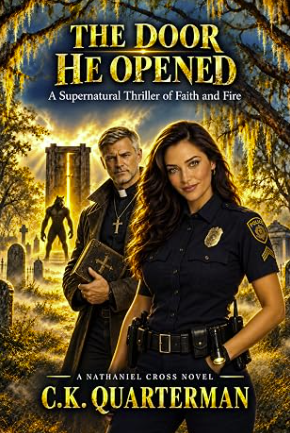
Chapter One
The moon was three days from full when Marcus Deveraux drew the circle in his own blood.
He worked in the basement of his mother’s house on Habersham Street, two blocks from the cemetery, with the lights off and a single candle burning low against the brick. He had read the instructions eleven times. He had prayed to nothing and no one, because prayer was for people who still believed something was listening on the other side.
He wasn’t asking. He was inviting.
“I open the door,” he said, and his voice didn’t shake. “Come in.”
The candle guttered. The air in the basement went thick, the way it gets before a storm breaks, pressure building behind his eyes and in his back teeth. Something answered. Not with words. With weight, a presence that filled the room from corner to corner and settled over him like a hand closing around a fist.
Marcus felt his spine bend. He felt his fingers curl into something that wasn’t a fist anymore. He felt hunger, a hunger so total it erased every other thing he had ever wanted, and he welcomed it, because for thirty-one years he had wanted power and never had it, and now here it was, pouring into him through a door he’d opened himself.
He didn’t scream. Screaming was for victims.
He threw back his head and started to laugh.
* * *
Detective Renee Okafor called Nathaniel Cross at 6:40 the next morning, and Cross knew before she said a word that it was bad, because Renee didn’t call before eight unless it was.
“I need you at Bonaventure,” she said. “Now.”
“Give me twenty minutes.”
He was already reaching for his boots.
Cross had been a deliverance minister for eleven years before Savannah PD ever heard his name, and he’d have stayed one, quiet and mostly unknown, if Renee’s partner hadn’t walked into a house on Wilder Street three years back and found a fourteen-year-old girl speaking in a voice that wasn’t hers, in a language none of them could place. The department had no protocol for that. Renee had heard, through a chaplain, through a chaplain’s wife, that there was a man in town who did. She’d called him at midnight. He’d come. The girl walked out of that house an hour later asking for pancakes and not remembering a word of it.
Nobody in the department talked about that case. Renee still called him first when something didn’t fit.
This didn’t fit.
Bonaventure Cemetery sat quiet under gray morning light when Cross pulled up, oak branches heavy with moss hanging still in air that hadn’t started moving yet. Two patrol cars blocked the side entrance. Renee met him at the tape line, arms crossed, jaw tight in a way he’d learned meant she hadn’t slept.
“Cause of death is going to say animal attack,” she said, walking him in. “It wasn’t an animal.”
“How do you know?”
“Because animals don’t close the gate behind them.”
The body lay forty yards off the path, near one of the older family plots, and Cross made himself look at it the way he’d trained himself to look at hard things, straight on, no flinching, cataloging rather than reacting. The wounds were deep and wide, torn rather than cut. Claw marks raked across the chest in four parallel lines. The jaw damage alone told him whatever did this had a bite radius no dog in Chatham County could match.
He didn’t need his eyes to tell him the rest. He felt it the moment he stepped past the tape, a wrongness pressing against the inside of his skull, cold and patient and very much still watching. Discernment didn’t come as a voice. It came as certainty, sudden and complete, the way you know a room is empty before you turn on the light.
This wasn’t an animal that killed here. It never had been. “Talk to me,” Renee said. She’d learned not to ask what he felt, only what it meant.
“Something walked away from this on two legs,” Cross said. “Something that used to be a man.”
Renee didn’t argue. Three years in, she’d stopped needing to.
“There’s a second one. Found two hours before this one, other side of the river. Same wound pattern. Coroner’s calling it a coyote.” “It’s not a coyote.”
“I know that. I need you to tell me what it is, and I need you to tell me before the next full moon, because that’s five nights out, and whatever this is, it’s not going to wait for us to catch up.”
Cross crouched near the body, close enough to see what the responding officers had missed: a single tuft of coarse dark hair caught on the edge of a broken headstone, too long and too coarse for any dog breed local to the coast. He didn’t touch it. He’d let the crime lab do that. What he wanted wasn’t in the hair.
He closed his eyes and did the thing he’d learned to do in a hundred rooms before this one, the thing that had cost him more than most people would understand and given him more than most people would believe. He opened himself, carefully, the way you crack a door rather than throw it wide, and he asked God what he was looking at.
What came back wasn’t a name. It was a feeling, and the feeling was invitation.
Nobody had cursed this man. Nobody had bitten him in the woods on some unlucky night and passed something down against his will. He had asked for this. He had opened a door himself and something had walked through it gladly, because that’s what happens when you ask evil in and mean it. It doesn’t force its way past a locked door. It waits by an open one.
Cross had seen this pattern before, in smaller and quieter ways, in a hundred deliverance sessions where the door had been a Ouija board or a blood oath or a whispered invitation made in anger or grief or plain hunger for something the world hadn’t given them. He’d read the old case files, the ones from decades back that pastors like Kurt Koch had documented across five continents, people who went looking for power in the dark and found something willing to trade for it. He’d never seen it produce this. But the shape of it, the door opened on purpose, was the same shape he’d walked into a hundred times before.
“He invited it,” Cross said, standing.
Renee’s face went still. “Invited what?”
“Whatever’s wearing him now.”
She looked at him for a long moment, the way she always did when he said something that belonged in one world and she was standing in another. Then she nodded, because three years had taught her that when Cross said something like that, the department’s version of the truth was going to be wrong and his was going to be right, and five nights wasn’t enough time to argue about it. “So how do we stop it?”
Cross looked past her, toward the tree line where the moss hung heavy and still, and for the first time since he’d knelt beside the body, he let himself feel the size of what they were up against.
“We don’t stop it,” he said. “We find the door he opened, and we close it. Before he opens it again and there’s nothing left of him to save.”
The wind moved through the oaks then, the first breath of it all morning, and somewhere beyond the cemetery wall, something large enough to matter watched them and waited for the moon to finish its work.