
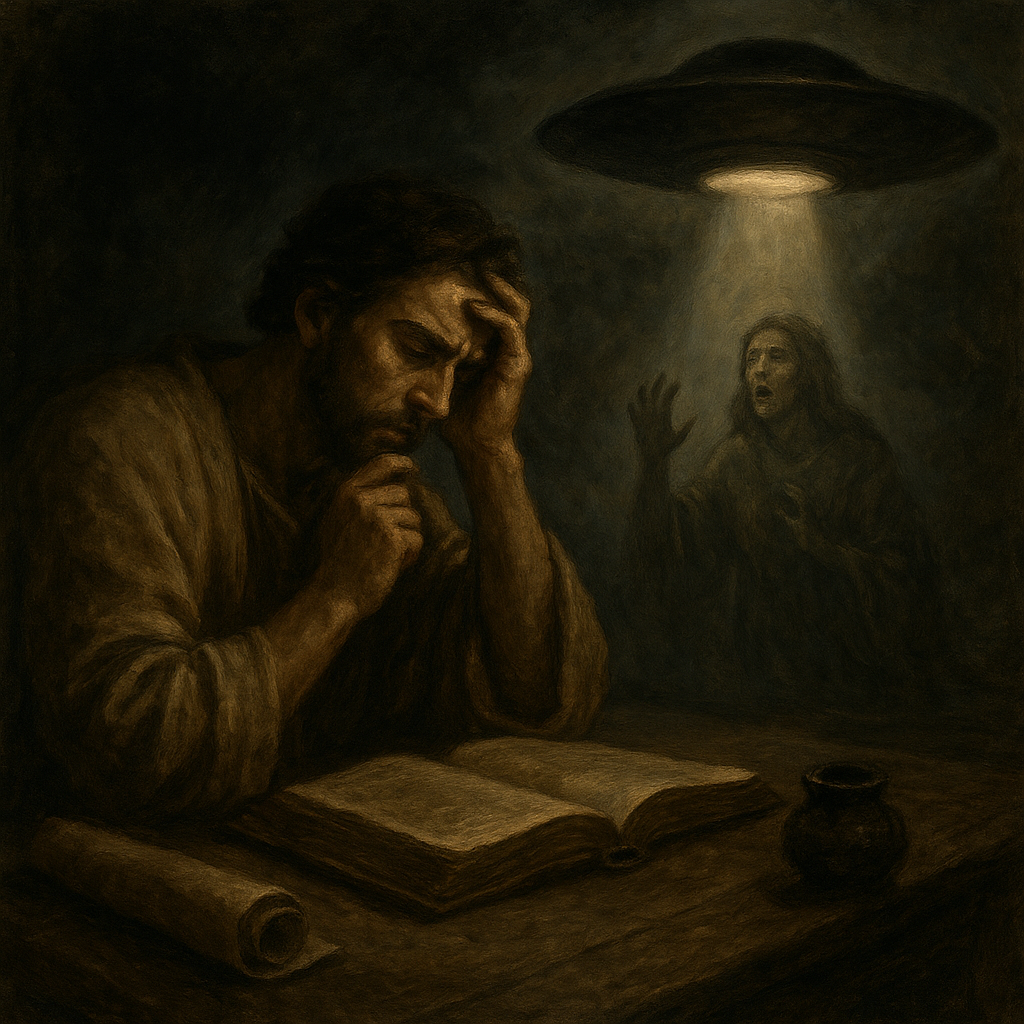
For many experiences, psychology is a large part of the answer. Sleep paralysis, vivid dreams, suggestion, and false memories can produce sincere accounts of abduction.
Term: False memory: a memory of an event that did not happen, or that happened differently, which the person sincerely believes.
Term: Suggestion: the way expectations, questions, or cultural ideas shape what a person perceives or remembers.
Term: Confabulation: filling gaps in memory with invented details, without an intent to deceive.
Are UFO Encounters All in the Mind?
For many experiences, psychology is a large part of the answer. Sleep paralysis, vivid dreams, suggestion, and false memories can produce sincere accounts of abduction. But some reports include radar tracks, several aircraft, or marks on the ground that psychology alone cannot account for. Those cases are disputed, and they are the reason the question is still open.
What psychology can explain
Sleep paralysis can create a felt presence, paralysis, and fear, and researchers have tied it to abduction stories. Hypnosis can produce false or mixed memories, as it may have in the Hill case. Media can shape details. Researcher Martin Kottmeyer noted that an episode of The Outer Limits resembled Barney Hill’s later description of the beings’ eyes. Groups of people can also shape each other’s accounts.
What the research shows about fear
A 2004 Harvard study by Richard McNally and colleagues found that people who said they had been abducted reacted to their stories with heart rate and sweating as strong as trauma patients. The authors concluded that this shows how belief can produce real fear, and that a body reaction is not proof that an event occurred.
What psychology does not easily cover
A person’s mind cannot show up on radar. Cases such as Tehran in 1976, Kaikōura in 1978, and the 2004 Nimitz encounter involve instruments or several aircraft. Cases such as Trans-en-Provence involve soil and plant samples. Skeptics offer explanations for each, such as Jupiter, Venus, sensor errors, and flawed analysis. Those explanations are plausible and disputed, and they show that not every case is a matter of individual perception.
The middle position
It is reasonable to say that many experiences are best explained by psychology, that some sightings are best explained by ordinary objects, and that a smaller set of cases remains unresolved. That position does not require every witness to be lying or every account to be true.
Where I come out
I take the psychological explanations seriously, and I do not claim that every experience is anything but ordinary. I ask what accounts for the patterns that appear again and again across centuries and cultures. That is the question my book Disclosure: They Are Not Extraterrestrials takes up. Disclosure is available on Amazon. You can find more of my work at ckqbooks.com.
Sources
Richard J. McNally and colleagues, Psychological Science (2004). Richard J. McNally and Susan A. Clancy, Transcultural Psychiatry (2005). David J. Hufford, The Terror That Comes in the Night (1982). Martin Kottmeyer, Entirely Unpredisposed (1990). AARO annual reports.
CK Quarterman. CK Quarterman is a USAF veteran, independent author, and publisher at CKQbooks (ckqbooks.com). He writes nonfiction under the Malaterrestrials brand. The concept of malaterrestrials describes evil earthbound non-human intelligences, as distinct from the holy angels of heaven. Truth · History · Scripture.
Topics
Related CKQ Book

Disclosure
They Are Not Extraterrestrials
Keep researching. Don't miss what's uncovered next.
Get first access to new Encyclopedia entries, Timeline updates, Watchers, Nephilim, Giants, Demons, Deliverance, and UFO/UAP research, plus new books and releases from CKQBooks. Free. Takes ten seconds.