
Encyclopedia
Structured reference entries, cross-linked to books, scripture, and articles.
Beings
The Watchers
also: Grigori, sons of God, the fallen angels, irin
A class of angelic beings who, in 1 Enoch, descend to earth, take human wives, and teach forbidden knowledge.
Azazel
also: Asael, the scapegoat, leader of the Watchers, Asael, Azael, Azazil, עֲזָאזֵל
A chief among the Watchers in 1 Enoch, blamed for teaching humanity metalworking, weaponry, and cosmetics.
Giants
also: gibborim, the mighty men, men of renown
A general term for the oversized clans and warriors of the ancient world tied to the Nephilim bloodline.
Hybrid Beings
also: hybrids, the mingled seed, human-angelic offspring
Offspring of the union between the fallen and humanity — the conceptual heart of the Nephilim account and its modern echoes.
Sirens
also: Seirēnes
In the Greek textual tradition of 1 Enoch 19:2, the fate assigned to the human women who bore children to the fallen Watchers — distinct from the Watchers themselves and from the Nephilim, their giant offspring.
Malaterrestrials
also: Malaterrestrial, evil earthbound non-human intelligences
A term coined by C. K. Quarterman for evil, earthbound non-human intelligences. It is a proposed framework, not an accepted scientific category.
Lilith in the Bible
also: lilit, lilitu, liliyyot
A figure named once in the Hebrew Bible, in Isaiah 34:14. Scholars debate whether the word names a female night demon or a night bird or other wild creature.
Se’irim
also: sa’ir, goat demons, satyrs, hairy ones
Goat-form spirit beings named in four passages of the Hebrew Bible. Israel was forbidden to sacrifice to them, and they are described as inhabiting wilderness and ruins.
Elioud
also: Eljo, Eliud, Naphidim, Naphil, Elioud
The third generation of giant hybrids in Second Temple Jewish literature, descended from the Watchers through the great giants and the Naphil.
Inanna & Ashtoreth
also: Inanna, Ishtar, Astarte, Ashtart, Ashtaroth, Isis, Hator, Aphrodite
Inanna, the ancient Sumerian "Queen of Heaven," was later syncretised as the Akkadian Ishtar, the Canaanite Astarte/Ashtart, and finally appeared in the Hebrew Bible as the deity Ashtoreth.
Vampires
The Bible never uses the word “vampire.” It never describes an undead creature that drinks blood. It does contain two things people connect to the legend. The first is the Alukah of Proverbs 30:15, Alukah is a Hebrew word meaning “leech” that appears once in Proverbs 30:15 and is sometimes linked by scholars to a blood‑drinking demon, while Rephaim are giants and dead spirits associated with Sheol.
Shedim
also: shed, devils, demons
Shedim are spirit beings mentioned twice in the Hebrew Bible to whom Israel offered sacrifices, including child sacrifice; the biblical text treats them as demonic.
Fallen Watchers
also: Watchers, 200 Angels, Sons of God, Fallen Angels
The Fallen Watchers are the two‑hundred angels described in 1 Enoch who descended on Mount Hermon, swore an oath to take human wives, and taught humanity forbidden skills, led by Semjaza with Azazel receiving the greatest blame.
Nephilim
also: giants
The Nephilim are the powerful, giant figures mentioned in Genesis 6:4 and Numbers 13:33, whose name is linked to the Hebrew verb “to fall” and has been interpreted as “giants” in ancient texts.
Penemue
Penemue is a fallen angel mentioned in 1 Enoch 69 who taught humanity writing with ink and paper, as well as secret wisdom, and is listed among the leaders who led the sons of God astray.
Cynocephaly – Dog Headed Men
also: Cynocephaly, Dog Headed Men, jackal
The characteristic of cynocephaly, or cynocephalus (/saɪnoʊˈsɛfəli/), having the head of a dog—or of a jackal—is a widely attested mythical phenomenon existing in many different forms and contexts. The literal meaning of “cynocephaly” is “dog-headed”; however, that this refers to a human body with a dog head is implied.
Semjaza
Semjaza: the leader of the two hundred Watchers in 1 Enoch, who organized the oath on Mount Hermon.
Bene ha’Elohim
also: Sons of God, sons of Elohim, bene elohim, b’nei ha’Elohim, בְּנֵי הָאֱלֹהִים, bene elim (בְּנֵי אֵלִים), bene Elyon (sons of the Most High), bar elahin (Aramaic, Daniel 3:25), Greek huioi tou theou (sons of God), angeloi tou theou (angels of God), Latin filii Dei, Watchers (Aramaic ʿirin, Greek egregoroi), the name 1 Enoch gives the sons of God of Genesis 6
Bene ha’Elohim: Hebrew for “sons of God,” a title the Old Testament uses for heavenly beings in God’s court and in Genesis 6:1-4 for the group who took human women as wives.
What Did the Watchers Teach Humanity?
also: Grigori, sons of God
The Book of Enoch describes how the fallen Watchers taught humanity weapons, cosmetics, enchantments, astrology, and divination, and why this forbidden knowledge was deemed sinful.
What Was the Judgment of the Watchers?
The judgment of the fallen Watchers describes how God bound these angels in darkness, reserving them for fire on the great day, with specific sentences for leaders like Azazel and Semjaza.
Will Fallen Angels Take Physical Bodies At The End Of Time
also: Fallen Angels
The entry examines whether fallen angels will assume physical bodies, analyzing Revelation 12 and related biblical passages, noting that Scripture records angelic appearances in flesh but does not state a forced embodiment.
Image of God
also: imago Dei
The image of God (imago Dei) is the likeness and likeness (tselem and demuth) that Genesis 1:26‑27 attributes to humanity, encompassing moral, functional, relational, and sometimes bodily aspects.
Lucifer’s Sin of Trade
also: Satan
An exploration of Ezekiel 28:16’s claim that trade filled the covering cherub with violence, examining the Hebrew terms rekullah and chamas and the differing views on whether the passage describes Lucifer, Satan, or the king of Tyre.
Polydactyly
also: Extra fingers and toes, supernumerary digits, hexadactyly (six digits on a hand or foot), postaxial polydactyly (extra digit on the little finger or little toe side), the six-fingered man of Gath
Polydactyly: the condition of having extra fingers or toes. First Chronicles 20:6 describes a man of the giant lineage with six digits on each hand and each foot.
Events
UFO Abductions
also: abduction phenomenon, alien abduction
Are alien abductions caused by fallen angels? No one can prove it, but the Bible offers reasons to be cautious. See what the reports describe, what Scripture warns about, and what skeptics say.
Antediluvian
also: Preflood
The period of biblical history between the creation of Adam and the flood of Noah, covering Genesis 1 through 6. The term was coined by the English writer Thomas Browne in the seventeenth century.
How Did the Nephilim Return After the Flood?
also: Second Incursion, Nephilim Return
The entry explains a theory that fallen angels returned after the Flood, causing a second incursion of Nephilim in Canaan, as presented in CK Quarterman's book The Watchers Fallen.
Why Did the Church Stop Teaching the Angelic View of Genesis 6?
The document explains how Augustine’s rejection of the angelic interpretation of Genesis 6 shifted Western Christianity from an early‑church view of angelic Watchers and Nephilim to the Sethite view, leading to the decline of the Book of Enoch in the West.
Ruin-Reconstruction
also: gap theory, gap creationism, ruin-restoration theory
Ruin‑reconstruction, also called the gap theory, teaches that God created a perfect heaven and earth in Genesis 1:1, a catastrophe ruined it, and Genesis 1:2‑7 records a six‑day restoration of the ruined world.
Second Incursion
also: Second contact, second descent, post-Flood incursion, post-Flood Nephilim, and also after that (Hebrew wegam acharei ken, וְגַם אַחֲרֵי־כֵן)
Second Incursion: the return of fallen angels to earth after the Flood, understood as the source of the Nephilim in Canaan.
What Does the War Scroll Say About the Great Tribulation?
also: War Scroll, War Rule, 1QM
The War Scroll (1QM) is a Dead Sea Scroll fragment describing a final war between the Sons of Light and the Sons of Darkness, including language that translators render as a “great tribulation.”
Investigations
Project Blue Book
also: Blue Book, Project Sign, Project Grudge
The U.S. Air Force’s official investigation of UFOs, run from Wright-Patterson Air Force Base from March 1952 to December 17, 1969. It collected 12,618 reports, 701 of which remained unidentified.
Robertson Panel
also: Scientific Advisory Panel on Unidentified Flying Objects
A panel of scientists convened by the CIA from January 14 to 18, 1953 to review the Air Force’s UFO evidence. It concluded UFOs posed no direct threat and recommended reducing public interest in them.
Condon Report
also: Scientific Study of Unidentified Flying Objects, Condon Committee
An Air Force-funded University of Colorado study of UFOs directed by physicist Edward Condon, completed in 1968 and released in January 1969. Its conclusion was used to close Project Blue Book.
AATIP
also: Advanced Aerospace Threat Identification Program, AAWSAP
A Pentagon program that studied reports of unidentified aerial phenomena with about $22 million in funding. Its existence was revealed by The New York Times in December 2017.
Objects
Rahab
also: proud one, boaster, Rahab
Rahab is both a Canaanite woman who aided Israelite spies in Jericho and a poetic biblical term for a proud, defeated power often interpreted as a sea monster or Egypt.
Book of Enoch
also: 1 Enoch, Ethiopic Enoch, Enoch (Hebrew Hanokh, חֲנוֹךְ), Greek Henoch, Book of the Watchers (chapters 1-36)
Book of Enoch (1 Enoch): an ancient Jewish text attributed to Enoch, the great-grandfather of Noah, and the fullest ancient account of the Watchers.
Book of Jubilees
also: Jubilees, Little Genesis (Greek Leptogenesis), Kufale (Ge’ez), Sefer ha-Yovelim (Hebrew), Ta Ioubilaia (Greek), the Book of the Divisions of the Days
Book of Jubilees: an ancient Jewish retelling of Genesis and Exodus organized in periods of forty‑nine years called jubilees, dated by scholars to the second century BC.
Did the Watchers Have Anything to Do With the Tower of Babel?
An exploration of the theory that the fallen angels known as the Watchers were involved in the construction and purpose of the Tower of Babel, linking ziggurats, Shinar, and a post‑Flood second incursion.
The Ziggurat and the Second Incursion
also: Ziggurat (Akkadian ziqqurratu), Etemenanki (Sumerian, “House of the Foundation of Heaven and Earth”), Tower of Babel, migdal (Hebrew “tower, ” Genesis 11:4), Temple of Bel (Herodotus)
The Ziggurat and the Second Incursion: the stepped temple tower of Babel in Shinar, built to lift a shrine toward heaven, and the place where the second incursion of fallen angels is understood to have begun.
Portals in the Bible
A portal in the Bible refers to a gate, doorway, ladder, or opened heaven where angels and divine glory pass between heaven and earth, though the word itself never appears in Scripture.
People
Peoples
Anakim
also: sons of Anak, Anakites, children of Anak
A clan of giants dwelling in Canaan, descended from Anak, feared by the Israelite spies.
Rephaim
also: the Rephaites, shades, Og’s people, Rāpi’ūma
An ancient people of giant stature east of the Jordan, of whom King Og of Bashan was the last remnant.
Nimrod
also: the mighty hunter, founder of Babel
The mighty hunter "before the Lord" who founded Babel and the first kingdoms in the land of Shinar.
Giant Tribes
Giant Tribes in the Bible
Augustine of Hippo
also: Saint Augustine, St. Augustine of Hippo, Aurelius Augustinus (Latin name), Augustine of Hippo Regius
Augustine of Hippo: the fifth-century theologian whose rejection of the angelic reading in The City of God moved Western Christianity toward the Sethite view.
Was Goliath a Nephilim?
also: Goliath, son of the giant
The entry examines whether the biblical giant Goliath can be classified as a Nephilim, tracing his lineage through the Anakim and Rephaim and citing scriptural references.
Tamim
also: tamim (תָּמִים), tāmîm, tam (תָּם), root tamam (תָּמַם), Greek teleios (Septuagint, Genesis 6:9), Latin perfectus (Vulgate)
Tamim: the Hebrew word in Genesis 6:9 meaning complete, whole, or without blemish, used of Noah as “perfect in his generations.”
Phenomena
Ezekiel's Wheel
also: the wheel within a wheel, the chariot, merkabah
The vision of wheels and living creatures in Ezekiel 1, often discussed in connection with modern sightings.
Sleep Paralysis
also: night hag, the old hag, nocturnal pressure
A state between sleep and waking, marked by immobility and a sense of presence, examined alongside historical accounts of spiritual encounter.
Nehushtan
also: Bronze Serpent
The name Israel eventually gave to the bronze serpent Moses set up in the wilderness, after the people began worshipping it as an idol. King Hezekiah destroyed it once it carried that name.
Places
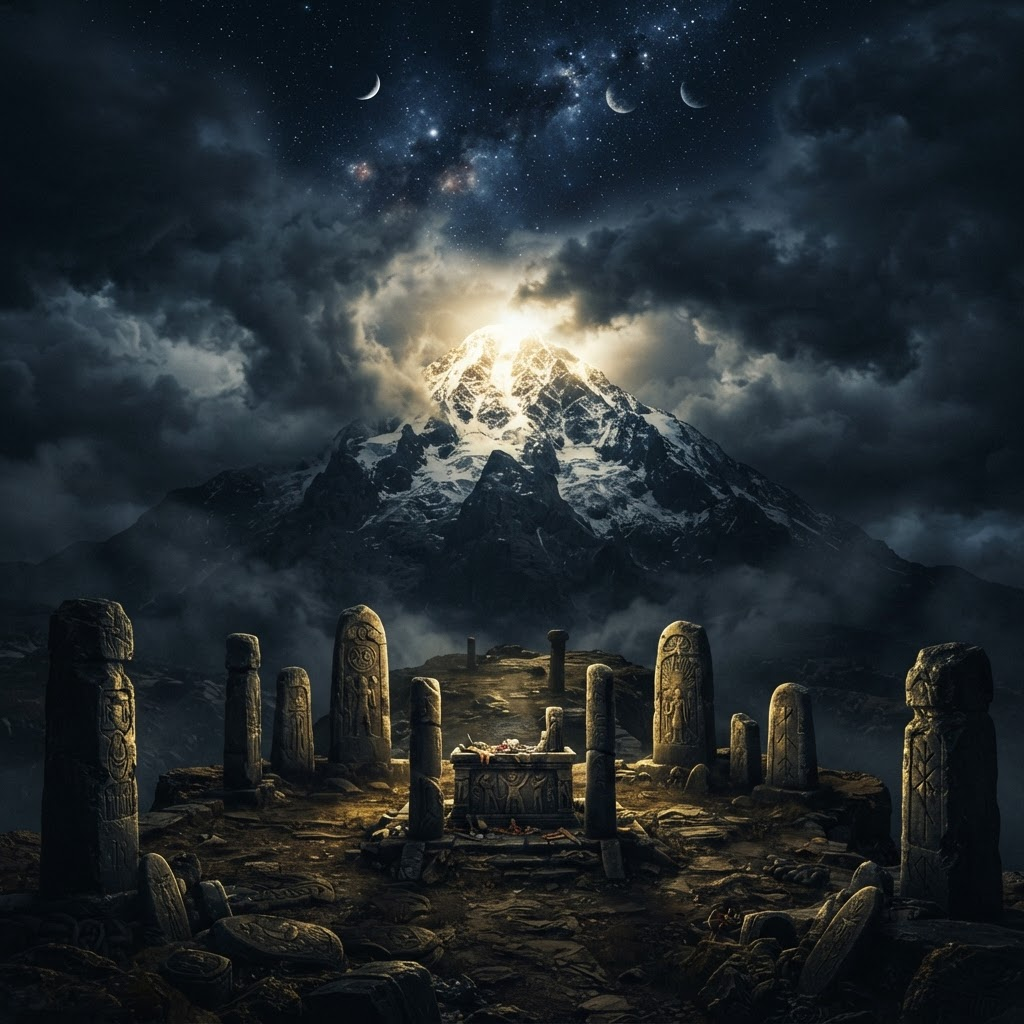
Mount Hermon
also: Senir, Sirion, Baal-Hermon, the mountain of oath
The mountain on the northern border of ancient Israel identified in 1 Enoch as the descent point of the Watchers.
The Tower of Babel
also: Babel, Babylon, the tower
The tower built in the plain of Shinar whose construction ended in the confusion of languages and the scattering of the nations.
Towns, cities or locations that were said to have had giants in them.
These cities and locations show evidence in the text of the Old Testament that they were home to the giants.
Tartarus
also: Tartaros (Greek spelling), Ταρτάρος, tartaroo (ταρταρόω, the verb), tartarosas (the form in 2 Peter 2:4)
Tartarus: the Greek term behind “cast them down to hell” in 2 Peter 2:4, a prison for divine beings who rebelled.
Divine Council
also: divine counsel
The divine council is the biblical assembly of heavenly beings that surround God’s throne, as described in passages such as Psalm 82, 1 Kings 22 and Daniel 7.
Garden of Eden
also: Gan, Eden, Paradise
The Garden of Eden is the biblical garden God planted for Adam and Eve, described in Genesis 2–3, featuring the trees of life and knowledge and a river that divided into four heads.
Gilgal Refaim
also: Rujm el-Hiri, wheel of the Rephaim, Wheel of Ghosts
Gilgal Refaim (Rujm el‑Hiri) is a prehistoric basalt stone circle on the Golan Heights, dated to around 3000 BCE, whose name links it to the biblical giants called the Rephaim.
Writings
Research Index
Demon Glossary
A dedicated reference covering biblical demonic entities — their ancient names, origins in the Book of Enoch, characteristics, reported symptoms, and modern-day effects. Drawn from Genesis 6, the Dead Sea Scrolls, and Second Temple sources.