
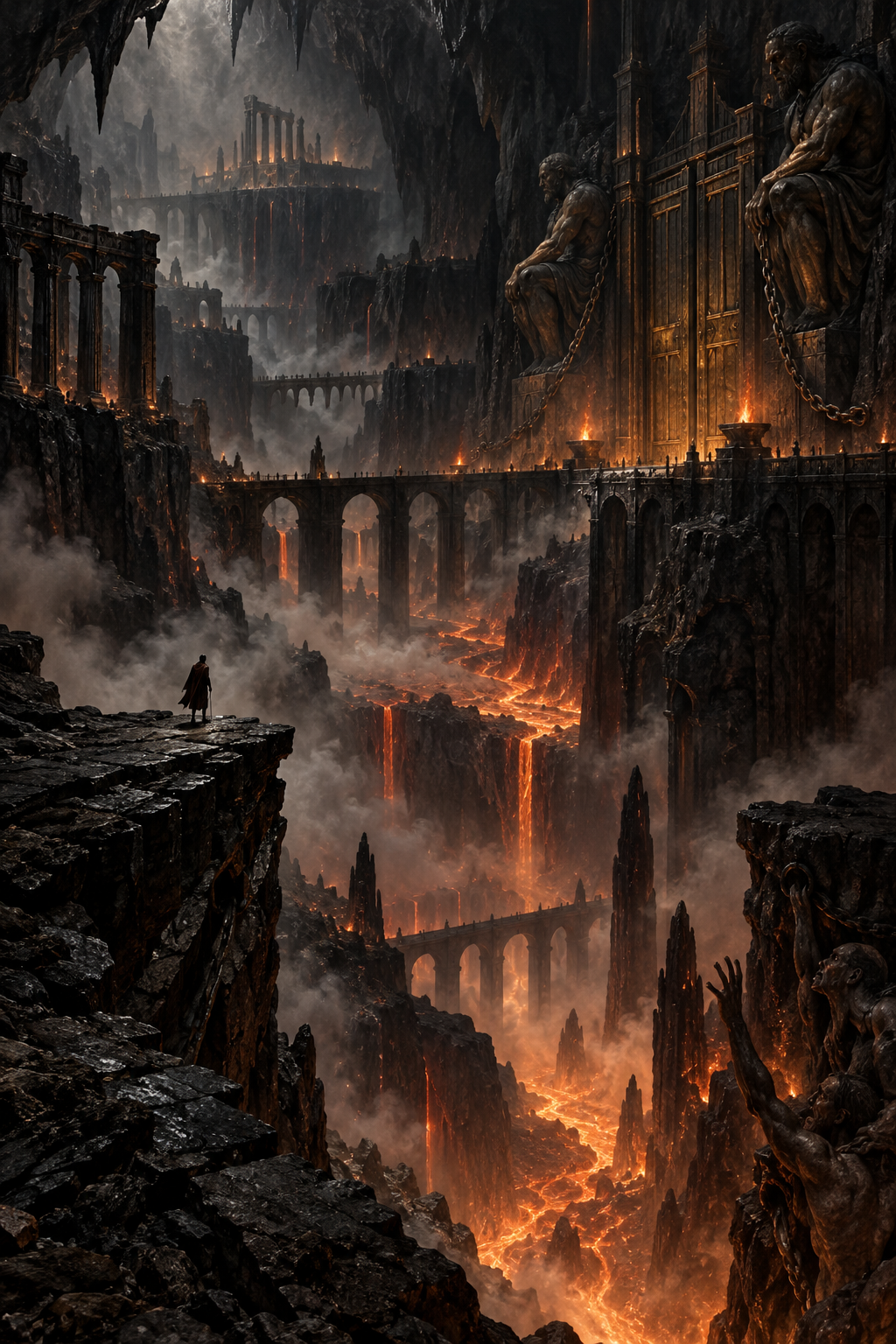
Tartarus
Also known as: Tartaros (Greek spelling), Ταρτάρος, tartaroo (ταρταρόω, the verb), tartarosas (the form in 2 Peter 2:4)
Tartarus: the Greek term behind “cast them down to hell” in 2 Peter 2:4, a prison for divine beings who rebelled.
Tartarus is the Greek name for the deepest place of imprisonment in the ancient world. In 2 Peter 2:4, Peter writes that God “spared not the angels that sinned, but cast them down to hell, and delivered them into chains of darkness, to be reserved unto judgment.” The Greek behind “cast them down to hell” is one verb, tartaroo (in the form tartarosas). It means “to consign to Tartarus.” It appears nowhere else in the New Testament.
Greek readers knew Tartarus well. Homer places it as far below Hades as heaven is above the earth (Iliad 8.13-16). Hesiod says Zeus bound the Titans in chains in Tartarus after they rebelled against the gods (Theogony 713-735). Plato uses Tartarus as the place where the worst offenders are held (Gorgias 523-526; Phaedo 112-114). Tartarus was not the ordinary home of the dead. It was the prison for rebels against the divine order.
Jewish writers had already taken the word into their own literature. The Greek text of 1 Enoch 20:2 names Tartarus and says the angel Uriel is set over the world and over Tartarus. In 1 Enoch 10, God orders Raphael to bind Azazel hand and foot and throw him into darkness (10:4-6). God orders Michael to bind Shemihazah and his companions for seventy generations in the valleys of the earth until the day of their judgment (10:11-12). On that day they are led into the abyss of fire (10:13). Jubilees 5:6 gives the same account and says the angels were bound in the depths of the earth until the day of the great judgment.
Peter chose the one word his readers already linked with the imprisonment of rebellious divine beings. He applied it to the Watchers, the angels who left heaven, took human wives, and fathered the Nephilim (Genesis 6:1-4). The context confirms the link. Peter names the sinning angels first and the Flood second (2 Peter 2:4-5). 1 Enoch tells the story in the same order: the angels sin, they are bound, and the Flood follows.
Jude 6 describes the same judgment. It says the angels “kept not their first estate, but left their own habitation,” and that God “hath reserved in everlasting chains under darkness unto the judgment of the great day.” Jude quotes 1 Enoch 1:9 a few verses later (Jude 14-15). Both Peter and Jude match Enoch on the offense, the chains, the darkness, and the wait for judgment.
The binding has already happened. Peter’s verb is in the past tense, and Jude’s “hath reserved” describes a completed act. The fire has not come yet. Tartarus holds these angels until the great day of judgment, and the lake of fire is the final sentence (Matthew 25:41; Revelation 20:10, 14-15). Tartarus is a prison where the angels wait for trial.
Tartarus differs from other New Testament terms for the unseen realm. Hades is the realm of the dead (Luke 16:23). Gehenna is the place of final punishment (Matthew 10:28). The abyss is a place of confinement for spirits (Luke 8:31; Revelation 9:1-2; 20:1-3). Tartarus is the word Peter reserves for the angels who sinned in the days before the Flood.
## My View
I believe the Watchers who came down on Mount Hermon are in Tartarus now. I believe the chains are real, the binding is finished, and the fire still waits for the great day of judgment.
I also believe Tartarus does not hold every fallen angel. The angels who came after the Flood, whose offspring Numbers 13:33 describes, were not bound in the days of Noah.
Topics
Scripture References
Sources
Biblical Text2 Peter 2:4-5; Jude 6, 14-15; 1 Enoch 1:9; 1 Enoch 10:4-6, 10:11-13; 1 Enoch 18:14-16; 1 Enoch 20:2; 1 Enoch 21:1-10; George W. E. Nickelsburg and James C. VanderKam, 1 Enoch: A New Translation (Minneapolis: Fortress Press, 2004); Jubilees 5:6-10; Homer, Iliad 8.13-16; Hesiod, Theogony 713-735; Plato, Gorgias 523-526; Plato, Phaedo 112-114; Revelation 20:1-3, 10, 14-15; Matthew 25:41; Luke 8:31.
Keep researching. Don't miss what's uncovered next.
Get first access to new Encyclopedia entries, Timeline updates, Watchers, Nephilim, Giants, Demons, Deliverance, and UFO/UAP research, plus new books and releases from CKQBooks. Free. Takes ten seconds.