
Fallen Watchers
Also known as: Watchers, 200 Angels, Sons of God, Fallen Angels
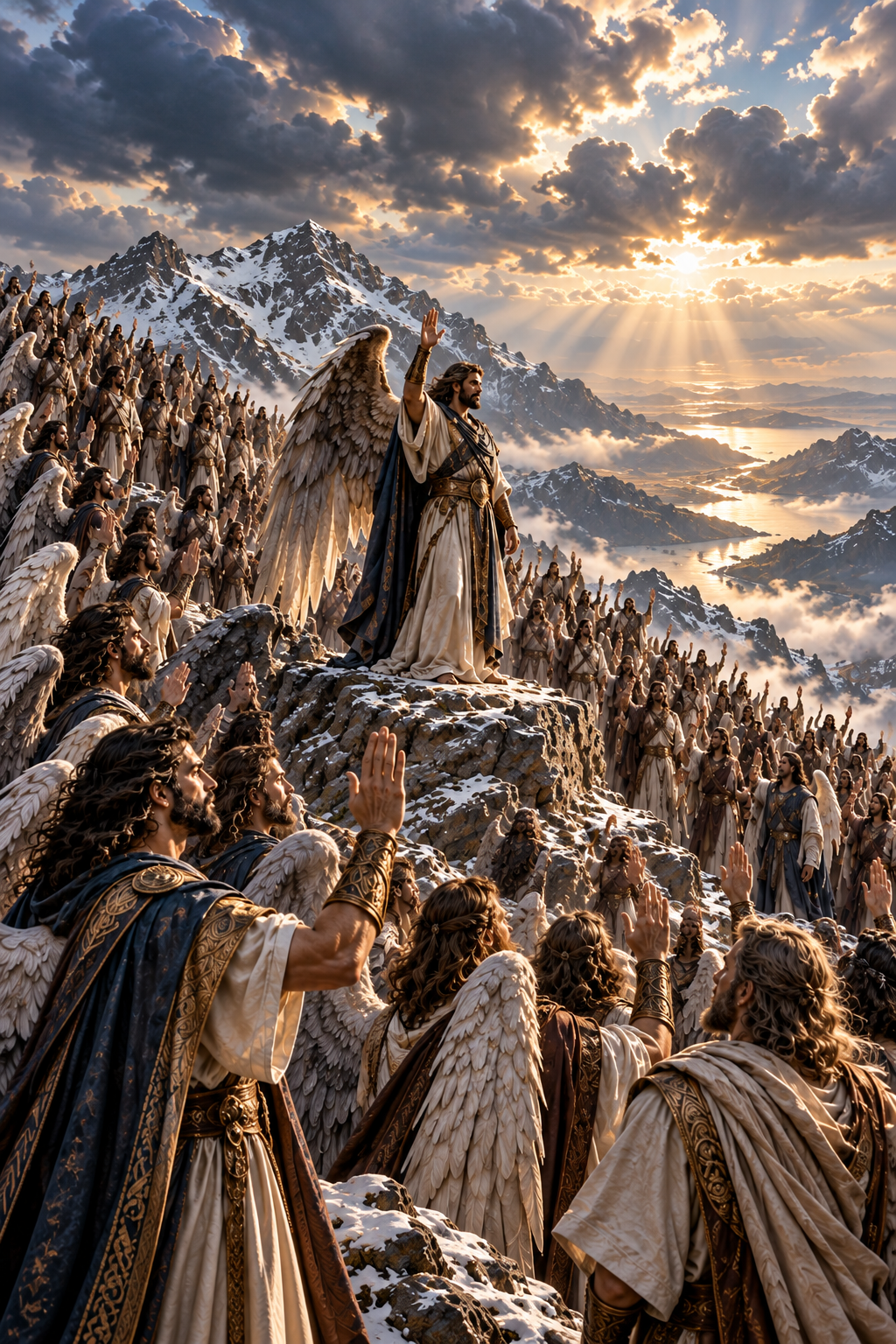
The Fallen Watchers are the two‑hundred angels described in 1 Enoch who descended on Mount Hermon, swore an oath to take human wives, and taught humanity forbidden skills, led by Semjaza with Azazel receiving the greatest blame.
## Key Facts of the Fallen Watchers The Fallen Watchers were 200 angels who, according to 1 Enoch, descended on Mount Hermon, swore an oath to take human wives, and taught people skills they were never meant to have. Semjaza led them. Azazel took the heaviest blame. Twenty leaders are named in 1 Enoch 6:7, and five more chiefs appear in 1 Enoch 69. Every reference below points to R. H. Charles’s English translation, which is in the public domain.
## The oath on Mount Hermon The story opens in 1 Enoch 6. The angels saw the beautiful daughters of men and decided to marry them (6:1-2). Semjaza, their leader, feared he would carry the penalty alone (6:3). The others answered by swearing a shared oath, and every one of them bound himself to it (6:4-5).
The text counts them at two hundred. They came down in the days of Jared onto the summit of Mount Hermon (6:6). Chapter 6 then names twenty leaders, with Semjaza first, and calls them the chiefs of tens (6:7-8). Twenty leaders over groups of ten account for the two hundred, although the text gives the total and the title and leaves the arithmetic unstated.
## Semjaza and Azazel Semjaza is the leader. Chapter 9 says God gave him authority to rule over his associates (9:7). He taught enchantments and root-cuttings (8:3).
Azazel has the longest list of teachings. He taught people to make swords, knives, shields, and breastplates. He showed them the metals of the earth and how to work them. He introduced bracelets, ornaments, antimony, eye cosmetics, costly stones, and every kind of dye (8:1). The next verse records the result: much godlessness, fornication, and corruption in all their ways (8:2).
God’s judgment condemns Azazel most severely. Chapter 10 orders him bound hand and foot and thrown into darkness in the desert at Dudael, under rough and jagged rocks (10:4-5). The charge against him reads, “to him ascribe all sin” (10:8).
## What each Watcher taught Watcher
What he taught
1 Enoch
Azazel
Swords, knives, shields, and breastplates; metals and metalworking; bracelets, ornaments, antimony, eye cosmetics, costly stones, and dyes
8:1
Semjaza
Enchantments and root-cuttings
8:3
Armaros
Resolving enchantments
8:3
Baraqijal
Astrology
8:3
Kokabel
The constellations
8:3
Ezeqeel
Knowledge of the clouds
8:3
Araqiel
The signs of the earth
8:3
Shamsiel
The signs of the sun
8:3
Sariel
The course of the moon
8:3
Gadreel
The blows of death and the weapons of death; led Eve astray
69:6-7
Penemue
The bitter and the sweet, the secrets of wisdom, and writing with ink and paper
69:8-10
Kasdeja
Wicked strikes against spirits, demons, and the unborn; snake bites; harm from noonday heat
69:12
## The five chiefs in 1 Enoch 69 Chapter 69 names five more chiefs who led the angels astray. Charles titles the chapter “The Names and Functions of the (fallen Angels and) Satans,” and many modern summaries call these five the Satans. The verses themselves call them chiefs of the angels (69:3).
Jeqon. He led astray all the sons of God, brought them down to the earth, and misled them through the daughters of men (69:4).
Asbeel. He gave the holy sons of God evil counsel, and they defiled their bodies with the daughters of men (69:5).
Gadreel. He showed people all the blows of death, led Eve astray, and introduced the shield, the coat of mail, and the sword for battle (69:6-7). Genesis 3 describes a serpent and names no angel. Intertextual.bible presents this verse as an expansion of the Eden story.
Penemue. He taught people the bitter and the sweet and all the secrets of their wisdom. He also taught writing with ink and paper. The text says many sinned through it, because people were not created to confirm their good faith with pen and ink (69:8-10).
Kasdeja. He showed people the wicked strikes against spirits and demons, and against the embryo in the womb. He also taught the bites of the serpent and the strikes that come with noonday heat (69:12).
## Four details readers often mix up Chapter 69 comes from a different book. 1 Enoch is a collection of separate writings. Chapters 1 to 36 form the Book of the Watchers, and chapters 37 to 71 form the Book of Parables, also called the Similitudes. Chapters 6 and 8 belong to the Watchers. Chapter 69 belongs to the Parables. Scholars date the Parables later and still debate how late. Fragments of the other sections of 1 Enoch appear among the Dead Sea Scrolls, but no fragment of the Parables has been found there.
Two angels get credit for weapons. Azazel introduces swords, knives, and shields in 8:1. Gadreel introduces the shield, the coat of mail, and the sword in 69:6. The two accounts come from different sections of 1 Enoch, and the text does not reconcile them.
Names vary between lists. In Charles’s translation, Ezeqeel taught the knowledge of the clouds (8:3). Some modern lists give a separate Watcher named Chazaqiel for the signs of the sky and the mists. Charles’s text has no such entry, and Wikipedia treats Chazaqiel as another form of Ezeqeel. Other names shift too. Chapter 6 gives Samsapeel where chapter 8 gives Shamsiel, and modern lists use Kokabiel for Kokabel and Baraqiel for Baraqijal.
The name list in 69:2 repeats chapter 6. Charles sets that verse in square brackets. One scholarly study treats the second half of 69:2 as a late duplicate of the list in 6:7-8.
## Sources Primary text
R. H. Charles, The Book of Enoch (Oxford: Clarendon Press, 1917), chapter 69: sacred-texts.com/bib/boe/boe072.htm
R. H. Charles, The Book of Enoch (1917), chapter 10: sacred-texts.com/bib/boe/boe013.htm
R. H. Charles, The Apocrypha and Pseudepigrapha of the Old Testament (Oxford: Clarendon Press), 1 Enoch chapters 6, 8, and 9: ccel.org/c/charles/otpseudep/enoch/ENOCH_1.HTM
Secondary sources
Reading Acts, “Dating the Similitudes (1 Enoch 37-71)”: readingacts.com/2016/06/07/dating-the-similitudes-1-enoch-37-71
Michael F. Bird, “Did 1 Enoch Influence the New Testament?”: michaelfbird.substack.com
Jonathan Ben-Dov and Eshbal Ratzon, “The Oath and the Name in 1 Enoch 69” (University of Haifa research portal): cris.haifa.ac.il
Wikipedia, “Chazaqiel”: en.wikipedia.org/wiki/Chazaqiel
Intertextual.bible, Genesis 3:4 and 1 Enoch 69:6: intertextual.bible/text/genesis-3.4-1-enoch-69.6
Sources named in the original notes
The notes behind this post named Scribd, Intertextual.bible, Biblical Hermeneutics Stack Exchange, and Angelarium. Intertextual.bible is cited above. Angelarium (angelarium.net) is an illustrated angel encyclopedia by Peter Mohrbacher, and I could not confirm its Penemue entry, so Penemue is cited to Charles instead. I could not locate the Scribd or Stack Exchange pages. Every claim in this post is checked against the Charles text.
Sources
Ancient SourceR. H. Charles, The Book of Enoch (Oxford: Clarendon Press, 1917), chapter 69: sacred-texts.com/bib/boe/boe072.htm; R. H. Charles, The Book of Enoch (1917), chapter 10: sacred-texts.com/bib/boe/boe013.htm; R. H. Charles, The Apocrypha and Pseudepigrapha of the Old Testament (Oxford: Clarendon Press), 1 Enoch chapters 6, 8, and 9: ccel.org/c/charles/otpseudep/enoch/ENOCH_1.HTM; Reading Acts, “Dating the Similitudes (1 Enoch 37-71)”: readingacts.com/2016/06/07/dating-the-similitudes-1-enoch-37-71; Michael F. Bird, “Did 1 Enoch Influence the New Testament?”: michaelfbird.substack.com; Jonathan Ben-Dov and Eshbal Ratzon, “The Oath and the Name in 1 Enoch 69” (University of Haifa research portal): cris.haifa.ac.il; Wikipedia, “Chazaqiel”: en.wikipedia.org/wiki/Chazaqiel; Intertextual.bible, Genesis 3:4 and 1 Enoch 69:6: intertextual.bible/text/genesis-3.4-1-enoch-69.6
Keep researching. Don't miss what's uncovered next.
Get first access to new Encyclopedia entries, Timeline updates, Watchers, Nephilim, Giants, Demons, Deliverance, and UFO/UAP research, plus new books and releases from CKQBooks. Free. Takes ten seconds.