
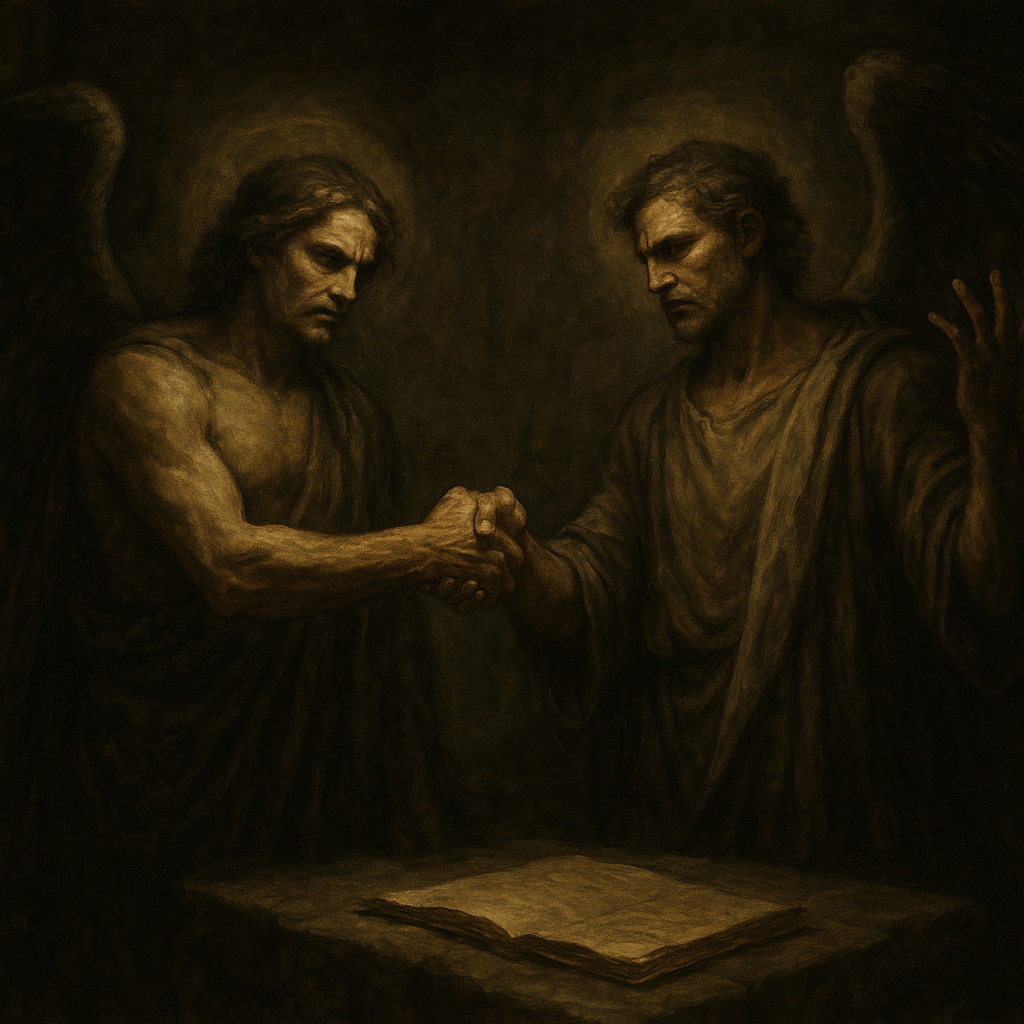
The Book of Enoch describes an oath sworn by two hundred watchers before they took human wives. This post looks at what that oath was actually meant to accomplish, and what it reveals about how these beings understood the judgment coming to them.
The watchers bound themselves together with a shared oath so that when judgment came, all two hundred would carry equal blame. Their leader, Shemihazah, was not afraid God would miss what they were doing. He was afraid he would be the only one held accountable for it.
Chapter 6 of the Book of Enoch describes the moment two hundred watchers decided to leave heaven for human wives. Their leader spoke first, and what he said sets the tone for everything that follows.
> "I fear ye will not indeed agree to do this deed, and I alone shall have to pay the penalty of a great sin." — 1 Enoch 6:3
The other watchers answered him.
> "Let us all swear an oath, and all bind ourselves by mutual imprecations not to abandon this plan but to do this thing." — 1 Enoch 6:4
They swore together, two hundred strong, on the summit of Mount Hermon.
Not Hiding From God
Read the oath as a plan to hide from God and it falls apart fast. Chapter 9 of the same book shows the archangels Michael, Uriel, Raphael, and Gabriel looking down from heaven on their own initiative. They see the bloodshed on earth and report it to God directly. No watcher has to confess anything. Nobody informs on anybody. God already knows.
That pattern holds throughout scripture. Genesis describes the same kind of unassisted observation before the flood.
> "Then the Lord saw that the wickedness of man was great in the earth, and that every intent of the thoughts of his heart was only evil continually." — Genesis 6:5
God sees. He does not need to be told.
Managing the Judgment, Not Avoiding It
So Shemihazah was not trying to prevent detection. His own words assume judgment is already coming. What worried him was standing alone when it arrived. The oath spreads the guilt across two hundred watchers so no single one of them can be singled out and left to answer for the rest.
That distinction changes how you read the whole episode. A group hiding from an all-seeing God and hoping to get away with something looks naive. A group that already accepts it will be caught, and spends its energy managing what happens next instead, looks calculated. The text supports the second reading, not the first.
This matters for the malaterrestrials framework. The beings described in these ancient accounts act with full awareness of consequences. Not ignorance. Not blind impulse. That pattern of calculation, of managing judgment rather than avoiding it, shows up again and again across the sources this series draws on.
CK Quarterman. CK Quarterman is a USAF veteran and the author behind CKQbooks, where he writes on the malaterrestrials concept: non-human intelligences with terrestrial origins, traced through ancient and modern sources. Find more at ckqbooks.com. Now you know the name of the Unknown.
Explore in the Encyclopedia
Nephilim
The offspring of the "sons of God" and the "daughters of men" described in Genesis 6, traditionally understood as giants.
The Watchers
A class of angelic beings who, in 1 Enoch, descend to earth, take human wives, and teach forbidden knowledge.
Mount Hermon
The mountain on the northern border of ancient Israel identified in 1 Enoch as the descent point of the Watchers.
Azazel
A chief among the Watchers in 1 Enoch, blamed for teaching humanity metalworking, weaponry, and cosmetics.
Sirens
In the Greek textual tradition of 1 Enoch 19:2, the fate assigned to the human women who bore children to the fallen Watchers — distinct from the Watchers themselves and from the Nephilim, their giant offspring.
Keep researching. Don't miss what's uncovered next.
Get first access to new Encyclopedia entries, Timeline updates, Watchers, Nephilim, Giants, Demons, Deliverance, and UFO/UAP research, plus new books and releases from CKQBooks. Free. Takes ten seconds.