
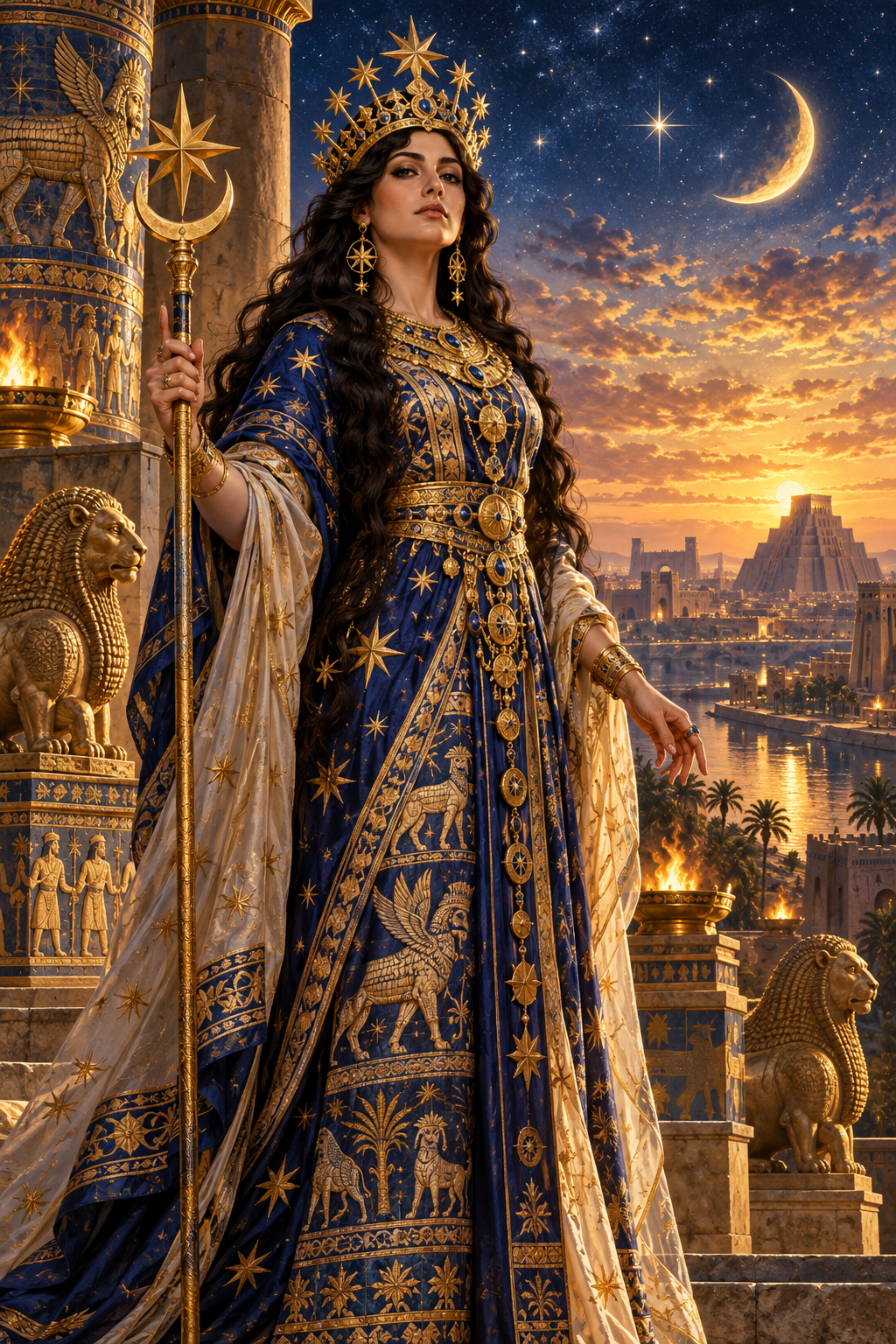
Inanna & Ashtoreth
Also known as: Inanna, Ishtar, Astarte, Ashtart, Ashtaroth, Isis, Hator, Aphrodite
Inanna, the ancient Sumerian "Queen of Heaven," was later syncretised as the Akkadian Ishtar, the Canaanite Astarte/Ashtart, and finally appeared in the Hebrew Bible as the deity Ashtoreth.
Queen of Heaven: From Inanna to Ashtoreth
## 1. The Sumerian Foundation: Inanna, the "Queen of Heaven"
The oldest recorded name for this deity is the Sumerian Inanna (c. 3000 BCE). Historical linguists generally agree that Inanna is a contraction of the Sumerian phrase Nin-an-ak:
Nin = "Lady" or "Queen"
An = "Sky" or "Heaven"
-ak = The genitive particle ("of")
Literally translated, her name means "Lady of Heaven" or "Queen of Heaven." The cuneiform sign often used for her name was a stylized reed knot, a symbol representing fertility and her temple storehouse.
## 2. The Akkadian Syncretism: Ishtar
When Semitic-speaking peoples (Akkadians, Babylonians, and Assyrians) came to dominate Mesopotamia, they merged Inanna with their own Semitic astral goddess, Ashtar.
The Sound Change: In the Akkadian language, the vowel shifted through a phonetic law influenced by localized dialects, transforming the masculine/neutral Semitic root ʿ-š-t-r into the feminine singular noun Ishtar.
The Retained Title: Even though her name changed to Ishtar, the Akkadians translated her original Sumerian title (Nin-an-ak) directly into Akkadian as Šarrat Šamê, maintaining her core identity as the "Queen of Heaven."
## 3. The Canaanite Transition: ʿAshtart (Astarte)
As the cult of Ishtar traveled westward into the Levant (Phoenicia, Ugarit, and Canaan), her name adapted to West Semitic linguistic rules.
The Feminine Suffix: In West Semitic languages, a female deity required an explicit feminine suffix, usually a -t.
The Result: The root ʿ-š-t-r received the suffix, yielding ʿAshtart (vocalized in Ugaritic and Phoenician). When later translated into Greek, this name became Astarte.
## 4. The Biblical Hebrew Distortion: Ashtoreth
When the writers and compilers of the Hebrew Bible (the Masoretes) cataloged the Canaanite goddess, they utilized a common ancient scribal technique known as dysphemism—the deliberate theological mocking of a foreign deity.
The Consonants: The basic Hebrew consonantal framework for the goddess was עשתרת (ʿ-š-t-r-t), which linguistically should have been pronounced "Ashtart."
The Vowel Vandalism: Rather than using the correct vowels, biblical scribes systematically stripped the vowels from the Hebrew word for "shame" or "abomination"—בֹּשֶׁת (bōšeth)—and superimposed them onto the goddess's consonants.
The Equation: Consonants of ʿAshtart (עשתרת) + Vowels of Bōšeth (וֹ ֶ) = ʿAshtōreth (עַשְׁתּוֹרֶת).
The Purpose: By forcing the reader to pronounce her name as Ashtoreth, the text embedded an audible condemnation into the scripture. Every time an ancient reader spoke her name, they were literally forced to call her a "shameful thing." (Note: When the Bible references the plural form, Ashtaroth, it drops the mock vowels and retains the standard West Semitic plural ending).
## 5. Astral Iconography: The Star of Venus
Beyond linguistics, the goddess maintained a consistent visual identity across empires through her association with the planet Venus. Because Venus appears in the sky during both dawn and dusk, she was worshipped as both the morning star (goddess of war) and the evening star (goddess of love).
The Eight-Pointed Star: Inanna/Ishtar’s primary visual symbol was an eight-pointed star or rosette. This symbol was carved into boundary stones (kudurrus), temple walls, and royal seals to invoke her protection.
The Lion and the Ring Staff: She was frequently depicted standing atop a lion, symbolizing her ferocity in battle, and holding a ringed staff—a Mesopotamian staff of authority that mirrored her celestial sovereignty as the Queen of Heaven.
## Academic Sources & Further Reading
Black, Jeremy, and Anthony Green. Gods, Demons and Symbols of Ancient Mesopotamia: An Illustrated Dictionary. British Museum Press, 1992.
Provides the foundational archaeological and iconographic context for Inanna's cuneiform signs, her eight-pointed star, and her transition into the Akkadian Ishtar.
Day, John. Yahweh and the Gods and Goddesses of Canaan. Sheffield Academic Press, 2002.
An essential text analyzing the West Semitic development of ʿAshtart and how Hebrew biblical writers adapted Canaanite deities into the Old Testament framework.
Pryke, Louise M. Ishtar. Routledge, 2017. Routledge Ishtar Monograph
A comprehensive academic monograph tracking the goddess’s extensive history across thousands of years from the late 4th millennium BCE through the classical era.
Smith, Mark S. The Early History of God: Yahweh and the Other Deities in Ancient Israel. William B. Eerdmans Publishing, 2002.
Deals extensively with the "Queen of Heaven" worship recorded in the book of Jeremiah and the blending of Mesopotamian and Canaanite cults.
"Ashtoreth." The Lexham Bible Dictionary. Lexham Press, 2016. Lexham Bible Dictionary on Biblia
Explicitly details the scribal practice of dysphemism—the systematic overlaying of the vowels from the Hebrew word for "shame" (bosheth) onto the consonants of foreign deities.
"Inana/Ištar (goddess)." Ancient Mesopotamian Gods and Goddesses. Open Richly Annotated Cuneiform Corpus (ORACC), University of Pennsylvania. ORACC Mesopotamian Deities Guide
A peer-reviewed digital resource mapping out the etymology of the Sumerian contraction "Nin-an-ak" and her distinct geographical cult centers.
Topics
Scripture References
Sources
Scholarly SourceBlack, Jeremy, and Anthony Green. Gods, Demons and Symbols of Ancient Mesopotamia: An Illustrated Dictionary. 1992; Day, John. Yahweh and the Gods and Goddesses of Canaan. 2002; Pryke, Louise M. Ishtar. 2017; Smith, Mark S. The Early History of God: Yahweh and the Other Deities in Ancient Israel. 2002; "Ashtoreth." The Lexham Bible Dictionary. 2016; "Inana/Ištar (goddess)." ORACC Mesopotamian Deities Guide.
Keep researching. Don't miss what's uncovered next.
Get first access to new Encyclopedia entries, Timeline updates, Watchers, Nephilim, Giants, Demons, Deliverance, and UFO/UAP research, plus new books and releases from CKQBooks. Free. Takes ten seconds.