
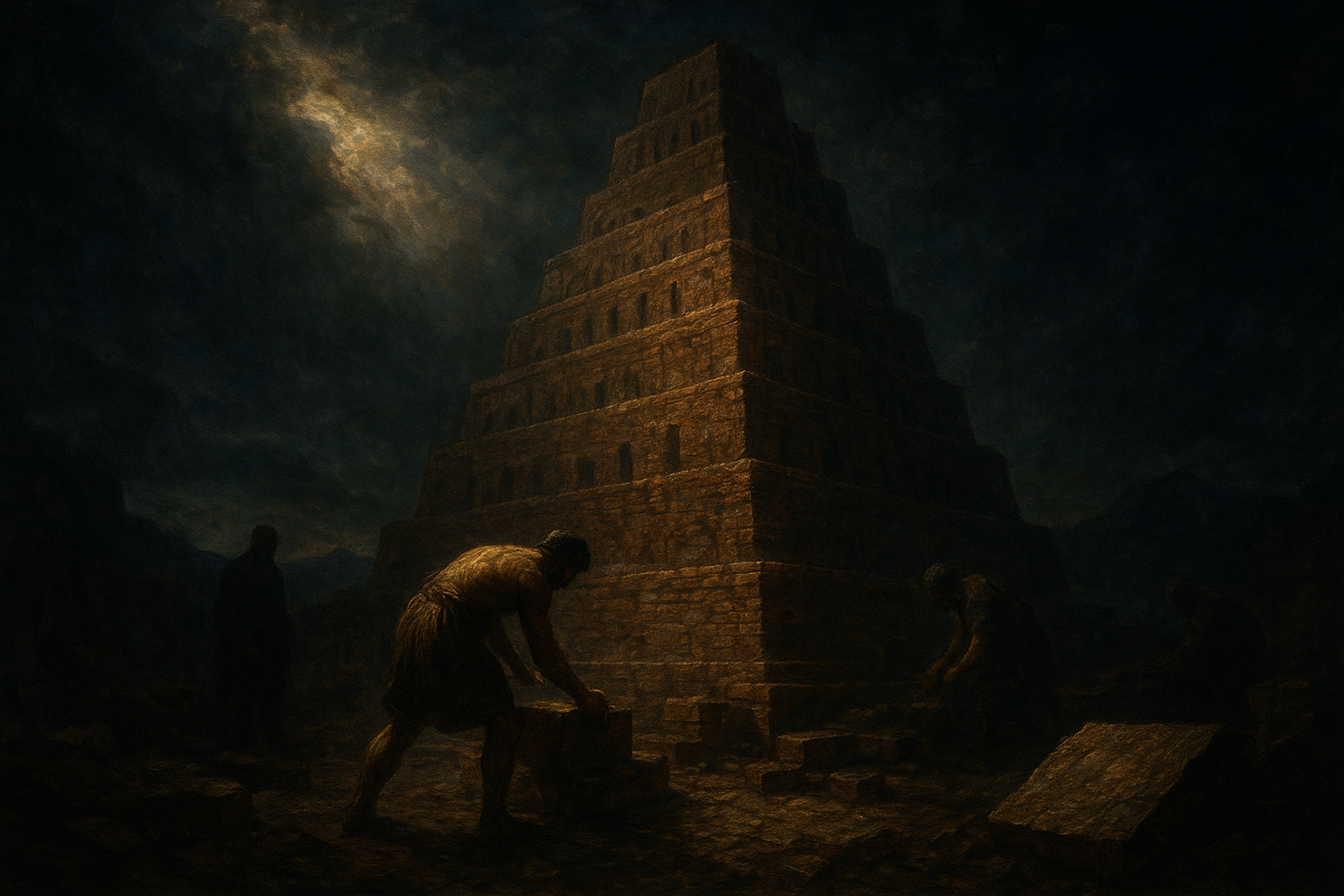
Did the Watchers Have Anything to Do With the Tower of Babel?
An exploration of the theory that the fallen angels known as the Watchers were involved in the construction and purpose of the Tower of Babel, linking ziggurats, Shinar, and a post‑Flood second incursion.
Did the Watchers Have Anything to Do With the Tower of Babel?
Genesis 11 never names angels. The Watchers Fallen argues that the ziggurat, its priesthood, and its timing point to Shinar as the place where contact with fallen beings resumed.
Ziggurat: a stepped platform temple of ancient Mesopotamia, built to lift a shrine toward heaven.
Second Incursion: the return of fallen angels to earth after the Flood, which the book holds explains the Nephilim in Canaan.
Did the Watchers Have Anything to Do With the Tower of Babel?
The Watchers Fallen argues yes. Genesis 11 does not name angels, but the book holds that the structure, the practice, and the timing point to Shinar as the place where contact with fallen beings most plausibly resumed after the Flood.
The Plain of Shinar
“Go to, let us build us a city and a tower, whose top may reach unto heaven; and let us make us a name, lest we be scattered abroad upon the face of the whole earth.” (Genesis 11:4, KJV)
Shinar is the region later called Babylonia, the heartland of ancient Mesopotamia. It held the oldest cities on earth, and it was already filled with ziggurats.
## What a Ziggurat Was
A ziggurat was a stepped platform that lifted a shrine above the city. It was never a tomb. Ur, Uruk, and Eridu each had one, and Eridu’s earliest platform shrine dates to the late fourth millennium BC. Babel joined a pattern already in place.
## What the Priests Did
Priests at the summit performed sacrifices, burned offerings, sang hymns, and conducted initiation rituals. All of it aimed at contact with the divine. The best documented example is Etemenanki, the great ziggurat of Babylon, whose name means “House of the Foundation of Heaven and Earth.” Scholars widely connect it with the tradition behind the Tower of Babel, though the surviving structure was likely built or rebuilt centuries after Genesis 11.
Herodotus recorded what the priests told him about the shrine at the summit: a richly covered couch, a golden table, and a single woman who spent the night there alone, chosen, they said, by the god. Every source agrees on one claim. The priests understood the summit as a meeting place where something from the other side of the sky could come down.
## Reading Shinar Through the Watchers
The book states that none of this proves contact with fallen angels by itself. Mesopotamian religion describes this kind of structure and practice for a thousand years before and after Babel. The book’s case rests on a comparison. The Watchers had already shown before the Flood that they would cross the line between heaven and earth when men opened a door. Genesis 6 describes them choosing to come.
If a priesthood spent generations building higher platforms and performing rituals to attract beings above the sky, and those efforts produced contact, the result would look like Genesis 11: one people, one language, one project, climbing toward heaven together. The book places the second incursion’s start here and follows the pattern in three steps. Conversation came first, unions second, and the Nephilim a third time, in the report of the spies at the edge of Canaan.
## Babel as the Severing of a Connection
Readers usually take God’s response at Babel as judgment on human pride. The book agrees and adds a second reading. Confusing the language and scattering the people would also break apart whatever sustained contact had built up at that location, and would scatter the priesthood that had spent generations learning how to reach it.
## Two Incursions
The first incursion ended at the Flood. The second began, in the book’s reading, in the practice of Shinar and surfaced by the time Israel reached Canaan. The book calls a pattern with two data points no longer a coincidence, and it plants a question for the rest of the series: if the Watchers crossed once and crossed again, what stopped a third crossing?
## Keep Reading
Read the story: The Watchers’ War, Book One of the Watchers’ Series, follows pilot Caleb Lee and Dr. Elena Vasquez as the non‑human intelligences behind the cover‑up come into the open.
Go deeper: The Watchers Fallen: They Were Not Supposed to Walk Among Us, by CK Quarterman.
Scripture References
Sources
InterpretationThe Watchers Fallen: They Were Not Supposed to Walk Among Us, by CK Quarterman; The Watchers’ War, Book One of the Watchers’ Series. Herodotus
Keep researching. Don't miss what's uncovered next.
Get first access to new Encyclopedia entries, Timeline updates, Watchers, Nephilim, Giants, Demons, Deliverance, and UFO/UAP research, plus new books and releases from CKQBooks. Free. Takes ten seconds.