
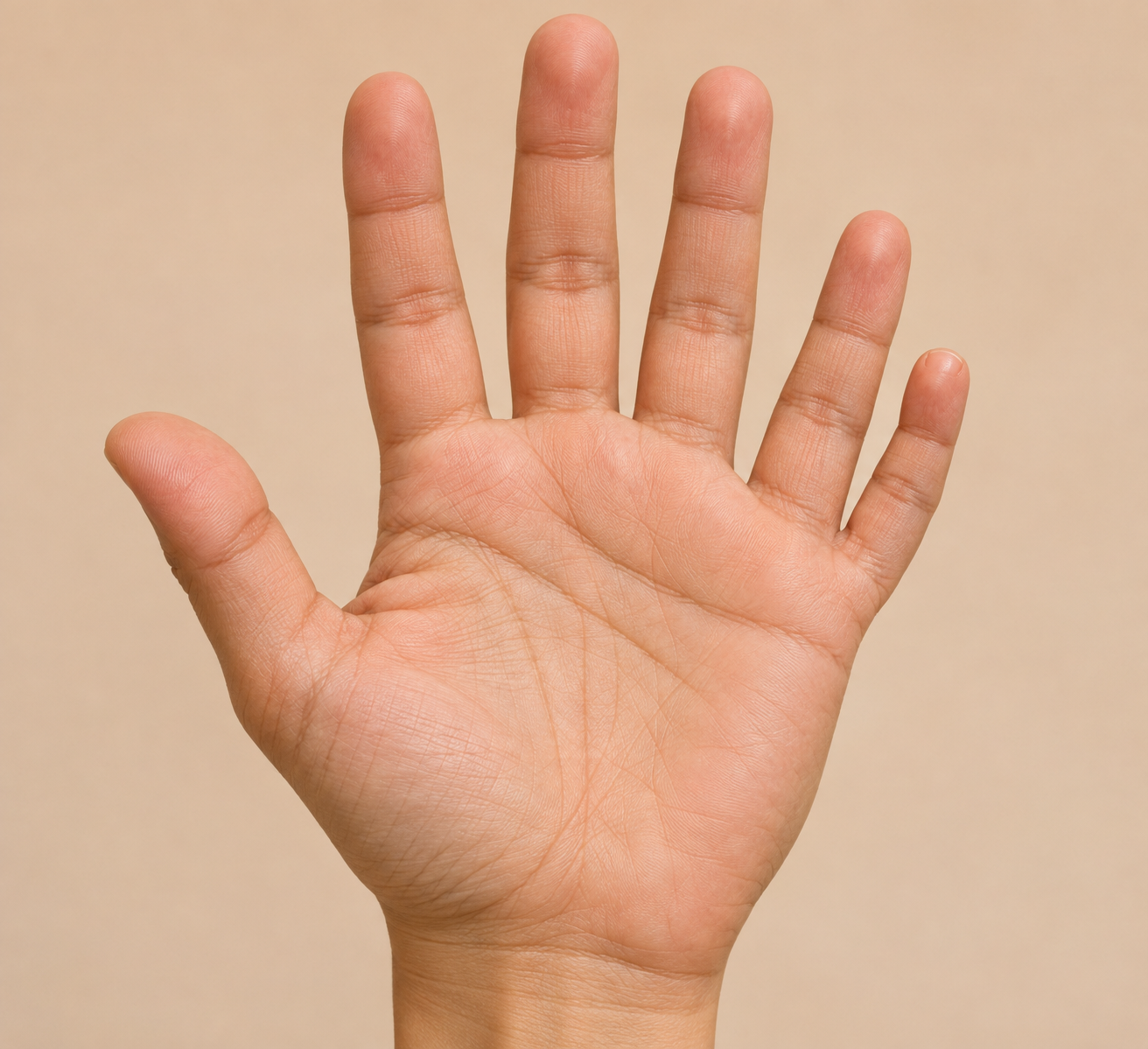
Polydactyly
Also known as: Extra fingers and toes, supernumerary digits, hexadactyly (six digits on a hand or foot), postaxial polydactyly (extra digit on the little finger or little toe side), the six-fingered man of Gath
Polydactyly: the condition of having extra fingers or toes. First Chronicles 20:6 describes a man of the giant lineage with six digits on each hand and each foot.
Polydactyly is the condition of having extra fingers or toes. The word joins the Greek poly, “many,” and daktylos, “finger.” The extra digit can sit on the thumb side, the little finger side, or in the middle of the hand or foot. The most common form is postaxial, with the extra digit on the little finger or little toe side. Polydactyly affects roughly 1.6 to 10.7 people per 1,000 in the general population.
Scripture records one case. Second Samuel 21:20 and 1 Chronicles 20:6 describe a man of great stature at Gath who had six fingers on each hand and six toes on each foot, twenty-four in all. First Chronicles 20:6 says he also “was the son of the giant.” He defied Israel, and Jonathan, the son of David’s brother Shimea, killed him (2 Samuel 21:21; 1 Chronicles 20:7). The text counts his digits because the count marks him as a member of the family of the giant of Gath.
Medical research describes how the trait passes between generations. A 2018 review in Frontiers in Genetics calls polydactyly the most common hereditary limb anomaly. It reports at least ten genetic loci and six genes tied to the non-syndromic form, including ZNF141, GLI3, and MIPOL1. The form usually follows an autosomal dominant pattern, so one altered copy of the gene is enough to produce it. A child of an affected parent has a one in two chance of inheriting that copy. Penetrance varies, so the trait can be carried without showing in every generation.
Family studies show how far the trait can travel. In 2003, Galjaard and colleagues traced postaxial polydactyly through six generations of a Dutch family of thirty-one members, eleven of whom had the trait. Six generations of descent spans roughly 150 years.
A dominant hereditary trait has no scientific reason to stop in an ancient line. If the family at Gath carried the trait, it could have continued in their descendants. This does not prove the bloodline survives. Polydactyly appears in people of every ancestry, so the trait cannot identify a bloodline on its own. The evidence shows that the trait could have continued, and that the text of 2 Samuel 21 and 1 Chronicles 20 describes a family in which it ran.
## My View I believe the six-fingered man of Gath belonged to the giant line. I believe the extra digits ran in his family as an inherited sign of that line, and that the trait could have continued in the descendants of that line.
Scripture References
Sources
Scholarly Source2 Samuel 21:15-22; 1 Chronicles 20:4-8. Muhammad Umair, Farooq Ahmad, Muhammad Bilal, Wasim Ahmad, and Majid Alfadhel, “Clinical Genetics of Polydactyly: An Updated Review,” Frontiers in Genetics 9 (2018): 447. doi:10.3389/fgene.2018.00447. Robert‑Jan H. Galjaard, Arie P. T. Smits, Joep H. A. M. Tuerlings, Aagje G. Bais, Aida M. Bertoli Avella, Guido Breedveld, Esther de Graaff, Ben A. Oostra, and Peter Heutink, “A New Locus for Postaxial Polydactyly Type A/B on Chromosome 7q21‑q34,” European Journal of Human Genetics 11 (2003): 409‑415.
Keep researching. Don't miss what's uncovered next.
Get first access to new Encyclopedia entries, Timeline updates, Watchers, Nephilim, Giants, Demons, Deliverance, and UFO/UAP research, plus new books and releases from CKQBooks. Free. Takes ten seconds.