
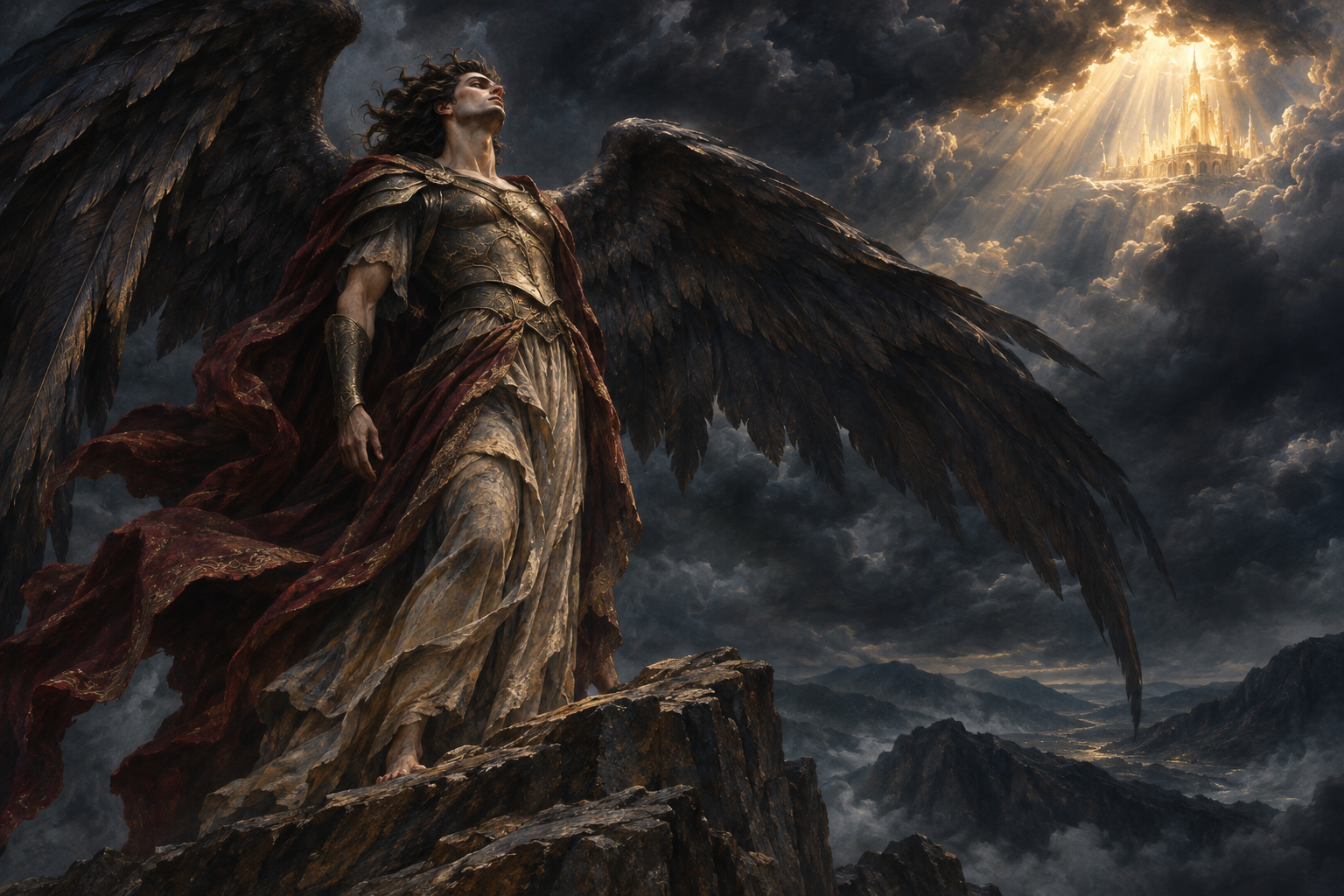
Lucifer’s Sin of Trade
Also known as: Satan
An exploration of Ezekiel 28:16’s claim that trade filled the covering cherub with violence, examining the Hebrew terms rekullah and chamas and the differing views on whether the passage describes Lucifer, Satan, or the king of Tyre.
Rekullah: The Hebrew word translated “merchandise” or “traffick” in Ezekiel 28:16. It comes from a root that means to go about as a trader, and it names trade, trafficking or commerce.
Chamas: The Hebrew word for violence in Ezekiel 28:16. It is also the word used of the earth before the flood in Genesis 6:11.
Covering cherub: The title in Ezekiel 28:14 and 28:16 for the being addressed in the passage. Readers who take the passage as describing Satan identify him with this cherub.
## What Is Lucifer’s Sin of Trade?
It is the charge in Ezekiel 28:16 that trade filled the covering cherub with violence, that he sinned, and that God cast him out of the mountain of God. Readers who take the passage as describing Satan call this his sin of trade. The Hebrew supports the charge of trading and violence. It does not say what he traded or with whom.
## The Verse
The King James Version reads: “By the multitude of thy merchandise they have filled the midst of thee with violence, and thou hast sinned: therefore I will cast thee as profane out of the mountain of God: and I will destroy thee, O covering cherub, from the midst of the stones of fire.” (Ezekiel 28:16)
The verse gives a sequence. Trade filled him with violence. He sinned. God cast him out and destroyed him.
## The Hebrew
Rekullah comes from the root rakal, which means to go about as a trader or peddler. The same word appears in Ezekiel 26:12, where Tyre’s merchandise is plundered, and in Ezekiel 28:5, 28:16 and 28:18. Every use in Ezekiel is tied to Tyre’s commerce, and the word has an ordinary commercial meaning.
Chamas means violence or wrong done to others. Genesis 6:11 uses the same noun and a form of the same verb for the earth before the flood: it was “filled with violence.” In Ezekiel 28:16, violence is the result of the trade.
The Message renders the verse as “In much buying and selling you turned violent, you sinned.” That is a faithful sense of the Hebrew.
## Who Is the Verse About?
Ezekiel addresses the “prince of Tyre” in 28:1-10 and the “king of Tyre” in 28:11-19. Tyre was the leading trading city of its day, and Ezekiel 27 lists its ships, goods and trading partners at length. Two readings follow.
The first reading takes the passage as an oracle against a human king. The Eden imagery is then a poetic comparison. Trade fits this reading well, since the sin charged is the city’s own commerce.
The second reading takes a spiritual being as the figure behind the king. The being is in Eden, the garden of God (28:13). He is an anointed cherub, he walks on the holy mountain of God, and he moves among the stones of fire (28:14). Origen read the passage this way in On First Principles, Book 1, chapter 5. He took it as describing a once-holy being who fell, and he read the Lucifer passage in Isaiah 14 the same way.
The name Lucifer does not appear in Ezekiel. It comes from the Latin Vulgate’s rendering of Isaiah 14:12. Linking the two passages is traditional, and each is addressed to a human king, the king of Tyre in one and the king of Babylon in the other.
## What the Verse Does Not Say
It does not say what was traded. It does not say who the trading partners were. It does not say the trade took place between planets or worlds. Those details come from interpretation, and the verse’s own context points to Tyre’s sea trade.
The “stones of fire” in 28:14 and 28:16 are usually read as gems or as fiery stones on the mountain of God. Reading them as planets is a minority view.
A textual note: the Hebrew of “I will destroy thee, O covering cherub” is ambiguous. The Greek Septuagint reads the verse as the cherub driving him out. This changes who acts in the verse, and it does not affect the charge of trade.
## My View
I believe the covering cherub is Lucifer. I believe he ruled over a system of trade among the worlds under his authority, and that he used it to extend his rule. Violence came from that, and God cast him out of the mountain of God. I read the stones of fire as the planets.
## Bottom Line
Ezekiel 28:16 names trade as the cause of violence and sin in the covering cherub. Readers differ on whether the figure is the king of Tyre, Satan, or both. The verse does not say what was traded, with whom, or on which worlds.
Origen, On First Principles, Book 1, chapter 5 (Crombie translation). Scripture quotations are from the King James Version.
Scripture References
Sources
Biblical TextOrigen, On First Principles, Book 1, chapter 5 (Crombie translation); King James Version, Ezekiel 28:16
Keep researching. Don't miss what's uncovered next.
Get first access to new Encyclopedia entries, Timeline updates, Watchers, Nephilim, Giants, Demons, Deliverance, and UFO/UAP research, plus new books and releases from CKQBooks. Free. Takes ten seconds.