
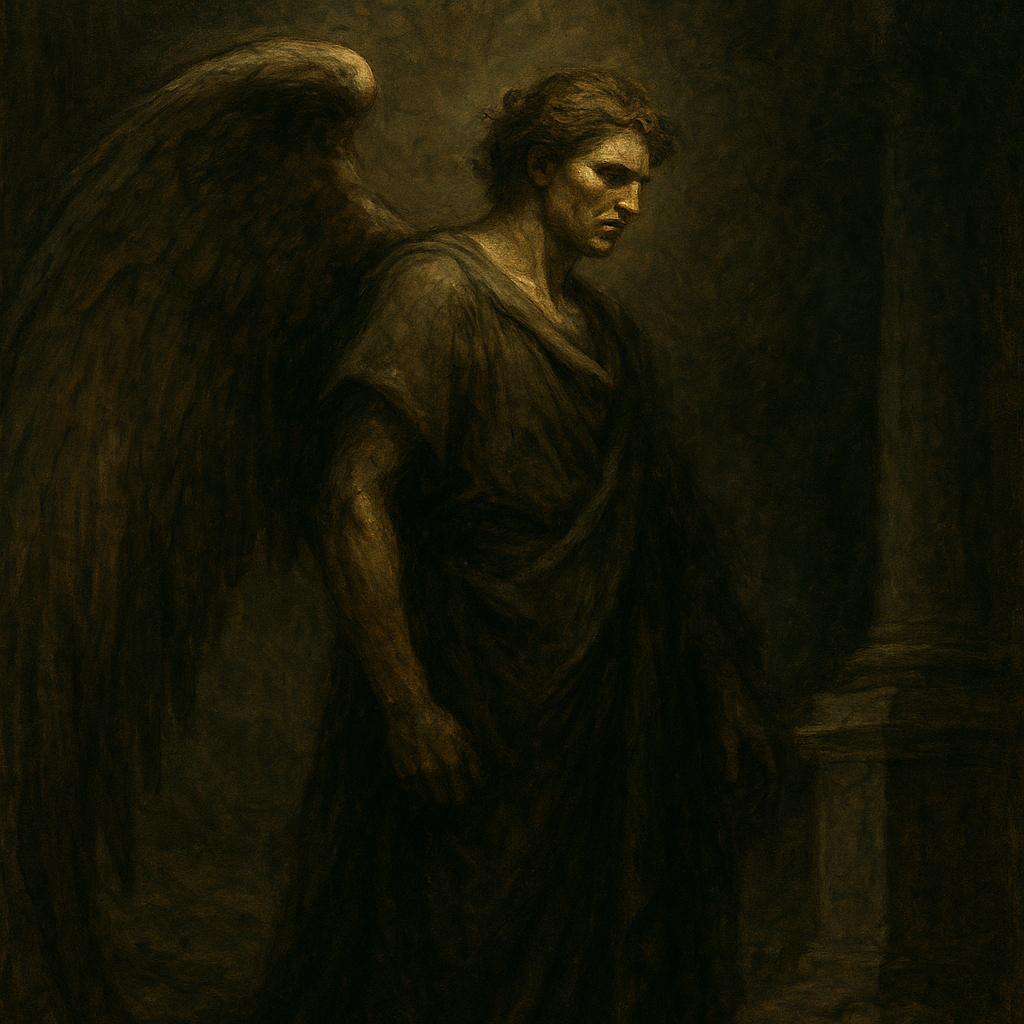
Exploring why the most perfect angel turned against God, this article examines biblical passages that reveal the pride‑driven rebellion that led to the fall of the heavenly host.
An angel stood in the direct presence of God. Not through faith. Not through inference. Face to face, every day, from the moment of creation. Then one day he turned and walked away, and he convinced a third of heaven to walk with him. That single fact should stop you cold. What could you possibly offer a being who already had everything?
Scripture gives you the answer in pieces. Put them together and you get a case file on the first rebellion in history, and on the argument still running today.
The description in Ezekiel 28
Ezekiel 28:12-15 is written as a lament for the king of Tyre, but the language goes far past any human ruler. Read it, and you're reading a description of an angel.
"You were the seal of perfection, full of wisdom and perfect in beauty." Not excellent. The standard other beings were measured against. Full of wisdom, not partial or growing into it. Perfect in beauty, no flaw anywhere.
"You were in Eden, the garden of God. Every precious stone adorned you." The text lists nine stones. Compare that to Exodus 28, where the high priest's breastplate carries twelve stones, one per tribe of Israel. This angel wore nine. He was three short of the complete set. His covering was magnificent and still incomplete, a draft rather than the finished design.
The next line names his settings and mountings, made of gold, prepared on the day he was created. Several Hebrew scholars read the underlying words, tupim and nekabim, as timbrels and pipes rather than settings and mountings. Instruments, not jewelry. If that reading holds, music was built into his body. He didn't perform worship. He was built to carry it, the way an eye is built to carry sight.
He's called an anointed guardian cherub, positioned on the holy mountain of God, walking among fiery stones. The tabernacle instructions in Exodus have two golden cherubim over the mercy seat, wings stretched over the place where God's presence rested (Hebrews 8 calls the earthly tabernacle a copy of a heavenly original). If the gold cherubim on the ark were copies, this angel may have been the original: the covering positioned directly over God's throne.
Then one word changes everything. "You were blameless in your ways from the day you were created, until wickedness was found in you." Until. Everything before that word is glory. Everything after it is ruin.
"Your heart became proud on account of your beauty, and you corrupted your wisdom because of your splendor." Trace the sequence: beauty produced admiration, admiration produced pride, and pride corrupted wisdom without destroying it. The intelligence stayed intact. Its direction changed. It stopped pointing at God and started pointing inward.
One more word deserves attention: rekullah, in verse 16, usually translated as trade or merchandise. Some Hebrew scholars read it as trafficking, in the sense of slander and manufactured discontent. If that's right, this wasn't a private fall he kept to himself. He was recruiting.
Five sentences that started a war
Isaiah 14:12-15 records five statements from the same being, now called the morning star:
"I will ascend to heaven." Not worship. Occupation.
"I will raise my throne above the stars of God." The stars are the other angels. He wanted them under him, not beside him.
"I will sit enthroned on the mount of assembly, on the utmost heights of Mount Zaphon." That's the divine council, the meeting place where God presided. He didn't want a seat. He wanted the head of the table.
"I will ascend above the tops of the clouds." This isn't about height. It's about category. He wanted to stop being a creature and start being something else entirely.
"I will make myself like the Most High." Equal to God. Same authority. Same worship. Same throne.
Five times, "I will." Not once, "God wills." Every rebellion in history traces back to that one small word.
The argument he made
A third of the angelic host didn't follow a slogan. They followed a case, built in stages. Scripture doesn't record his exact words, but the shape of the argument shows up again in Genesis 3 and throughout Paul's letters, aimed at people this time instead of angels.
First: God demands worship because He's a tyrant, and submission is beneath a being of your stature. Second: you deserve autonomy, so why kneel at all. Third: God is withholding something better from you, the same line used on Eve in the garden. Fourth: worship shouldn't be required of anyone, framed as a defense of free will while it quietly cancels the whole purpose of being created. Fifth: follow me, and I'll give you what God never will, a kingdom where you answer to no one.
The trigger
Hebrews calls angels "ministering spirits sent to serve those who will inherit salvation." Paul writes in 1 Corinthians 6:3, "Do you not know that we will judge angels?"
Picture the highest angel in creation, learning that beings made from dust would be raised above beings made of fire, and that angels themselves would one day serve them. He wore nine stones. The complete set was twelve. He was always the draft, and now a creature of clay was set to receive the full priesthood while he was asked to bow. That may be the detail that turned pride into open revolt. If it is, the angels didn't rebel because they hated God. They rebelled because they couldn't accept how much God loved humanity.
Why intelligent beings chose a lie
Augustine spent years on this problem. Evil, he argued, isn't a thing in itself. It's a privation, an absence, the way darkness is the absence of light. Nothing forced the rebellion. The angels who fell simply turned away, and in turning away, they unmade something in themselves.
Aquinas refined the point: they wanted something real, joy and fulfillment, and they wanted it through the wrong channel. They wanted the reward without the position that comes with being a creature. His sharpest line on the subject: the greatest gifts produce the greatest temptation toward pride.
C.S. Lewis called pride the one vice that operates without a body, no hunger, no weakness, pure intellect turning against its source. Once pride took hold in the sharpest mind in creation, that same intelligence became the tool it used to justify the fall.
The core of it: perfection was the raw material of the collapse. Every gift came from God. The larger the gift, the easier it became to mistake the gift for its source, to look at your own brilliance and conclude you made it yourself. The Talmud states it plainly: he knew his master and rebelled against him anyway, with full knowledge of what he was rejecting.
The two-thirds who stayed
Two-thirds of the angelic host didn't fall. One of them stepped forward, and he didn't bring a counterargument. He brought a name that was really a question. Michael, in Hebrew, means "who is like God." That question ended the fight before it started. Five declarations of "I will" against one question, and the question won.
Revelation 12:7-9 records the outcome: "War broke out in heaven. Michael and his angels fought against the dragon, and the dragon and his angels fought back, but he was not strong enough, and they lost their place in heaven." All that beauty and wisdom, deployed in open rebellion, and it wasn't enough.
God didn't send Himself against the rebellion. He sent Michael, another created being. That choice makes a point sharper than raw power could: obedience holds up against rebellion, even when the rebel started out stronger and higher-ranked. Jesus confirms it firsthand in Luke 10:18: "I saw Satan fall like lightning from heaven." Not "I was told." He watched it happen. One moment at the throne, the next moment cast down.
Consider what it took for the loyal two-thirds to hold. They watched the highest being in all creation, more brilliant and more powerful than any of them, build his case in real time. They didn't have every answer to his argument. They knew one thing he'd forgotten: the gifts came from somewhere, and the response to a gift is not to take the giver's throne.
They won the war and still lost something. A third of the beings they'd existed alongside since creation were gone, not destroyed but turned, now the enemy they'd face permanently. Paul calls the ones who stood the "elect angels" in 1 Timothy 5:21. They weren't smarter than the one who fell. He was, by every measure, the most gifted being among them. They were simply humbler, and in the end, humility was the one thing that separated the ones still standing from the ones who fell.
Explore in the Encyclopedia
The Watchers
A class of angelic beings who, in 1 Enoch, descend to earth, take human wives, and teach forbidden knowledge.
Fallen Watchers
The Fallen Watchers are the two‑hundred angels described in 1 Enoch who descended on Mount Hermon, swore an oath to take human wives, and taught humanity forbidden skills, led by Semjaza with Azazel receiving the greatest blame.
Keep researching. Don't miss what's uncovered next.
Get first access to new Encyclopedia entries, Timeline updates, Watchers, Nephilim, Giants, Demons, Deliverance, and UFO/UAP research, plus new books and releases from CKQBooks. Free. Takes ten seconds.