
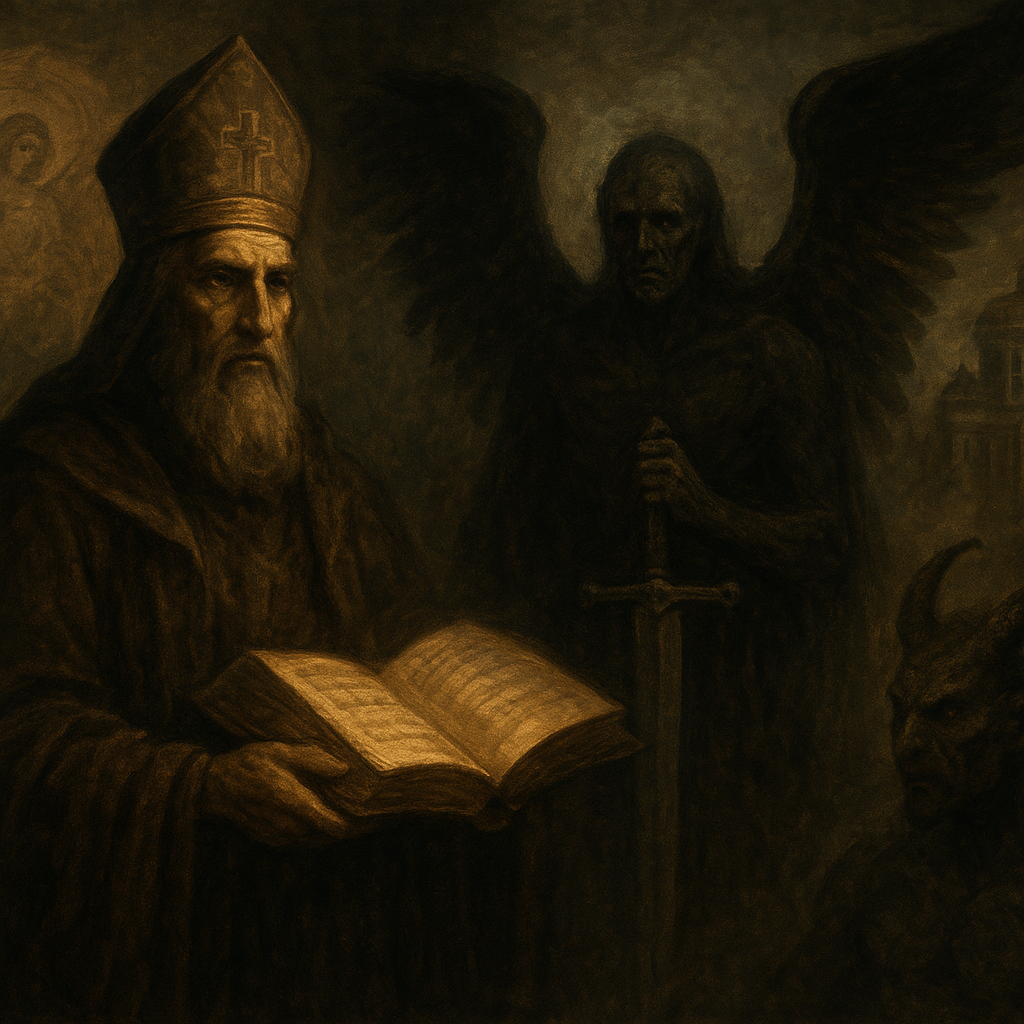
A breakdown of the four Greek terms Paul uses in Ephesians 6:12, drawing on named Catholic and Protestant commentators, the medieval angelic hierarchy tradition, and the occult and imperial context of ancient Ephesus.
In Ephesians 6:12, Paul names four ranks of spiritual opposition: principalities (archai), powers (exousiai), the rulers of the darkness of this world (kosmokratoras), and spiritual wickedness in high places (pneumatika tes ponerias). Catholic commentators such as Haydock and Protestant commentators such as Barnes and Wesley agree, independently of each other, that these terms describe fallen angels who once held legitimate rank in the heavenly order and kept that rank, corrupted, after their rebellion.
Paul sat down to write a letter to a church in Ephesus, a city crawling with sorcery, magic scrolls, and spirit worship as Acts 19 actually records, and right in the middle of that letter he stopped and told them the truth about who they were actually fighting. He wrote it plainly. "We wrestle not against flesh and blood, but against principalities, against powers, against the rulers of the darkness of this world, against spiritual wickedness in high places."
Those words are easy to read as a general statement about the struggles believers face, but Paul chose his language carefully. In the original Greek, he uses four distinct expressions when describing the spiritual opposition behind the struggle. Paul does not stop to explain them as a formal four-level hierarchy, as later Christian traditions sometimes have, but the four terms themselves reveal a much more detailed picture of what he believed was operating beyond the visible world.
1. Principalities
In Greek this word is archai, meaning rulers or first ones, beings occupying a position of authority. Here is what most people never get told about this word. Around the year 500, a theologian writing under the name Dionysius the Areopagite produced a treatise called The Celestial Hierarchy. It organized the angels into nine choirs arranged in three triads, and it became the standard reference point for Christian angelology for the next thousand years. In that scheme, Principalities are named as one of the good angelic orders, placed in the third and lowest triad alongside Archangels and Angels, and tied specifically to guardianship over nations and kingdoms. The nineteenth-century Catholic writer James Bellord made the connection explicit in his Meditations on Christian Dogma, assigning to this class "such spirits as the one whom the Prophet Daniel calls the Prince of the Kingdom of the Persians," pointing directly to Daniel 10:13.
So when Paul uses this exact word, archai, for something believers wrestle against, the Haydock Catholic Bible Commentary, compiled in the early 1800s by George Leo Haydock and drawing on the earlier annotators Witham and Estius, explains it directly: the principalities and powers are "devils, or apostate angels, who before their fall were in such ranks of spirits, and who are permitted to rule over the wicked in this world of darkness." Estius adds a further detail. Because these beings were, in his phrase, the governors of this corporeal world by nature and from their creation, they lost that authority for their pride, then received it back in limited form to tempt mankind.
That reading did not stay inside the Catholic tradition. Two of Protestant Christianity's most widely used commentators arrived at nearly the same place from the other side of the Reformation. Albert Barnes, in his Notes on the New Testament from the 1830s, argued that principalities and powers names the ranks and orders the fallen angels held before their fall, ranks they may still partly retain. John Wesley, in his Explanatory Notes Upon the New Testament almost a century earlier, pictured the principalities and powers remaining "mostly in the citadel of their kingdom of darkness," with other spirits ranging abroad through the provinces of the world. Barnes and Wesley were not reading Haydock, and Haydock was not reading them. They read the same Greek word and landed on the same conclusion independently, across a Reformation that split the church over nearly everything else. When two traditions that disagree on so much converge on a detail like this without citing each other, that convergence carries more weight than either side's opinion alone. It points to a reading rooted in the text and the world behind it, not in denominational bias.
Paul was not inventing new vocabulary for this idea. He uses the same word, archai, in Colossians 1:16 for the ranks Christ himself created and now reigns over, and again in Ephesians 1:19–21 for the authorities placed under Christ's feet at his resurrection. Whatever these ranks are, Paul treats them as real positions, positions that can be held by loyal beings or by rebels who kept the rank after losing everything else that came with it.
2. Powers
In Greek this word is exousiai, and it means something different from the first one. Where principalities describes rank, powers describes function, delegated authority, the actual right to exercise control over a specific sphere. In the Dionysian scheme, Powers belong to the second and middle triad, grouped with Virtues and Dominations, and their original role centered on the exercise and regulation of supernatural authority within the ordered heavenly realm.
Barnes reads Paul's use of the term the same direction as principalities, describing powers as those who held power, or to whom the name of power was given. He even points to Milton's Paradise Lost, where Satan addresses the fallen host as "Thrones, dominations, princedoms, virtues, powers," as evidence that the old titles survived the fall in popular imagination as well as in commentary. If principalities are the ruling authorities, powers are the authorities exercising that rule, a chain of command with delegated jurisdiction that functions the way any government or army does, except this one is invisible and it is not on your side.
3. Rulers of the Darkness of This World
In Greek this is kosmokratoras tou skotous toutou, and this is the most explicit term in the entire verse. Kosmokrator literally means world ruler or world holder. The word occurs exactly once in the whole New Testament, right here. One of the early Greek commentators preserved in the patristic catena on Ephesians, a tradition dominated by John Chrysostom's homilies, noted that the expression appears nowhere else in the Old or New Testament, framing it as a name Paul had to coin because ordinary vocabulary could not carry what he meant.
Outside Scripture, kosmokrator was already a loaded word. Greek astrological writers such as Vettius Valens used it for the planets themselves, treating them as cosmic rulers who determined fate. The Greek Magical Papyri, a body of spell and prayer texts from Roman Egypt, invoke kosmokratores directly in their incantations. The title was political too. The historian Quintus Curtius Rufus repeatedly called Alexander the Great kosmokrator, and by the second century the title had attached itself to Roman emperors, including Marcus Aurelius, Lucius Verus, and later Constantine. Paul was writing to a city that sold amulets and horoscopes in its marketplace and lived under an empire that called its own emperor a world ruler. He picked up the one word his readers would have recognized instantly from both the occult trade and the imperial cult, and he turned it against the powers those objects and titles claimed to serve.
A striking parallel to this shows up in Daniel 10, where a supernatural prince of Persia is described opposing a heavenly messenger for twenty-one days until Michael the archangel came to help, though Scripture never explicitly states that the being in Daniel and the kosmokratoras of Ephesians 6:12 are one and the same. It stands as a genuine pattern connecting the two texts rather than a proven identification, and it is the same connection Bellord draws when he places the Prince of Persia inside the Principalities category discussed above. Barnes reads the phrase in a similarly functional sense, describing these as the rulers who preside over the regions of ignorance and sin that the earth abounds in.
4. Spiritual Wickedness in High Places
In the original Greek this is closer to the spiritual things of wickedness in the heavenly places. Pneumatika points to spiritual things or beings, poneria means wickedness at its core, and epouraniois refers to the heavenly or supernatural sphere itself, not a physical location in the sky above your head. Both the Catholic tradition through Haydock and the Protestant tradition through Wesley understand this final phrase not as a fifth separate category stacked on top of the other three, but as a description of spiritual evil operating in the heavenly or supernatural realm.
This entire conflict is presented as a spiritual struggle involving powers operating in the unseen realm, rather than a battle against human beings, echoing the same kind of supernatural conflict shown in Daniel 10, where a heavenly messenger describes being opposed by the prince of Persia before Michael intervenes.
Where This Language Comes From
None of this language appeared out of nowhere in Paul's writing. Second Temple Jewish literature, especially the Enochic tradition, had already developed an elaborate angelology of named archangels and ranked heavenly beings governing nations and cosmic order. That tradition survives complete today only through the Ethiopian Orthodox Tewahedo Church, which kept the full text of 1 Enoch in Ge'ez manuscripts long after the Greek and Latin churches let it go. The Scottish explorer James Bruce brought the first copies back to Europe in 1773. Those traditions provide important background for understanding the supernatural worldview behind both Daniel and Paul.
The clearest modern academic case for this comes from Clinton Arnold, professor of New Testament at Talbot School of Theology, whose 1989 study Power and Magic: The Concept of Power in Ephesians remains a standard reference on the subject. Arnold examined the archaeological and literary record of first-century Ephesus, a city he describes as unique among Hellenistic cities for the reach of its patron goddess Artemis, and concluded that the Christians there converted out of a culture soaked in magic, astrology, and fear of hostile spiritual powers. Paul was writing from within that broader Jewish and pagan supernatural worldview, telling a church living in the middle of real occult practice exactly what kind of spiritual opposition he believed they were facing, using categories they already had the framework to understand.
CK Quarterman. CK Quarterman is a USAF veteran, independent author, and publisher under the CKQbooks imprint (ckqbooks.com). He writes on the malaterrestrials concept, non-human intelligences with terrestrial rather than extraterrestrial origins, documented across ancient and modern sources. Truth · History · Scripture.
Explore in the Encyclopedia
Keep researching. Don't miss what's uncovered next.
Get first access to new Encyclopedia entries, Timeline updates, Watchers, Nephilim, Giants, Demons, Deliverance, and UFO/UAP research, plus new books and releases from CKQBooks. Free. Takes ten seconds.