
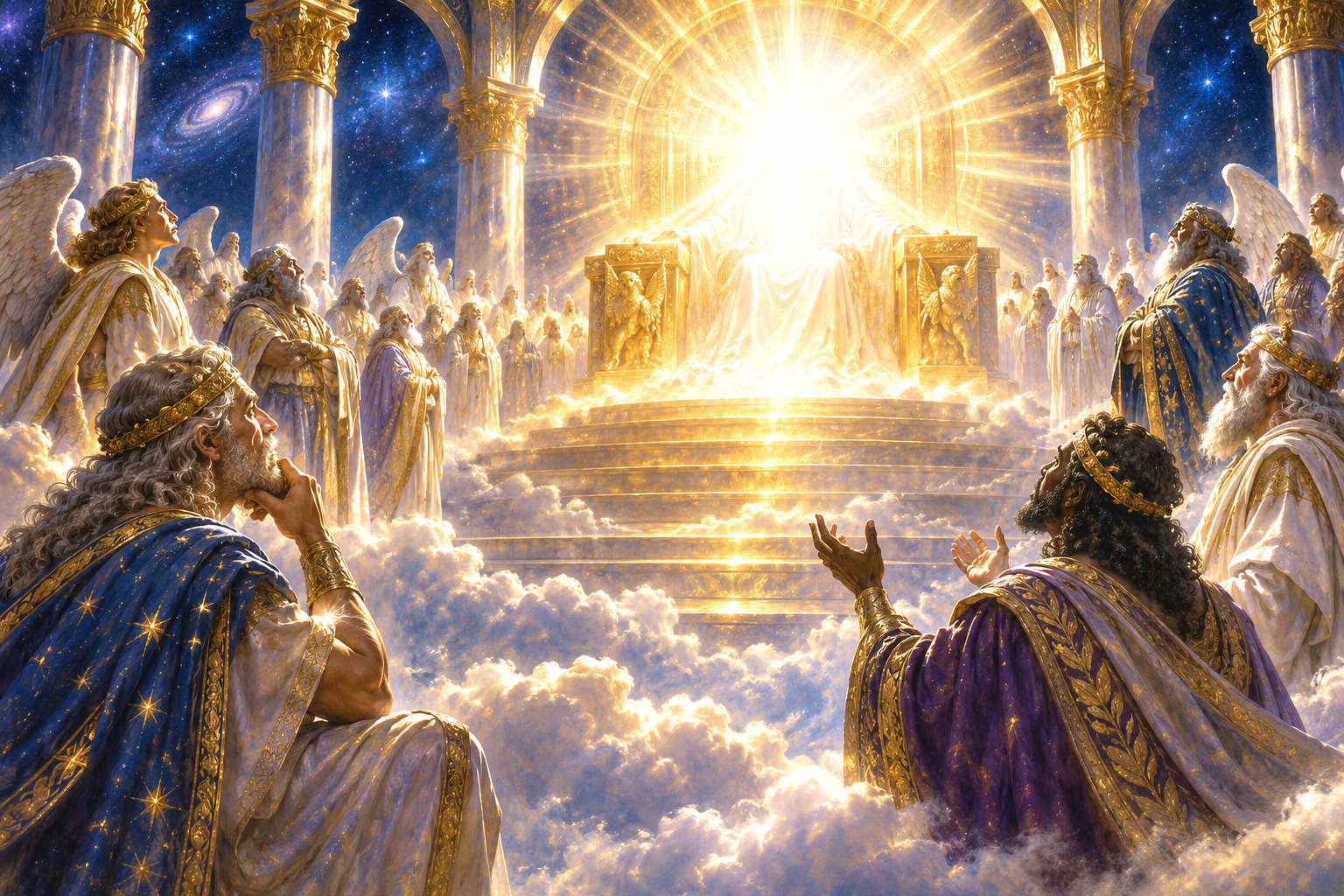
Divine Council
Also known as: divine counsel
The divine council is the biblical assembly of heavenly beings that surround God’s throne, as described in passages such as Psalm 82, 1 Kings 22 and Daniel 7.
Divine Council
The divine council is the assembly of heavenly beings that the Bible shows around God’s throne. Passages such as Psalm 82, 1 Kings 22 and Daniel 7 describe it. Some writers spell it “divine counsel.”
## Divine council: The assembly of heavenly beings who attend God in the Bible. “Council” is the standard spelling. “Counsel” means advice, but the Hebrew word sod covers both an assembly and the counsel given in it.
## Elohim: A Hebrew noun that can mean God, gods, heavenly beings or, in a few verses, human judges. It is plural in form and usually takes a singular verb when it names the God of Israel.
## Sod: A Hebrew word for a council, a confidential counsel or a secret. The King James Version renders it “counsel” in Jeremiah 23:18 and 23:22, and “secret” in Job 15:8 and Amos 3:7.
## What Is the Divine Council?
Several passages show God surrounded by heavenly beings who attend him, hear his decisions and sometimes speak. Scholars call this scene the divine council. The picture is not unique to Israel, since texts from Ugarit describe an assembly of gods under the high god El. The Bible differs on one point. God is not one member of the assembly among equals. Others stand before him, and he decides.
## What Does Elohim Mean?
Elohim appears more than 2,500 times in the Hebrew Bible. Grammarians explain the plural ending in several ways: a plural of majesty or excellence, an abstract plural meaning “divinity,” or an honorific form. The word is not found only in Hebrew. Ugaritic ilhm names the pantheon, and related forms appear in Aramaic and Arabic.
When elohim names the God of Israel, it usually takes singular verbs and adjectives, with a few exceptions such as Genesis 20:13 and 35:7. When it names several beings, it takes plural forms, as in 1 Samuel 28:13. El is usually derived from a root meaning “to be strong” or “to be in front,” but the root is not settled. Christian readers often see the plural as consistent with the Trinity. Many grammarians do not use it as evidence for the Trinity, which rests on the New Testament.
## Where the Council Appears
1 Kings 22:19-23 and 2 Chronicles 18:18-22. The prophet Micaiah says, “I saw the LORD sitting on his throne, and all the host of heaven standing by him on his right hand and on his left.” The LORD asks who will persuade King Ahab to go to battle. A spirit comes forward and offers to be a lying spirit in the mouths of Ahab’s prophets, and the LORD sends him.
Job 1:6, 2:1 and 38:7. The sons of God come to present themselves before the LORD, and Satan comes among them. In Job 38:7, the sons of God shout for joy at creation.
Psalm 89:5-7. The assembly of the holy ones praises the LORD, and the psalm asks which heavenly being can be compared to him.
Isaiah 6:1-8. Isaiah sees the LORD enthroned with seraphim attending him. The LORD asks, “Whom shall I send, and who will go for us?”
Daniel 7:9-10. Thrones are set, and the Ancient of Days takes his seat. Thousands serve him, ten thousand times ten thousand stand before him, and the court sits in judgment. Daniel 4:13, 17 and 23 use the word “watcher” for a holy being who speaks and decrees.
Revelation 4 and 5. John sees twenty‑four elders on thrones, four living creatures around the throne, and myriads of angels.
Jeremiah 23:18 and 22. The KJV asks who has stood in the “counsel of the LORD.” True prophets are those who have. Amos 3:7 says the Lord does nothing without revealing his secret to his servants the prophets.
## Psalm 82: Two Readings
The KJV reads, “God standeth in the congregation of the mighty; he judgeth among the gods” (Psalm 82:1). The psalm has God accuse these gods of judging unjustly. In verses 6 and 7 he says, “Ye are gods; and all of you are children of the most High. But ye shall die like men, and fall like one of the princes.”
One reading takes the gods as heavenly beings who ruled the nations and failed. Supporters point to the phrase “assembly of El” in verse 1, the plural elohim, and the contrast with men in verse 7. This reading is common in modern scholarship.
The other reading takes the gods as human rulers or judges. Exodus 21:6 and 22:8-9 use elohim for judges, and this reading has a long history in Jewish and Christian commentary. Jesus quotes Psalm 82:6 in John 10:34-36, and both sides claim that passage.
The psalm itself says only that they will die like men. It does not describe a final judgment.
## Deuteronomy 32:8-9
The Hebrew text of the Masoretic tradition says God set the boundaries of the nations by the number of the “sons of Israel.” A Dead Sea Scrolls fragment and the Greek Septuagint read “sons of God,” or angels of God. Many scholars prefer the second reading as older. If it is right, the nations were placed under heavenly beings. Others keep the Masoretic reading.
## What the Council Does Not Mean
The council does not mean that God needs advice. Isaiah 40:13-14 asks who has taught or counseled him. In 1 Kings 22 the LORD asks the question and then decides. The heavenly beings serve, report and carry out what he orders.
It does not describe a group of equal gods. Psalm 89 compares no one to the LORD, and Psalm 82 shows him judging the others.
## Bottom Line
The Bible shows God enthroned with heavenly beings who stand before him, serve and report. The scene appears in the historical books, the poetry, the prophets and Revelation. What those beings are, and how to read Psalm 82 and Deuteronomy 32:8, are still debated.
## My Earlier Work on Psalm 82
In 2012 I posted a divine council reading of Psalm 82 online. That was three years before Michael Heiser published The Unseen Realm in 2015. I have written on the divine council since then in other posts on this site.
Scripture References
Sources
Biblical Text2014 CK Quarterman Fallen Angels UFOs and the New World Order by Ambassador Press, Greenville, SC
Keep researching. Don't miss what's uncovered next.
Get first access to new Encyclopedia entries, Timeline updates, Watchers, Nephilim, Giants, Demons, Deliverance, and UFO/UAP research, plus new books and releases from CKQBooks. Free. Takes ten seconds.