
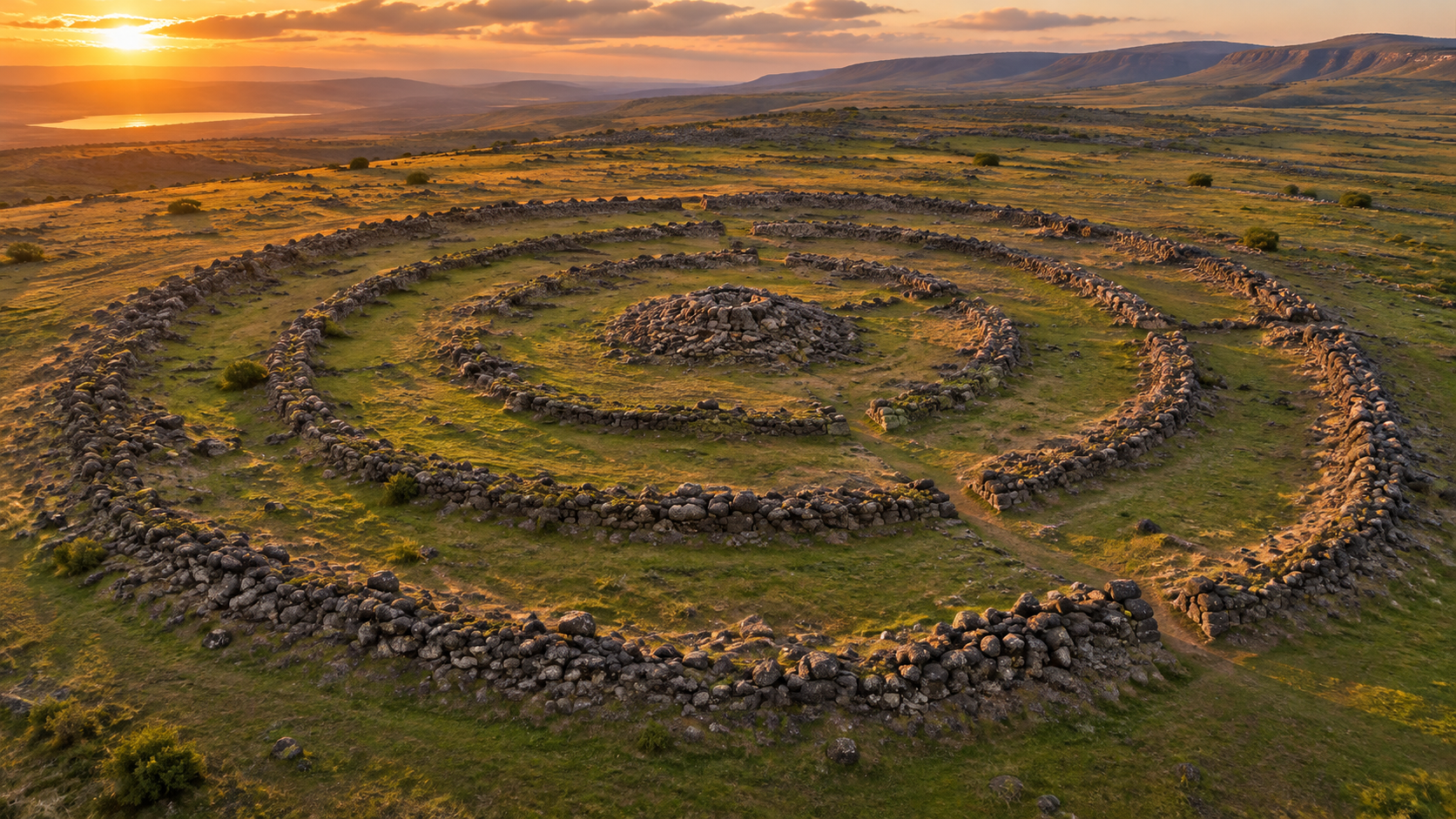
Gilgal Refaim
Also known as: Rujm el-Hiri, wheel of the Rephaim, Wheel of Ghosts
Gilgal Refaim (Rujm el‑Hiri) is a prehistoric basalt stone circle on the Golan Heights, dated to around 3000 BCE, whose name links it to the biblical giants called the Rephaim.
## What Is Gilgal Refaim? Gilgal Refaim: A prehistoric stone monument on the Golan Heights made of about five concentric basalt rings around a central cairn. Its name means “wheel of the Rephaim.” Its Arabic name is Rujm el‑Hiri.
Rephaim: A group of giants named in the Hebrew Bible. The last of them was Og, king of Bashan. In some passages the same word refers to the shades of the dead.
## What Is Gilgal Refaim? Gilgal Refaim is a huge circular stone monument on the Golan Heights in northern Israel. Builders stacked about 40,000 tons of basalt into concentric rings around a central cairn, most likely around 3000 BCE. Nobody knows for certain who built it or why.
## Quick Facts Location: Golan Heights, roughly 16 kilometers (10 miles) east of the Sea of Galilee.
Arabic name: Rujm el‑Hiri, “stone heap of the wildcat.” The name comes from older Syrian maps.
Hebrew name: Gilgal Refaim, “wheel of the Rephaim.”
Discovery: Israeli archaeologists surveyed the area after the 1967 Six‑Day War. Aerial photographs taken in 1968 revealed the ring pattern.
Size: About 150 meters (nearly 500 feet) across. The outer ring measures roughly 145 by 155 meters.
Material: Basalt, the local volcanic stone. Estimates of the total weight run from 37,500 to 42,000 tons.
Central cairn: About 5 meters (15 feet) tall, with a burial chamber.
Date: Around 3000 BCE, in the Early Bronze Age, according to archaeologist Yonathan Mizrachi. Researchers describe the site as up to 5,000 years old.
Purpose: Unresolved.
## What Does the Site Look Like? From the ground, Gilgal Refaim looks like a tangle of low, crumbling walls in an open field. The walls stand up to about two meters high. From the air, the pattern is clear. Five rings of stacked basalt circle a central mound. Shorter radial walls cross the rings, and they are not evenly spaced.
Two wide entrances break the outer wall. One faces northeast and measures about 29 meters. The other faces southeast and measures about 26 meters. The northeast entrance leads to a short passage toward the center.
People often call the site the “Stonehenge of the Levant.” The nickname fits the age and the circular plan. The two monuments differ in design, materials, and culture.
## Who Built Gilgal Refaim? No inscription names the builders, and the dig has produced few datable objects. Archaeologists place the main construction in the Chalcolithic and Early Bronze Age, when farming and herding communities lived on the Golan plateau.
Uri Berger of the Israel Antiquities Authority told Reuters in 2015 that nobody knows who built it. Some researchers have suggested a nomadic group that settled in the area. Berger pointed out that a monument this size needed a large support network, which wandering people were unlikely to have.
Excavations began in the 1980s under Moshe Kochavi and Yonathan Mizrachi. Yosef Garfinkel and Michael Freikman dug at the site again in 2007. Mizrachi proposed that the rings date to about 3000 BCE and that builders added the central tomb roughly a thousand years later.
## What Was It Used For? Researchers have offered several explanations. None has won agreement.
Calendar or observatory. Mizrachi argued that the northeast entrance lines up with sunrise on the June solstice. Visitors still gather there at the solstices to watch the first light.
Ceremonial center. Some scholars see a place where scattered herding communities met for ritual and trade.
Burial site. The central cairn contains a tomb, and hundreds of dolmens, which are stone burial chambers, cover the surrounding plateau.
The astronomy claim lost ground in 2024. A team led by Olga Khabarova and Michal Birkenfeld published a study in the journal Remote Sensing. They reported that shifts in the ground over thousands of years rotated the monument and moved it by tens of meters. The present orientation of its walls therefore cannot prove what the builders intended. When the team modeled the original position, it found no evidence of astronomical alignment.
## What Did the 2026 Satellite Study Find? In March 2026, Michal Birkenfeld of Ben‑Gurion University, Olga Khabarova, Lev Eppelbaum, and Uri Berger published a paper in PLOS One. They studied satellite images taken over two decades and combined them with geophysical modeling.
They found more than 30 large circular basalt structures within 25 kilometers of Gilgal Refaim. Twenty‑eight of them had never been recorded. Many measure more than 50 meters across. Builders used local basalt fieldstone, and many of the circles sit near seasonal water sources.
The authors conclude that Gilgal Refaim is the largest and most elaborate example of a regional building tradition. It was not a lone monument. They also say the finding may change how scholars read the site’s purpose.
## What Is the Connection Between Gilgal Refaim and the Rephaim? The Bible places the Rephaim in Bashan. Deuteronomy 3:11 says Og, king of Bashan, was the last of the Rephaim, and it describes his iron bed as nine cubits long and four wide. Deuteronomy 3:13 says that all of Bashan was called the land of the Rephaim. Deuteronomy 4:43 lists Golan as a city in Bashan. The Golan Heights sit inside the region the Bible calls the land of the Rephaim.
The Hebrew word also carries a second meaning. Several passages use Rephaim for the shades of the dead, and modern Hebrew uses the word for ghosts or spirits. That is why English writers sometimes call the site the “Wheel of Ghosts.”
The name Gilgal Refaim is modern. It is a Hebrew adaptation of the Arabic name Rujm el‑Hiri, which appears on Syrian maps. No ancient text links the monument to the Rephaim. Archaeology dates the rings to around 3000 BCE, well over a thousand years before the time of Og. The name ties the site to the region’s biblical geography. It does not show who built the stones.
## My View I believe the Rephaim were real giants. I believe they came from a second angelic incursion after the Flood, and that Bashan was their homeland. The Golan lies inside Bashan. I believe the name Gilgal Refaim records a memory of who held this land.
Scripture References
Sources
Scholarly SourceBirkenfeld et al., 2026; Phys.org, 2026; Khabarova et al., 2024; Reuters, 2015; Wikipedia; Vietnam.vn, 2026; Fiction: Sons of the Flood series
Keep researching. Don't miss what's uncovered next.
Get first access to new Encyclopedia entries, Timeline updates, Watchers, Nephilim, Giants, Demons, Deliverance, and UFO/UAP research, plus new books and releases from CKQBooks. Free. Takes ten seconds.