
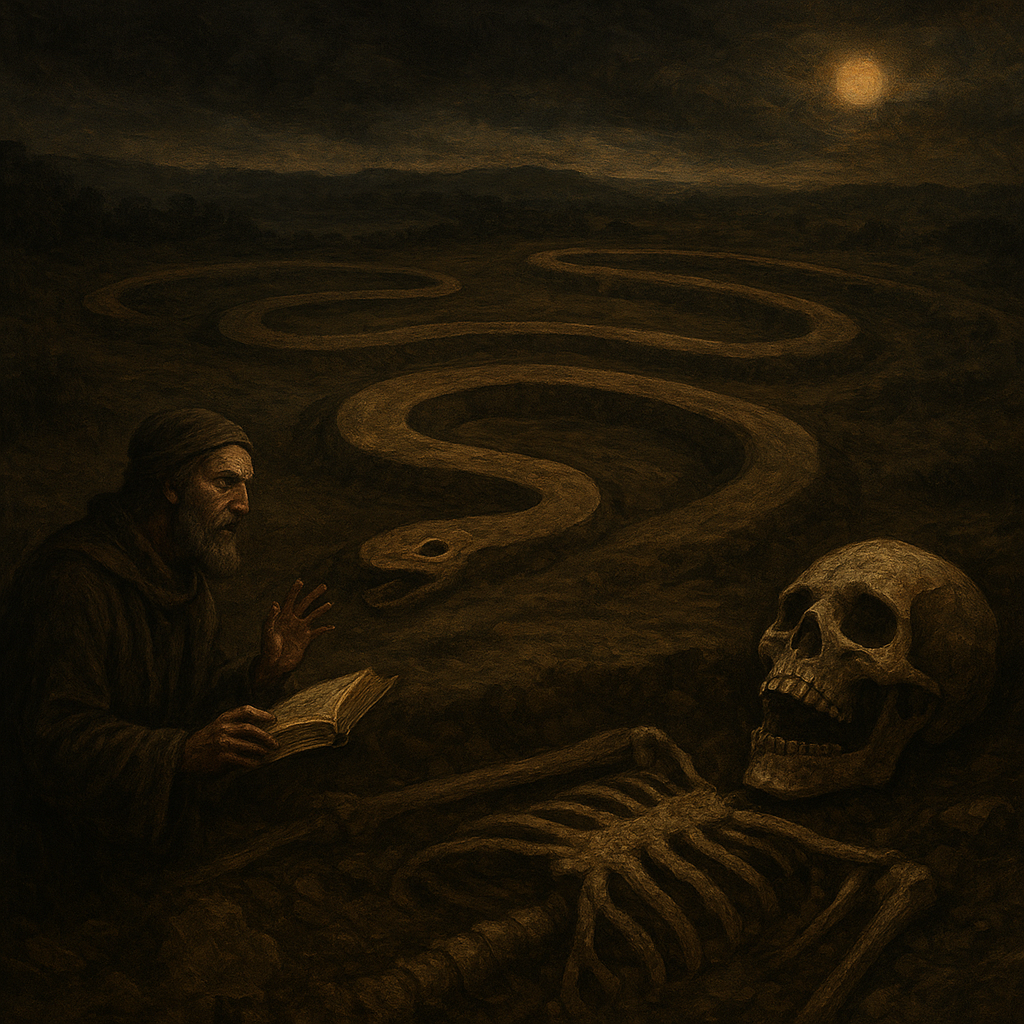
A look at Ohio's Serpent Mound, its uncanny astronomical precision, the giant skeletons once reported nearby, and what the effigy's open-mouthed serpent may really be guarding against.
The Serpent Mound's precise solar and lunar alignments, paired with a documented history of unusually large skeletons found near it, suggest it was never just ceremonial ground. Read against Genesis 3:15 and Genesis 6, the mound's central image, a serpent with its mouth open around an egg, echoes an old and specific claim: that the seed of the serpent has always been working to stop the seed of the woman from ever reaching the world.
A Mound Built to Watch the Sky
Serpent Mound sits on a plateau ridge in Adams County, Ohio, roughly three hours from the Newark Earthworks. The effigy stretches 1,348 feet from its coiled tail to its open mouth, and it barely rises off the ground, somewhere between one and five feet high. You cannot really see the shape of it from the ground at all. You have to get above it, which is worth sitting with for a moment. Whoever built this designed something meant to be read from the air, or from somewhere higher than any hill in the county.
The alignments are the part that keeps researchers coming back. The serpent's head points at the summer solstice sunset. Several of its coils line up with the winter solstice sunrise, the equinox sunrise and sunset, and even the lunar standstills, a set of extreme points in the moon's rise and set positions that only repeat once every 18.6 years. That is not the kind of thing a culture stumbles into by accident. It takes sustained observation, generations of it, just to notice the pattern in the first place.
Archaeologists mostly place construction around 1070 AD, tied to the Fort Ancient culture, though some think Fort Ancient rebuilt or repaired something the earlier Adena culture had already laid out closer to 300 BC. A smaller number of researchers push the date back much further still, into the thousands of years, closer to the end of the last Ice Age. Whichever date is correct, the level of precision built into it argues against the idea that this was just decoration.
The Bones That Keep Disappearing
Newspapers across the 19th and 20th centuries carried a steady stream of stories about oversized skeletons pulled out of mounds like this one, ranging anywhere from seven feet to over twelve. A small pamphlet from 1924 describes a six-foot man removed from a burial mound near the Serpent effigy itself, tall for the era but not the kind of detail that would make headlines on its own. The pattern that should make headlines is what happens to these remains afterward. They get logged, described, sometimes photographed, and then they vanish from any institution anyone can actually go check. L.A. Marzulli has documented this exact problem at multiple sites, including a set of remains recovered off Catalina Island, California, showing a skeleton just under nine feet tall, analyzed from a photograph he found buried in an archive that was never meant to see daylight again. Different site, same pattern.
The Serpent Swallowing the Egg
Look at the shape long enough and the design stops looking neutral. The serpent's mouth is open around an oval, egg-shaped object at the head of the effigy, and the honest question is whether the serpent is swallowing that shape or delivering it. Marzulli has argued for years that this is the serpent in the act of swallowing, and that the swallowing is the whole point of the monument.
Here is the scripture that makes that reading worth taking seriously. Genesis 3:15 has God speaking directly to the serpent in the garden: the seed of the serpent will be at enmity with the seed of the woman, and the seed of the woman will crush the serpent's head. The seed of the woman is understood, across both Jewish and Christian reading, to point forward to the Messiah. If that is the prophecy, then a serpent effigy with its mouth open around an egg, built by hands that clearly understood the sky in intimate detail, reads less like folk art and more like a message. A defiant one. The serpent trying to make sure that particular birth never happens.
Giants Are Never Only About Height
Genesis 6 tells us the Nephilim were on the earth in those days, and also afterward, when the sons of God saw the daughters of men and took them as wives. That is not a throwaway line. Moses is writing this account centuries after the Flood, and he goes out of his way to specify that the Nephilim showed up again after the judgment that was supposed to end them. If Genesis 3:15 sets up a seed war, Genesis 6 is where that war breaks out into biology, into an actual lineage the text takes seriously enough to name.
This series has made the case elsewhere, writing about the Anakim and the Rephaim, that the giant clans Israel met in the Promised Land were not survivors of the pre-Flood line. They were the result of a second incursion, a repeat performance by fallen intelligences who watched the first attempt get drowned and tried again anyway. Serpent Mound fits into that same pattern. Whether it was built in 300 BC or ten thousand years earlier, it sits downstream of an idea that keeps returning across cultures and centuries: giants, sky knowledge, and a serpent that will not stop trying.
A Second Witness an Ocean Away
You do not have to stay in Ohio to find this combination. Gilgal Rephaim, sometimes called the Wheel of the Giants, sits on Israel's Golan Heights, built from more than 42,000 basalt stones arranged in five concentric rings around a central cairn covering a dolmen tomb. It dates to somewhere between 4500 and 2500 BC, and biblical tradition ties the region to Bashan, the territory ruled by Og, one of the last named Rephaim. Different continent, different builders, no plausible contact between the two cultures, and yet the same combination shows up again: giant legend wrapped around a precisely engineered structure tied to the sky.
One Serpent, Many Names
The serpent motif itself will not stay contained to one culture, either. Mesoamerica has Quetzalcoatl. India and Cambodia have the Nagas. Egypt puts the Uraeus serpent on the crown of every pharaoh. Greek and alchemical tradition hands down the Ouroboros, a serpent eating its own tail. Aboriginal Australia has the Rainbow Serpent. This is the foundation the malaterrestrials framework rests on: the same non-human intelligence showing up under different regional names and masks, terrestrial in origin rather than extraterrestrial, leaving the same fingerprints in ancient testimony that we are still finding in modern testimony today.
So, What Is the Answer?
Read on its own, Serpent Mound is an impressive feat of ancient engineering. Read against Genesis 3:15, against the giant bones that keep vanishing from the record, and against a nearly identical pattern sitting on the other side of the world at Gilgal Rephaim, it starts to look like something closer to a monument, built by hands that understood exactly what they were guarding against, and exactly what they did not want to see born.
CK Quarterman. CK Quarterman is a USAF veteran and independent author writing under the CKQbooks imprint at ckqbooks.com. He is the researcher behind the malaterrestrials framework, the theory that many of the entities described across ancient and modern testimony are terrestrial, not extraterrestrial, non-human intelligences. Now you know the name of the Unknown.
Explore in the Encyclopedia
Nephilim
The offspring of the "sons of God" and the "daughters of men" described in Genesis 6, traditionally understood as giants.
Anakim
A clan of giants dwelling in Canaan, descended from Anak, feared by the Israelite spies.
Rephaim
An ancient people of giant stature east of the Jordan, of whom King Og of Bashan was the last remnant.
Og of Bashan
The giant king of Bashan defeated by Israel, described as the last remnant of the Rephaim.
Giants
A general term for the oversized clans and warriors of the ancient world tied to the Nephilim bloodline.
Hybrid Beings
Offspring of the union between the fallen and humanity — the conceptual heart of the Nephilim account and its modern echoes.
Sirens
In the Greek textual tradition of 1 Enoch 19:2, the fate assigned to the human women who bore children to the fallen Watchers — distinct from the Watchers themselves and from the Nephilim, their giant offspring.
Keep researching. Don't miss what's uncovered next.
Get first access to new Encyclopedia entries, Timeline updates, Watchers, Nephilim, Giants, Demons, Deliverance, and UFO/UAP research, plus new books and releases from CKQBooks. Free. Takes ten seconds.