
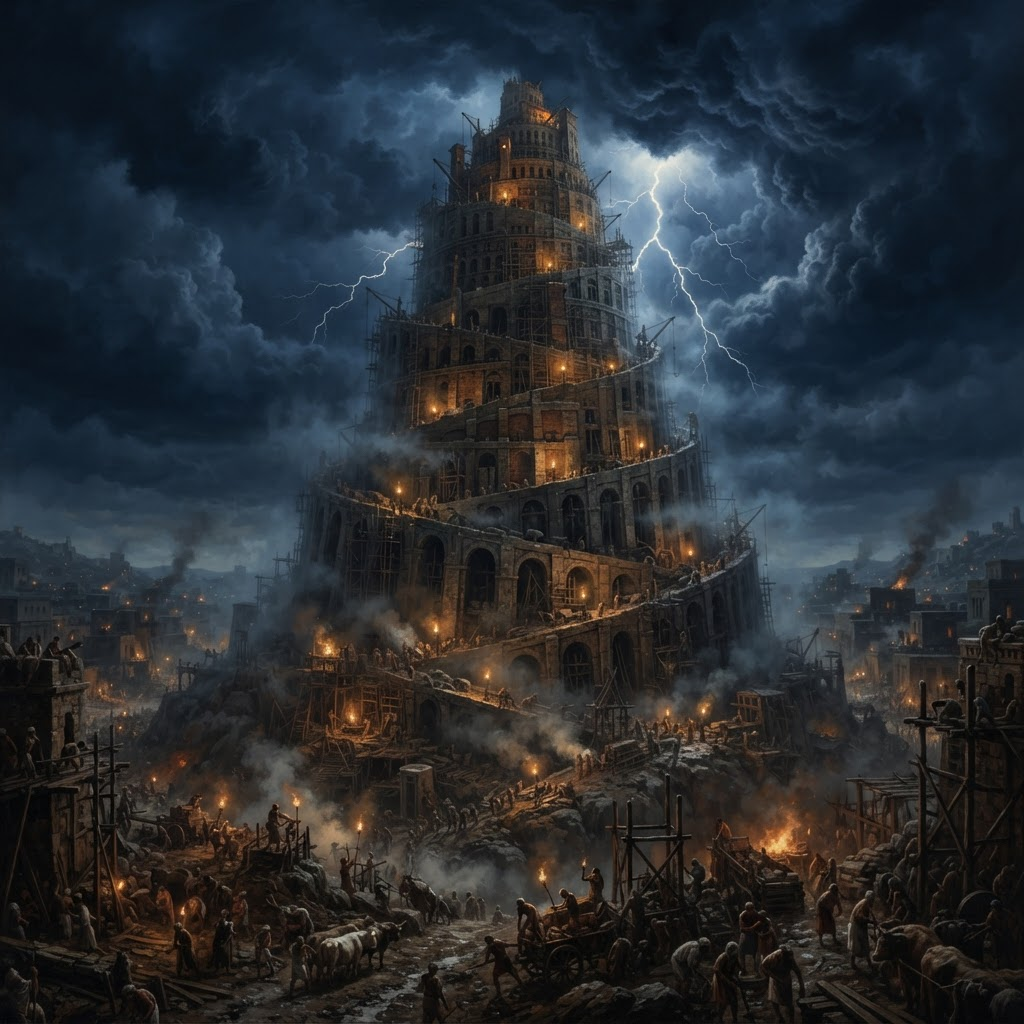
The Ziggurat and the Second Incursion
Also known as: Ziggurat (Akkadian ziqqurratu), Etemenanki (Sumerian, “House of the Foundation of Heaven and Earth”), Tower of Babel, migdal (Hebrew “tower, ” Genesis 11:4), Temple of Bel (Herodotus)
The Ziggurat and the Second Incursion: the stepped temple tower of Babel in Shinar, built to lift a shrine toward heaven, and the place where the second incursion of fallen angels is understood to have begun.
A ziggurat is a stepped platform temple of ancient Mesopotamia, built to lift a shrine toward heaven. The word comes from the Akkadian ziqqurratu, “a high place.” Builders raised ziggurats from the third millennium BC, with a mud-brick core, a fired-brick face, and a shrine at the summit. The Great Ziggurat of Ur, built about 2100 BC, is the best preserved. Many ziggurat names speak of joining heaven and earth.
Genesis 11:1-9 describes the same kind of structure in Shinar, the plain of Babylonia. The people said, “Let us build us a city and a tower, whose top may reach unto heaven; and let us make us a name.” They used baked brick and bitumen for stone and mortar (Genesis 11:3), which matches Mesopotamian building, where stone was scarce. Genesis 10:8-10 says the beginning of Nimrod’s kingdom was Babel in the land of Shinar. Genesis calls Nimrod a gibbor, “a mighty one,” the singular of the word for the “mighty men” (gibborim) of Genesis 6:4. Josephus says Nimrod led the people to build the tower in defiance of God (Antiquities 1.4.2-3).
The practice at the summit points the same way. A shrine sat at the top of every ziggurat. Only a few priests could climb the stairs, and the rituals were hidden from the city below. Etemenanki, the great ziggurat of Babylon, means “House of the Foundation of Heaven and Earth.” A Babylonian tablet describes it as a tower of seven stages about ninety meters high. Herodotus visited Babylon around 450 BC and described the temple at the top of the tower. It held a large couch and a golden table. No one slept there except one woman, chosen from all the women by the god, according to the Chaldean priests (Histories 1.181). Herodotus adds that the priests also said the god came down to the room in person, and that he did not believe it. His account describes the tower as rebuilt long after Genesis 11, so it shows the practice of the later temple.
The timing also points to Shinar. The Flood ended the first incursion, and Noah’s line was unmixed (Genesis 6:9). Jubilees 10:1 says that in the third week of the jubilee after the Flood, unclean spirits began to lead the children of Noah’s sons astray. That puts the activity of evil spirits among Noah’s descendants before the scattering at Babel. By Abraham’s day the Rephaim are living in the land east of the Jordan (Genesis 14:5), and the Anakim are counted among them (Deuteronomy 2:10-11). Numbers 13:33 places Nephilim descendants there.
Genesis 11 does not name angels. It records a city, a tower, and a purpose to make a name, and it records that God came down and confused the languages so that the people could no longer act together (Genesis 11:5-9). The structure, the practice, and the timing together point to Shinar as the place where contact with fallen beings resumed. On this reading, the confusion of languages cut a connection that God would not let stand.
A separate tradition places angels at Babylon. Qur’an 2:102 says Harut and Marut taught people magic at Babylon and warned them, “We are only a trial, so do not disbelieve.” Many early Muslim commentators called them angels. In Tabari’s version, two angels descend to earth, desire a woman, sin, and are punished at Babylon. Al‑Kalbi linked them to the fallen angels of 3 Enoch. Other scholars rejected the story. Ibn Kathir called parts of it fabricated and traced them to Ka’b al‑Ahbar. Al‑Razi and the Mu’tazilites held that angels cannot sin. Hasan al‑Basri read the Arabic as malikayn, “two kings,” instead of malakayn, “two angels.” The story shows that Muslim tradition also set angelic teaching and a fall at Babylon. It does not prove angelic contact, and the dispute over who the two were is unsettled.
The pattern of the first incursion is contact through conversation, then unions, then Nephilim children. The second incursion follows the same order, and Shinar is where it begins.
## My View
I believe the ziggurat at Babel was built to open contact with fallen beings, and that the second incursion began there. I believe God confused the languages to cut off that contact.
Topics
Scripture References
Sources
InterpretationGenesis 10:8-10; 11:1-9; 14:5; Numbers 13:33; Deuteronomy 2:10-11. Herodotus, Histories 1.181-182. Josephus, Antiquities of the Jews 1.4.2-3. Jubilees 10:1-14. Qur’an 2:102; Tabari, Jami’ al-Bayan on 2:102; Ibn Kathir, Tafsir on 2:102. A. R. George, Babylonian Topographical Texts (Leuven: Peeters, 1992), on the Tintir tablet and Etemenanki. A. R. George, “The Tower of Babel: Archaeology, History and Cuneiform Texts,” Archiv für Orientforschung 51 (2005-2006): 75-95. Francis Brown, S. R. Driver, and Charles A. Briggs, A Hebrew and English Lexicon of the Old Testament (Oxford: Clarendon Press, 1907), entries gibbor and migdal.
Keep researching. Don't miss what's uncovered next.
Get first access to new Encyclopedia entries, Timeline updates, Watchers, Nephilim, Giants, Demons, Deliverance, and UFO/UAP research, plus new books and releases from CKQBooks. Free. Takes ten seconds.