
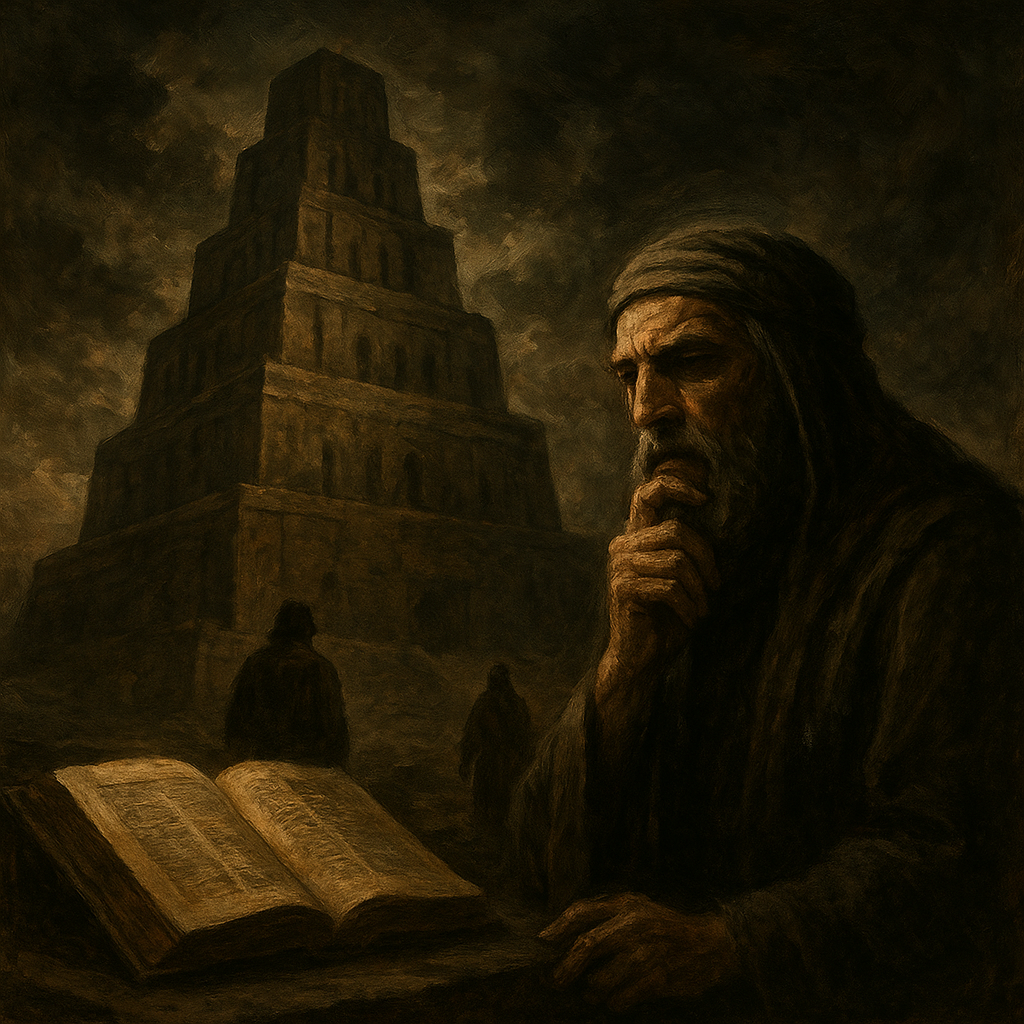
This post traces the word Babel back to its Akkadian and Hebrew roots, and explains why Genesis reinterprets Babylon's own name as an act of judgment.
Babel means confusion. That's the direct answer Genesis 11:9 gives: "Therefore its name was called Babel, because there the Lord confused the language of all the earth." But that answer only tells half the story, because Babel wasn't originally a Hebrew word at all. It was Babylon's own name for itself, and it meant something very different before Genesis got hold of it.
The Akkadian Root: Bab-ilu, Gate of God
The city we know as Babylon called itself Bab-ilu in Akkadian, built from two words: bab, meaning gate, and ilu, meaning god. Put together, the name meant Gate of God, or in its plural form Bab-ilani, Gate of the Gods. The Sumerians rendered the same concept as Ka-dingir. This wasn't a modest civic name. It was a theological claim. Babylon considered itself the point where heaven and earth met, the navel of the earth, the gateway through which the divine world touched the human one.
Every element of the city backed up that claim. Its ziggurat temples were built as literal staircases toward the heavens. Its priesthood positioned the city as the seat of divine order on earth. Babylon didn't just claim to worship the gods. It claimed to be their front door.
The Hebrew Root: Balal, to Confuse
Genesis doesn't accept that claim. Instead, the Hebrew author takes Babylon's proud name and rewrites its meaning through a different root entirely: balal, a verb that means to mix, to mingle, or to confound. The word carries a specific image, drawn from ritual food preparation, of oil poured into flour until the mixture is saturated past the point of separating out again. Applied to language, balal doesn't just mean noise. It means an overflow, a mixture so complete that nothing can be pulled back apart.
Genesis 11:9 makes the word-play explicit: the name is Babel because the Lord balal'd the speech of the whole earth there. It's a pun, and it's a pointed one. Bab-ilu and balal don't actually share a linguistic root. Scholars are clear on this: the connection is not etymological, it's rhetorical. Genesis is not explaining where the word Babel really came from. It's answering Babylon's claim on its own terms, using the sound of Babylon's own name against it.
Why the Word-Play Matters
Babylon said: we are the gate to the gods. Genesis answered: no, you are the place where God scattered you. The city that claimed to be the meeting point of heaven and earth became, in the Hebrew text, the site of humanity's forced dispersal. The name itself carries the argument. Every time a reader says Babel, they are repeating God's verdict on Babylon's own claim to divine access.
That argument doesn't stay confined to Genesis 11. Babel and Babylon are the same Hebrew word, transliterated two different ways in English depending on context. Every later reference to Babylon in scripture, including Revelation's Babylon the Great, reaches back and invokes this same word-play, whether the English translation preserves that connection or not.
Babel in Context: After the Flood, After the Nephilim
The Tower of Babel narrative sits immediately after Genesis 6 and the Flood, and it reads as a mirror image of what came before it. Genesis 6 describes an incursion moving in one direction: divine beings crossing into human affairs, taking human wives, fathering the Nephilim. Genesis 11 describes an attempted crossing moving the other way: humanity building a structure designed to reach up into the divine realm. Both accounts end in judgment. Both accounts end in scattering.
Read side by side, Genesis 6 and Genesis 11 form a single argument about boundaries between the divine and human worlds, and about what happens when either side tries to cross them without permission. The name Babel isn't incidental to that argument. It's the verdict, built directly into the word.
CK Quarterman. CK Quarterman is a USAF veteran and the author and publisher behind the CKQbooks imprint (ckqbooks.com). He coined the term malaterrestrials to describe non-human intelligences of terrestrial origin, and his research and fiction are grounded in Genesis 6, the Book of Enoch, and the Divine Council. Now you know the name of the Unknown.
Explore in the Encyclopedia
Keep researching. Don't miss what's uncovered next.
Get first access to new Encyclopedia entries, Timeline updates, Watchers, Nephilim, Giants, Demons, Deliverance, and UFO/UAP research, plus new books and releases from CKQBooks. Free. Takes ten seconds.