
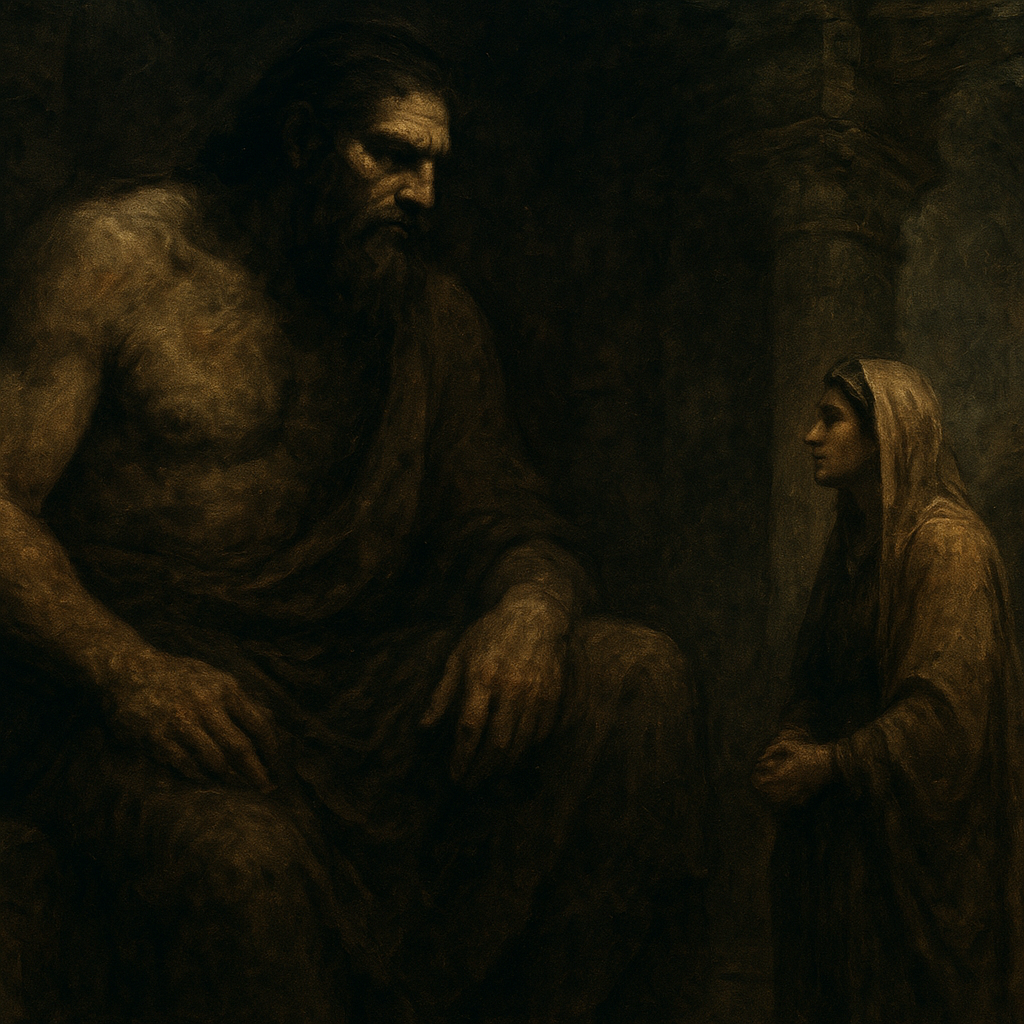
The Hebrew Bible never says whether the Nephilim could have children. Second Temple Jewish texts fill that silence with two contradicting answers.
The short answer is that nobody knows for certain. The Hebrew Bible never says. But Second Temple Jewish literature gives you two competing answers, and they flatly contradict each other. One tradition traces three generations of giant offspring. Another states outright that the giants "neither marry nor bear children." Both come from the same broad body of literature. Neither one wins by consensus.
What Genesis Actually Says
Genesis 6:1-4 tells you the Nephilim existed. It doesn't tell you where they came from beyond the union of the "sons of God" and human women, and it says nothing about their capacity to reproduce. No claim of sterility. No claim of fertility. The silence is total. Everything written on this question since then is an attempt to fill a gap the text leaves wide open.
Jubilees and the Family Tree Nobody Named "Giants"
The Book of Jubilees, written sometime in the second century BC, picks up where Genesis leaves off. Jubilees 7:22 says the Watchers "fathered as their sons the Nephilim. All of them were dissimilar from one another and would devour one another: the giant killed the Naphil; the Naphil killed the Elyo; the Elyo humanity."
Notice what that verse actually names. Three separate groups: the giants, the Naphil, and the Elyo. Only the first group carries the label "giants." The other two show up as their own distinct categories, killing their way down a chain that ends with ordinary humanity at the bottom. Jubilees calls them "dissimilar from one another," though it never spells out what that difference means. Size is a reasonable guess, since Jubilees elsewhere gives the first-generation giants a height of 3,000 cubits. But the text itself leaves "dissimilar" open to interpretation.
The Greek Enoch Tradition: Three Generations
The most direct evidence for continued Nephilim reproduction comes from a Greek variant of 1 Enoch 7:2, preserved by the ninth-century Byzantine chronographer George Syncellus. This version states that the giants fathered Nephilim, and the Nephilim fathered Elioud. Three generations, each descended from the last.
This tradition holds that the Watchers were seduced by mortal women who bore three generations of giants: first the Anaqim, then the Nephilim, then the Elioud. The text doesn't say the line dies out after the third generation. It simply stops naming any further ones.
The Contradiction Nobody Talks About
Here is what most discussions of this topic miss. A separate strand of Second Temple tradition, drawn from the Aramaic Book of Giants fragments found at Qumran, states the opposite. In that material, the giants "neither marry nor bear children" at all.
Some scholars treat the Syncellus three-generation reading as reflecting older material. Others argue it looks like a later addition, absent from the earlier Aramaic sources, with the "neither marry nor bear children" tradition closer to the original picture.
So this is not simply a case of "the text goes quiet after three generations, so who knows." Two branches of the same literary tradition actively disagree about whether Nephilim reproduction happened at all. One says three generations and counting. The other says none.
What About the Rabbis?
Jump forward a few centuries to Genesis Rabbah 26:7, a rabbinic commentary on Genesis 6:4. It plays on the Hebrew root n-p-l, meaning "to fall," saying of the Nephilim that they "caused the world to fall... and filled the world with abortions through their licentiousness." The Hebrew word for these abortions or miscarriages, nefalim, shares that same root.
It is tempting to read this as proof the Nephilim themselves were infertile or that their own offspring failed to survive. The text does not say that. This midrash describes moral corruption on a societal scale, not a clinical statement about giant reproductive biology. It is wordplay connecting a name to a downfall, not a fertility report.
Where Are the Daughters?
One more gap is worth naming. No text anywhere excludes the Nephilim, or the Watchers before them, from fathering daughters. Every genealogy in this literature runs through named sons, standard practice across biblical genealogies generally. Absence from a list of names is not evidence of absence from existence. It is evidence of how ancient genealogies were written.
The Honest Conclusion
The Nephilim's reproductive capacity is a question the primary texts never settle. Genesis is silent. Jubilees describes distinct generational categories without confirming how or whether they kept reproducing. The Greek Enoch tradition describes three generations with no stated endpoint. A competing tradition denies reproduction happened at all. And the rabbinic wordplay in Genesis Rabbah speaks to moral corruption, not biology.
Anyone who tells you the ancient texts settle this question in either direction is overstating the evidence. The honest position is that Second Temple Judaism argued with itself about this, and left the argument unresolved.
CK Quarterman. CK Quarterman is a USAF veteran, independent author, and publisher writing under the Malaterrestrials brand at CKQbooks.com. Truth · History · Scripture.
Explore in the Encyclopedia
Nephilim
The offspring of the "sons of God" and the "daughters of men" described in Genesis 6, traditionally understood as giants.
Anakim
A clan of giants dwelling in Canaan, descended from Anak, feared by the Israelite spies.
Giants
A general term for the oversized clans and warriors of the ancient world tied to the Nephilim bloodline.
Hybrid Beings
Offspring of the union between the fallen and humanity — the conceptual heart of the Nephilim account and its modern echoes.
Sirens
In the Greek textual tradition of 1 Enoch 19:2, the fate assigned to the human women who bore children to the fallen Watchers — distinct from the Watchers themselves and from the Nephilim, their giant offspring.
Keep researching. Don't miss what's uncovered next.
Get first access to new Encyclopedia entries, Timeline updates, Watchers, Nephilim, Giants, Demons, Deliverance, and UFO/UAP research, plus new books and releases from CKQBooks. Free. Takes ten seconds.