
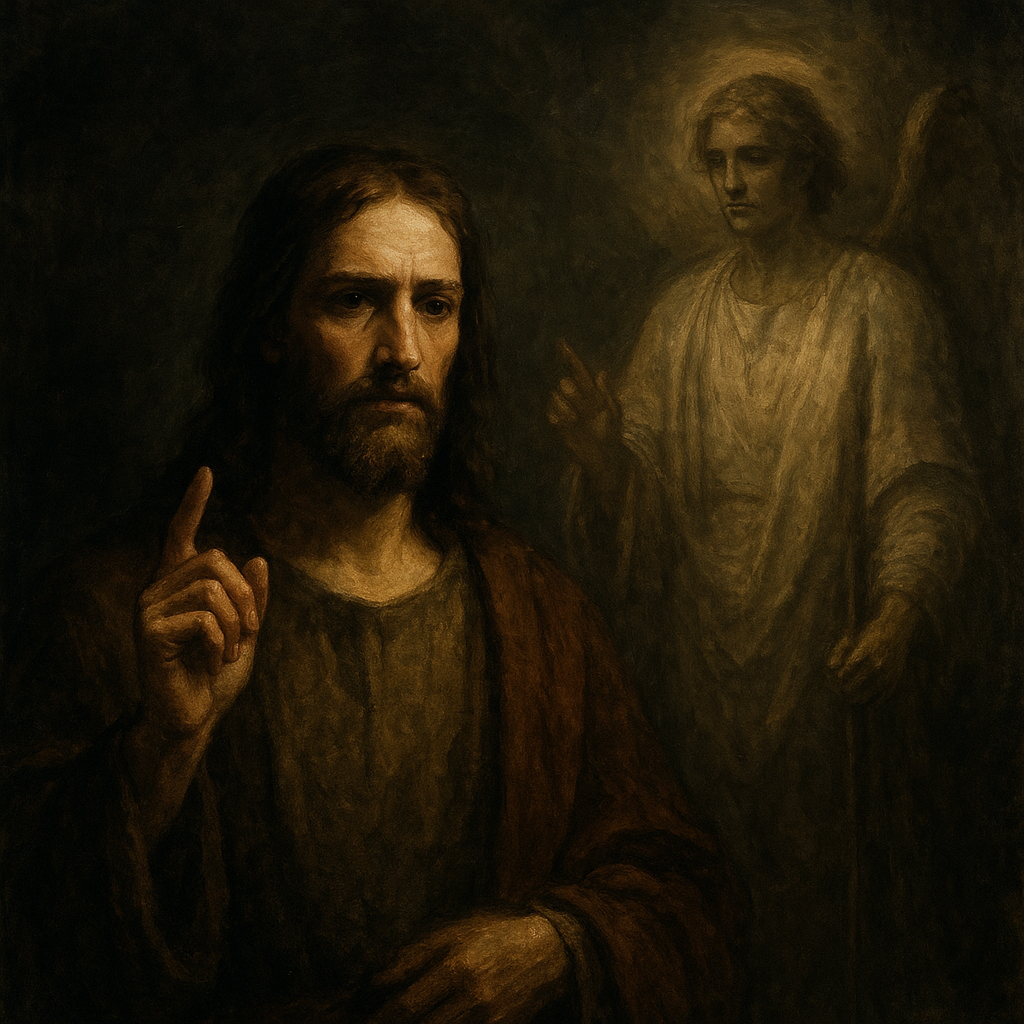
Jesus claimed divinity by saying “Before Abraham was, I am,” echoing the I AM name God gave Moses; the article shows how John’s Logos and the Angel of the LORD support this claim.
Logos: Greek for “Word.” John 1:1 uses it for the eternal Son of God, who became flesh as Jesus Christ.
I AM: The name God gave Moses at the burning bush in Exodus 3:14. In Hebrew it is ehyeh asher ehyeh, “I AM THAT I AM,” and it speaks of God’s self-existence.
Angel of the LORD: A figure in the Old Testament who speaks as God, is called God, and accepts worship. Many Christians, beginning with the early church fathers, identify Him as the Son of God before His incarnation.
Christology: The study of who Christ is and His place within the Godhead.
Keywords: did Jesus claim to be God, Before Abraham was I am, John 8:58, I AM THAT I AM, Exodus 3:14, the Logos, John 1:1, Angel of the LORD, deity of Christ, Christology
Did Jesus Claim to Be God?
Jesus claimed to be God, and His enemies understood Him perfectly. When He said, “Before Abraham was, I am” (John 8:58), He used the name God gave Moses at the burning bush. The crowd picked up stones to kill Him for blasphemy. John’s Gospel opens with the same truth: the Word who became flesh is God.
Christology is the study of who Christ is and His place within the Godhead. Two titles unlock it: the Logos and the I AM.
The Logos
John begins his Gospel this way:
“In the beginning was the Word, and the Word was with God, and the Word was God. The same was in the beginning with God. All things were made by him; and without him was not any thing made that was made.” (John 1:1-3)
The Greek word translated “Word” is Logos. John tells us exactly who the Logos is a few verses later:
“And the Word was made flesh, and dwelt among us, (and we beheld his glory, the glory as of the only begotten of the Father,) full of grace and truth.” (John 1:14)
The Word who became flesh is Jesus Christ. Read John 1:1-2 again with His name in place of “the Word”: In the beginning was Jesus, and Jesus was with God, and Jesus was God. The same was in the beginning with God.
Jesus did not begin in Bethlehem. He was with God in the beginning, and nothing was made without Him. To see Him before Bethlehem, go back to Moses.
The Burning Bush
Moses had spent 40 years tending sheep in the wilderness when God met him:
“Now Moses kept the flock of Jethro his father in law, the priest of Midian: and he led the flock to the backside of the desert, and came to the mountain of God, even to Horeb. And the angel of the LORD appeared unto him in a flame of fire out of the midst of a bush; and he looked, and, behold, the bush burned with fire, and the bush was not consumed. And Moses said, I will now turn aside, and see this great sight, why the bush is not burnt. And when the LORD saw that he turned aside to see, God called unto him out of the midst of the bush, and said, Moses, Moses. And he said, Here am I. And he said, Draw not nigh hither: put off thy shoes from off thy feet, for the place whereon thou standest is holy ground.” (Exodus 3:1-5)
Horeb is another name for Mount Sinai. Notice what happens in the passage. The angel of the LORD appears in the bush. Then “God called unto him out of the midst of the bush.” The next verse removes all doubt:
“Moreover he said, I am the God of thy father, the God of Abraham, the God of Isaac, and the God of Jacob. And Moses hid his face; for he was afraid to look upon God.” (Exodus 3:6)
Who Is the Angel of the LORD?
The angel of the LORD appears many times in the Old Testament, and He does not act like an ordinary angel. He speaks as God, He is called God, and He accepts worship.
Hagar met Him in the wilderness and “called the name of the LORD that spake unto her, Thou God seest me” (Genesis 16:13).
He stopped Abraham from sacrificing Isaac and said, “thou hast not withheld thy son, thine only son from me” (Genesis 22:12). Abraham was offering Isaac to God, and the angel says it was offered to Him.
He told Jacob in a dream, “I am the God of Bethel” (Genesis 31:13).
Jacob wrestled a man until daybreak and then said, “I have seen God face to face” (Genesis 32:30). Hosea 12:4 says Jacob “had power over the angel, and prevailed.”
He told Israel, “I made you to go up out of Egypt” and “I will never break my covenant with you” (Judges 2:1).
Manoah and his wife watched Him ascend in the flame of their altar. Manoah said, “We shall surely die, because we have seen God” (Judges 13:22).
In one night He struck down 185,000 soldiers in the camp of the Assyrian army that besieged Jerusalem (2 Kings 19:35).
Compare that with a created angel. When John fell down to worship the angel who showed him the visions of Revelation, the angel stopped him at once: “See thou do it not: for I am thy fellowservant... worship God” (Revelation 22:8-9). Created angels refuse worship. The angel of the LORD receives it.
Joshua met a similar figure outside Jericho, the “captain of the host of the LORD.” Joshua “fell on his face to the earth, and did worship.” The captain did not stop him. He told him, “Loose thy shoe from off thy foot; for the place whereon thou standest is holy” (Joshua 5:14-15). Those are almost the same words spoken to Moses at the bush.
The angel of the LORD is God. More precisely, many Christians believe He is the Son of God appearing before He took on flesh. That belief is very old. Justin Martyr argued in the second century that the one who spoke to Moses from the bush was the Son. Some Bible teachers take a different view and see the angel as a created messenger who speaks in God’s name. The worship He accepts is hard to explain on that view.
I AM THAT I AM
Moses asked the question every messenger needs answered. Who shall I say sent me (Exodus 3:13)? God answered:
“And God said unto Moses, I AM THAT I AM: and he said, Thus shalt thou say unto the children of Israel, I AM hath sent me unto you.” (Exodus 3:14)
In Hebrew the phrase is ehyeh asher ehyeh. It can be read “I am who I am” or “I will be what I will be.” Jerome’s Latin Vulgate renders it Ego sum qui sum, “I am who am.” The Greek Septuagint, the Old Testament many first‑century Jews read, gives it as ego eimi ho on, “I am the One who is.”
The name speaks of self‑existence. God depends on nothing and no one. He was not made, and He does not change. Everything else that exists was made by Him. So God told Moses, in effect, to tell Israel that the self‑existent One had sent him.
The God of Sinai
The God who spoke from the bush is the same God who came down on Mount Sinai. When He descended, “there were thunders and lightnings, and a thick cloud upon the mount, and the voice of the trumpet exceeding loud” (Exodus 19:16). The whole mountain smoked and shook. Any person or animal that touched the mountain was to be put to death (Exodus 19:12-13).
Later Moses asked to see God’s glory. God answered, “Thou canst not see my face: for there shall no man see me, and live.” He put Moses in a cleft of the rock, covered him with His hand as He passed by, and let him see His back (Exodus 33:20-23). Moses saw what no one else had seen and lived.
When Moses came down from the mountain with the second set of tablets, his face shone so brightly that the Israelites were afraid to come near him. He wore a veil when he spoke with them (Exodus 34:29-35).
This is among the most treasured accounts in Jewish memory. God revealed His name, brought Israel out of Egypt, and gave the Law at Sinai. Every Jew in Jesus’ day knew the name I AM and whose name it was.
Before Abraham Was, I Am
Now move to the New Testament. In John 8, Jesus was debating religious leaders in the temple:
“Then said the Jews unto him, Now we know that thou hast a devil. Abraham is dead, and the prophets; and thou sayest, If a man keep my saying, he shall never taste of death. Art thou greater than our father Abraham, which is dead? and the prophets are dead: whom makest thou thyself? Jesus answered, If I honour myself, my honour is nothing: it is my Father that honoureth me; of whom ye say, that he is your God: Yet ye have not known him; but I know him: and if I should say, I know him not, I shall be a liar like unto you: but I know him, and keep his saying. Your father Abraham rejoiced to see my day: and he saw it, and was glad.” (John 8:52-56)
They answered Him:
“Then said the Jews unto him, Thou art not yet fifty years old, and hast thou seen Abraham? Jesus said unto them, Verily, verily, I say unto you, Before Abraham was, I am. Then took they up stones to cast at him: but Jesus hid himself, and went out of the temple, going through the midst of them, and so passed by.” (John 8:57-59)
“Verily, verily” means “truly, truly.” Jesus used it for emphasis. Notice His grammar. He did not say, “Before Abraham was, I was.” He said, “I am.” In Greek the words are ego eimi, the same words the Septuagint uses in God’s answer to Moses.
Why They Picked Up Stones
The Law said, “he that blasphemeth the name of the LORD, he shall surely be put to death, and all the congregation shall certainly stone him” (Leviticus 24:16). The crowd reached for stones because they understood exactly what Jesus claimed. He was calling Himself by the name of the God of the burning bush and of Sinai.
Two chapters later the same thing happened, and this time they said why: “For a good work we stone thee not; but for blasphemy; and because that thou, being a man, makest thyself God” (John 10:33).
On the night of His arrest, soldiers came looking for Jesus of Nazareth. He answered, “I am he.” In Greek, again, ego eimi. “As soon then as he had said unto them, I am he, they went backward, and fell to the ground” (John 18:6).
God called Himself I AM, the self‑existent One. Jesus took that name for Himself. The Logos who was with God and was God in John 1 is the I AM of the burning bush. Jesus is God.
What This Means for You
Jesus said, “if ye believe not that I am he, ye shall die in your sins” (John 8:24). The word “he” is printed in italics in the KJV because the translators supplied it. Jesus said, “if ye believe not that I am.” Who you believe Jesus is determines where you stand with God.
A good teacher or prophet could not save you. Only the I AM could. If you want to see this for yourself, read John 1, Exodus 3, and John 8 side by side in one sitting, and mark every place where God or Jesus says “I am.”
Related reading: Who Was Justin Martyr? and What Is the Nicene Creed?
About the Author
CK Quarterman is a USAF veteran, independent author, and publisher at CKQbooks. He writes the Malaterrestrials nonfiction series, which examines evil earthbound non‑human intelligences through Scripture and history, along with the Watchers’ Universe and Sons of the Flood fiction series. Find his books at ckqbooks.com.
Truth · History · Scripture
Topics
Keep researching. Don't miss what's uncovered next.
Get first access to new Encyclopedia entries, Timeline updates, Watchers, Nephilim, Giants, Demons, Deliverance, and UFO/UAP research, plus new books and releases from CKQBooks. Free. Takes ten seconds.