
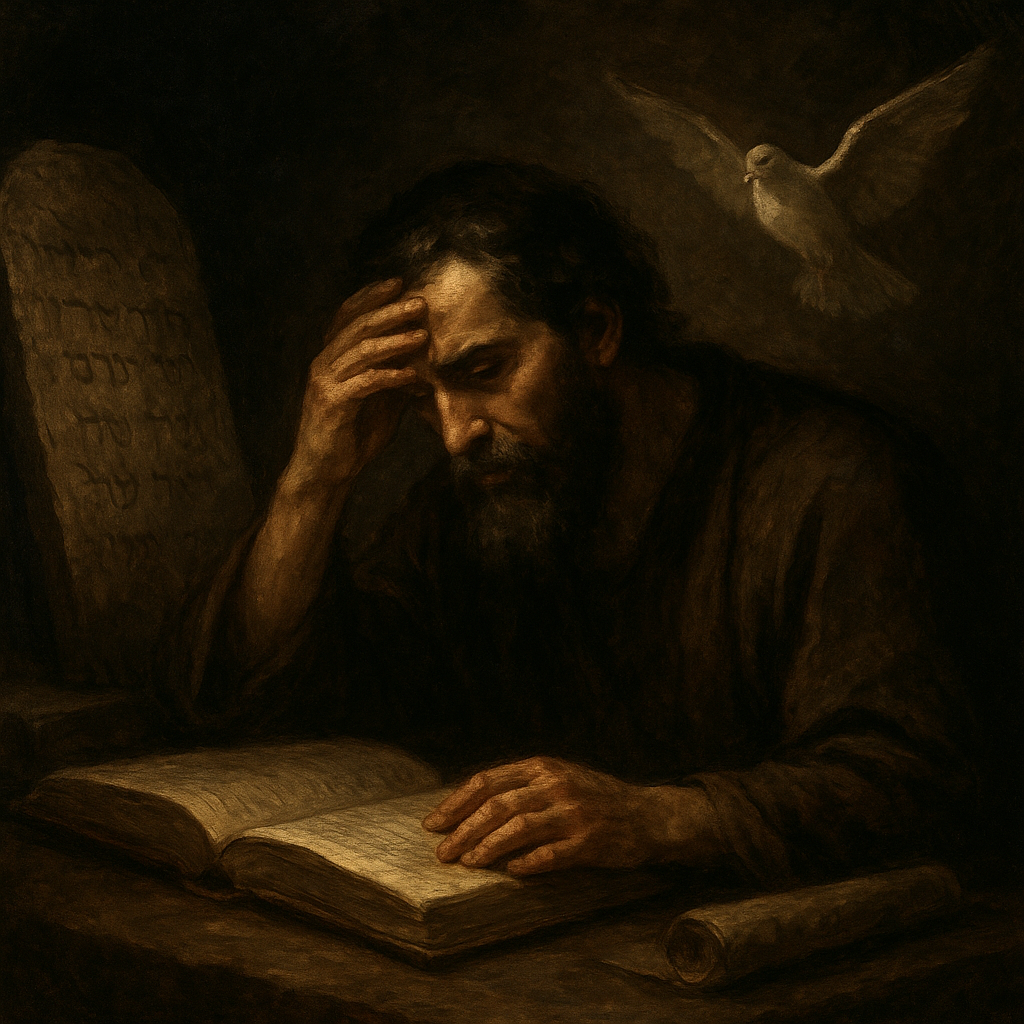
The word “Trinity” never appears in Scripture, but the Bible reveals one God who exists eternally as three persons—Father, Son, and Holy Spirit—through Old and New Testament teachings.
Trinity: The Christian teaching that there is one God who exists eternally as three distinct persons, the Father, the Son, and the Holy Spirit, who share one divine essence.
Elohim: The most common Hebrew word for God in the Old Testament. It is plural in form but is used with singular verbs when it refers to the true God.
Theophany: From the Greek theos, “God,” and phaino, “to appear.” A visible appearance of God, especially of the Son before His incarnation.
Comma Johanneum: The words in 1 John 5:7-8 that name the Father, the Word, and the Holy Ghost as three that bear record in heaven. They appear in the KJV but not in most modern translations.
Modalism: The teaching that God is one person who appears as Father, Son, and Spirit in turn. The church has rejected it since the third century.
Keywords: is the Trinity in the Bible, Trinity, one God three persons, Elohim, Genesis 1:26, 1 John 5:7, Comma Johanneum, Father Son and Holy Spirit, Godhead, theophany
The word “Trinity” does not appear in the Bible. The teaching does. Scripture declares that there is one God, and it shows three persons who are each God: the Father, the Son, and the Holy Spirit. The word Trinity is simply the name the church gave to what Scripture already teaches.
One God The Bible leaves no room for more than one God. Every Jew in Jesus’ day recited the Shema: “Hear, O Israel: The LORD our God is one LORD.” (Deuteronomy 6:4) Paul says the same in the New Testament: “For there is one God, and one mediator between God and men, the man Christ Jesus” (1 Timothy 2:5). Any teaching about the Trinity has to begin here. Christians do not worship three Gods.
Elohim: A Plural Word for One God “In the beginning God created the heaven and the earth.” (Genesis 1:1) The Hebrew word for God in this verse is Elohim. It appears about 2,600 times in the Old Testament. The word is plural in form. Yet in Genesis 1:1 the verb “created,” bara, is singular. A plural noun with a singular verb is unusual, and many theologians through the centuries have seen in it a hint of plurality within the one God. That hint is not proof on its own. Hebrew sometimes uses plural forms to express greatness, and Elohim can refer to a single false god, such as “Chemosh the god of the Moabites” (1 Kings 11:33). The plural name fits the Trinity well, but the stronger evidence comes from how God speaks.
“Let Us Make Man” God speaks of Himself in the plural several times in the Old Testament: “And God said, Let us make man in our image, after our likeness.” (Genesis 1:26) “Behold, the man is become as one of us.” (Genesis 3:22) “Whom shall I send, and who will go for us?” (Isaiah 6:8) “Us” and “our” refer to the Godhead. God is not speaking to angels. Angels did not create man, and man was not made in the image of angels. Genesis 1:27 says, “So God created man in his own image.” The “us” of verse 26 and the “his” of verse 27 describe the same Creator. The Holy Spirit is present at creation too: “And the Spirit of God moved upon the face of the waters” (Genesis 1:2). The Son is there as well: “All things were made by him” (John 1:3), and “by him were all things created, that are in heaven, and that are in earth” (Colossians 1:16).
The Father Plans, the Son Performs, the Spirit Gives Life Within the unity of the Godhead, each person has a role. The Father wills and plans. The Son carries out the work. The Holy Spirit brings it to life and makes it manifest. Gregory of Nyssa put it this way in the fourth century: every work of God begins with the Father, goes forth through the Son, and is completed in the Holy Spirit. You can see this in the creation of man. “And the LORD God formed man of the dust of the ground, and breathed into his nostrils the breath of life; and man became a living soul” (Genesis 2:7). The Father planned man. I believe the Son, through whom all things were made, formed Adam from the dust, and He is the LORD God who walked in the garden in the cool of the day (Genesis 3:8). Elihu says, “The Spirit of God hath made me, and the breath of the Almighty hath given me life” (Job 33:4).
The Son Seen in the Old Testament A theophany is a visible appearance of God. The word comes from the Greek theos, “God,” and phaino, “to appear.” Many of the Old Testament theophanies are appearances of the Son before He took on flesh, often as the angel of the LORD. The angel of the LORD appeared to Moses in the burning bush and said, “I am the God of thy father, the God of Abraham, the God of Isaac, and the God of Jacob” (Exodus 3:6). He told Moses to take off his shoes because the ground was holy. When Moses asked His name, God answered, “I AM THAT I AM” (Exodus 3:14). Centuries later, Jesus said, “Before Abraham was, I am” (John 8:58). The crowd picked up stones to kill Him. They understood He was claiming to be the God of the burning bush. The Son has always existed and always will. “In the beginning was the Word, and the Word was with God, and the Word was God” (John 1:1).
All Three at the Jordan The clearest scene of the Trinity in the Gospels is the baptism of Jesus: “And Jesus, when he was baptized, went up straightway out of the water: and, lo, the heavens were opened unto him, and he saw the Spirit of God descending like a dove, and lighting upon him: And lo a voice from heaven, saying, This is my beloved Son, in whom I am well pleased.” (Matthew 3:16-17) The Son comes up out of the water. The Spirit descends on Him like a dove. The Father speaks from heaven. All three persons are present at once, each doing something different. This one scene rules out the idea that God is one person who changes roles, because all three are there together. Jesus sent His disciples out to baptize “in the name of the Father, and of the Son, and of the Holy Ghost” (Matthew 28:19). Notice the word “name,” singular, followed by three persons. Paul closed a letter with the same three: “The grace of the Lord Jesus Christ, and the love of God, and the communion of the Holy Ghost, be with you all” (2 Corinthians 13:14).
Equal in Nature, Ordered in Role The Father, the Son, and the Holy Spirit are coequal and coeternal. None is greater than the others in being. All three share one divine nature, equal in power, glory, and authority. Scripture also shows an order in how they work. The Father sends the Son. The Son does the Father’s will. The Father and the Son send the Spirit. Theologians call this order in role, not inequality in nature. A son can obey his father and still be every bit as human as his father. In the same way, the Son submits to the Father’s will and is every bit as much God.
One Being, Three Persons Here is where people often go wrong. The Trinity does not mean God is one person with three names. It does not mean three separate Gods. It means one divine being, one essence, who exists as three distinct persons. The Athanasian Creed, a Latin creed from the fifth or sixth century, states it carefully: “we worship one God in Trinity, and Trinity in Unity; neither confounding the Persons, nor dividing the Substance.” To confound the persons is to merge them into one person. To divide the substance is to make three Gods. The truth lies between those two errors. You will not fully understand the Godhead. No human can. You can believe what Scripture reveals: one God in essence, three persons in relationship.
The Sun, Its Light, and Its Heat Theologians have used many pictures for the Trinity. One of the best is the sun. The sun, its light, and its heat all exist together at the same time. You cannot have the sun without its light or without its heat, and none of the three is the sun by itself, yet all three are fully present in every sunbeam. No illustration fully captures the Trinity, since nothing else in creation is three persons sharing one essence. This one avoids a trap that other illustrations fall into. It does not suggest that God is one person who simply changes form. The Father, Son, and Holy Spirit are three distinct persons who exist together, not three modes God wears in turn.
The Spirit of His Son in Your Heart “And because ye are sons, God hath sent forth the Spirit of his Son into your hearts, crying, Abba, Father.” (Galatians 4:6) All three persons are in this one verse. God the Father sends. The Spirit is sent, and He is called “the Spirit of his Son.” The Spirit then cries out to the Father from inside the believer. The Holy Spirit is called the Spirit of God and the Spirit of Christ (Romans 8:9), yet He is His own person who cries, prays, and intercedes. That is how the Trinity touches your life. The Father adopts you. The Son redeems you. The Spirit lives in you and teaches you to call God “Father.”
The Word “Trinity” in Church History The doctrine of the Trinity did not begin as a reaction to Arius. Christians baptized in the name of the Father, Son, and Holy Spirit from the start. Around AD 180, Theophilus of Antioch used the Greek word trias for God, His Word, and His Wisdom. Around 213, Tertullian became the first known writer to use the Latin trinitas, and he described God as one substance in three persons. Around 250, Cyprian of Carthage wrote of the Father, Son, and Holy Spirit, “And these three are one.” When Arius began teaching around 318 that the Son was created, the church defended what it already believed. The Council of Nicaea in 325 affirmed the full deity of the Son. The Council of Constantinople in 381 affirmed the full deity of the Holy Spirit. Philip Schaff’s History of the Christian Church traces this whole development in detail.
What About 1 John 5? The King James Version reads: “For there are three that bear record in heaven, the Father, the Word, and the Holy Ghost: and these three are one. And there are three that bear witness in earth, the spirit, and the water, and the blood: and these three agree in one.” (1 John 5:7-8) Most modern Bibles leave out the words about the Father, the Word, and the Holy Ghost, or add a footnote saying they are not in the earliest manuscripts. Scholars call this passage the Comma Johanneum. Here are the facts on both sides. The case for the verse: Cyprian quoted “these three are one” of the Father, Son, and Spirit around AD 250. Priscillian quoted the full words in Latin around 380. In 484, African bishops cited the verse in a confession of faith presented at Carthage. The verse is in the Latin Bible tradition. Some also point to the grammar of verse 8, where the Greek word for “three” is masculine while spirit, water, and blood are not. They argue the sentence reads more naturally with verse 7 in place. The case against the verse: The words do not appear in any Greek manuscript earlier than about the tenth century, and then only in a handful of late copies, several of them written in the margin. Codex Vaticanus and Codex Sinaiticus, both from the fourth century, lack them. Greek writers during the Arian controversy never quoted them, though the verse would have been a powerful weapon. Erasmus left the words out of the first two editions of his Greek New Testament, in 1516 and 1519. He added them to his third edition in 1522 after a Greek manuscript containing them was produced. The King James translators worked mainly from later Greek editions by Stephanus and Beza, which descend from Erasmus and include the verse. In 1881, Westcott and Hort published a Greek text that relied most heavily on Vaticanus and Sinaiticus, and most modern translations follow their approach. Sincere believers land on both sides of this question. The doctrine of the Trinity does not stand or fall with it. Matthew 3, Matthew 28:19, 2 Corinthians 13:14, John 1, and Galatians 4:6 teach the same truth, and every one of them is in every manuscript tradition.
Groups That Deny the Trinity Several groups reject the historic teaching of the Trinity: The Church of Jesus Christ of Latter-day Saints teaches that the Father, Son, and Holy Ghost are three separate beings, one in purpose. Jehovah’s Witnesses teach that Jesus is a created being and that the Holy Spirit is God’s active force, not a person. Oneness Pentecostals teach that God is one person who manifests Himself as Father, Son, and Spirit. Herbert W. Armstrong’s Worldwide Church of God taught that God is a family, now made up of the Father and the Son, into which believers will one day be born, and that the Spirit is a power rather than a person. After Armstrong’s death, the church itself renounced those teachings and affirmed the Trinity in the 1990s. Other movements, including the Unification Church and Unity, also reject the Trinity. Each of these groups either denies that Jesus is fully God, denies that the Spirit is a person, or merges the three persons into one. Scripture requires all three truths together.
The Trinity and Your Faith If Jesus is not God, He cannot save you. If the Spirit is not God, He cannot make you new. If the Father, Son, and Spirit are only one person in different masks, then the Son never truly prayed to the Father, and the Father never truly sent the Son. The gospel depends on the Trinity. You do not have to understand everything about God to believe what He has revealed. Read Matthew 3:13-17, John 14:16-17, and Galatians 4:4-6 together in one sitting. Watch how the Father, the Son, and the Spirit each work for your salvation.
Related reading Did Jesus Claim to Be God?, What Is the Nicene Creed?, and Who Was Tertullian?
About the Author CK Quarterman is a USAF veteran, independent author, and publisher at CKQbooks. He writes the Malaterrestrials nonfiction series, which examines evil earthbound non-human intelligences through Scripture and history, along with the Watchers’ Universe and Sons of the Flood fiction series. Find his books at ckqbooks.com. Truth · History · Scripture
Topics
Keep researching. Don't miss what's uncovered next.
Get first access to new Encyclopedia entries, Timeline updates, Watchers, Nephilim, Giants, Demons, Deliverance, and UFO/UAP research, plus new books and releases from CKQBooks. Free. Takes ten seconds.