
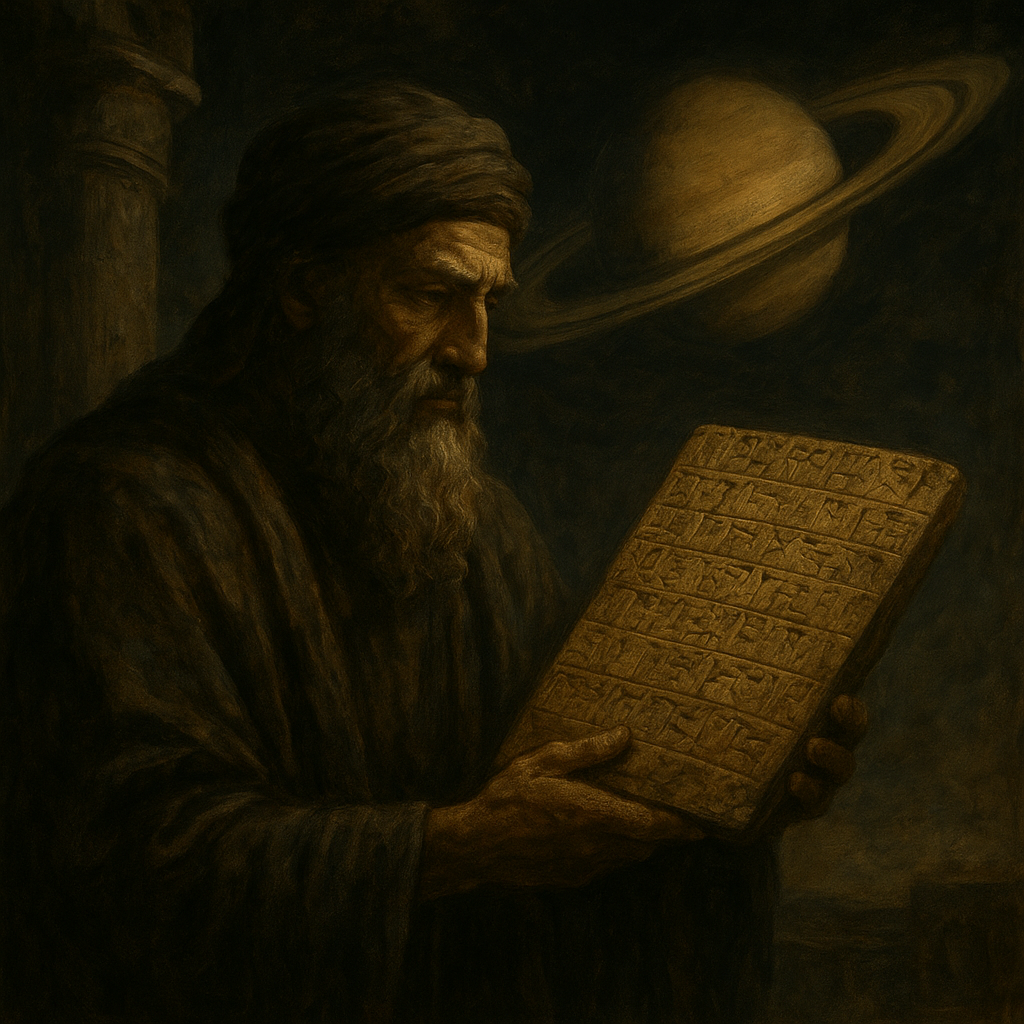
A viral video claims a Sumerian tablet describes what Saturn broadcasts and what its rings contain. Here is what the real Sumerian record says about Saturn, and why the claim cannot be true.
No such tablet exists. The claim comes from a recent YouTube video, not an excavation, and it describes technology and observations no Sumerian could have had access to.
The Claim I Keep Seeing
A video making the rounds claims an ancient Sumerian tablet describes what Saturn broadcasts and what its rings contain, along with effects on human beings. It traces to a YouTube channel, not a museum, a journal, or an excavation report. That alone is worth noticing before we get to the content.
What Sumerians Actually Recorded About Saturn
Sumerians and Babylonians tracked Saturn and gave it a name: Kajamanu, meaning "the constant," a reference to its slow, steady movement across the sky. They linked it to the god Ninurta. This is real, documented astronomy, preserved in cuneiform and cataloged by Assyriologists. It is also the full extent of what the record shows. Nothing in the Sumerian or Babylonian corpus describes broadcasting, ring contents, or effects on human biology.
Why the Rings Claim Cannot Be True
Saturn's rings are not visible to the naked eye. Galileo was the first person to observe them at all, in 1610, using a telescope, and even then he could not identify what he was seeing. He recorded two blobs beside the planet and was confused a few years later when they seemed to disappear, which happens when the rings turn edge-on to Earth. The rings were not correctly identified as rings until Christiaan Huygens did it in 1655, with a better telescope.
Sumer had collapsed as a civilization roughly 4,000 years before that. No naked-eye observer in ancient Mesopotamia could have seen Saturn's rings, because the rings are not visible from Earth without magnification, under any conditions. A tablet describing their contents would require equipment that did not exist yet, pointed at something no one on Earth could see without it.
The Word "Broadcasts" Is the Tell
Broadcasting is a twentieth-century radio term. Sumerian religious and astronomical texts describe gods, omens, and the movements of celestial bodies as signs to be read, not signals being transmitted. Projecting a modern electromagnetic concept onto a Bronze Age culture, then claiming they wrote about it, runs the wrong direction. It takes a modern idea and dresses it in ancient language. It does not recover an ancient idea.
How to Spot This Genre
This claim fits a specific, identifiable pattern: AI-narrated channels that invent a tablet, attach a modern-sounding revelation to it, and never name a museum collection, an excavation site, a catalog number, or a publishing scholar. Real Sumerian tablets are cataloged and searchable through resources like the Cuneiform Digital Library Initiative and the British Museum's collection. A genuine claim points to a specific tablet, the way scholars point to the Enuma Anu Enlil series for real Babylonian astronomical omens. This claim points to nothing, because there is nothing to point to.
What This Means for How You Read Ancient Astronomy Claims
Sumerian and Babylonian astronomy is genuinely impressive on its own terms. They tracked planetary motion with real precision and built a working omen system around it centuries before Greek astronomy existed. That achievement does not need embellishment, and dressing it up with modern technology it never had actually cheapens what they really accomplished. Check for a catalog number before you repeat a tablet claim. If there is not one, there is probably not a tablet.
CK Quarterman. C. K. Quarterman is a USAF veteran, independent author, and publisher at CKQbooks (ckqbooks.com). He writes on the malaterrestrials concept, biblical mysteries, and ancient history. Truth · History · Scripture.
Keep researching. Don't miss what's uncovered next.
Get first access to new Encyclopedia entries, Timeline updates, Watchers, Nephilim, Giants, Demons, Deliverance, and UFO/UAP research, plus new books and releases from CKQBooks. Free. Takes ten seconds.