
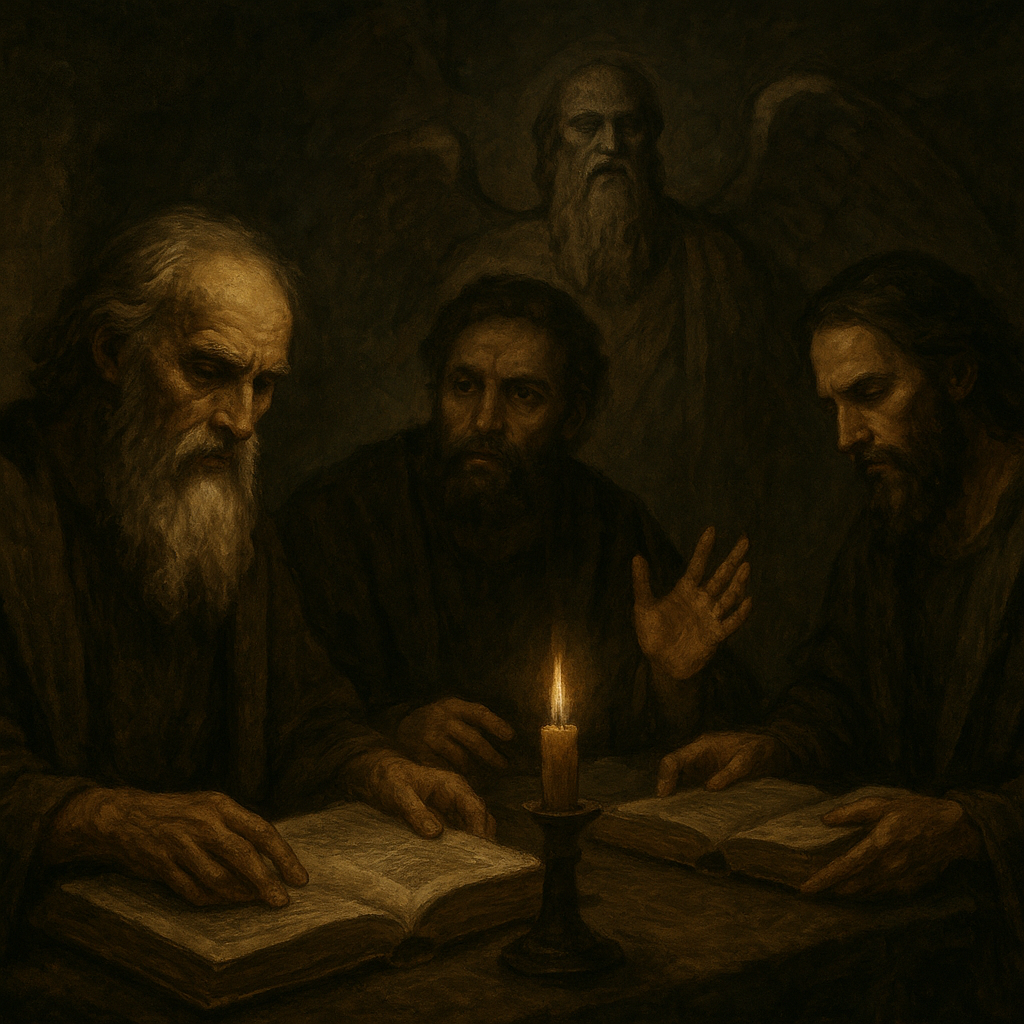
Discover how apostles Jude and Peter directly cite the Book of Enoch, linking New Testament passages to the ancient Watcher and Nephilim narrative.
The Book of Enoch is often dismissed as fringe literature with no real connection to scripture. That dismissal doesn't survive contact with the New Testament itself. Two apostles, Jude and Peter, drew directly from Enoch's account of the Watchers, and one of them names the book outright and calls it prophecy.
Jude Names Enoch and Calls Him a Prophet
Jude's epistle contains the most direct citation of Enoch anywhere in the New Testament:
"And Enoch also, the seventh from Adam, prophesied of these, saying, Behold, the Lord cometh with ten thousands of his saints, To execute judgment upon all, and to convict all that are ungodly among them of all their ungodly deeds which they have ungodly committed, and of all their hard speeches which ungodly sinners have spoken against him." (Jude 1:14-15)
This is a quotation of 1 Enoch 1:9, attributed by name, and labeled prophecy. Jude isn't alluding to a vague tradition. He's citing a specific book his readers were expected to recognize, treating it as an authoritative source worth quoting the same way he might quote Isaiah.
A few verses earlier, Jude references the Watchers directly without naming his source, because he assumes his readers already know it:
"And the angels which kept not their first estate, but left their own habitation, he hath reserved in everlasting chains under darkness unto the judgment of the great day." (Jude 1:6)
"Kept not their first estate" and "left their own habitation" compress Enoch's Watcher narrative, chapters 10 and 14 in particular, into a single sentence. Jude doesn't need to explain who these angels are or why they're bound. His audience already has the background from Enoch.
Peter Borrows a Word That Appears Nowhere Else
Peter covers the same ground from a different angle:
"For if God spared not the angels that sinned, but cast them down to hell, and delivered them into chains of darkness, to be reserved unto judgment." (2 Peter 2:4)
The phrase “cast down to hell” translates the Greek word tartaroo, borrowed from Greek myth to describe Tartarus, a specific prison beneath Hades reserved for imprisoned beings. This word appears exactly once in the entire New Testament, right here. Peter isn't reaching for a generic term for punishment. He's naming a specific holding place for a specific category of fallen angel, and that detail matches Enoch's description of the Watchers bound and held for a future judgment, not simply condemned to hell in the ordinary sense.
Peter returns to the same territory in his first epistle:
"By which also he went and preached unto the spirits in prison; Which sometime were disobedient, when once the longsuffering of God waited in the days of Noah." (1 Peter 3:19-20)
Peter doesn't explain who these imprisoned spirits are or why they're tied specifically to Noah's generation. He assumes the reader already knows, and the only text supplying that context is Enoch's account of the Watchers being imprisoned before the flood.
The Root Goes Back to Genesis
None of this is disconnected from the Old Testament. Genesis 6:1-4 is the seed account: the sons of God, the daughters of men, and the Nephilim born from that union. Enoch expands the story; it doesn't invent it. Numbers 13:33 confirms the Nephilim as a real category later spies use as a point of comparison, which tells you this wasn't treated as myth by the biblical writers who came after Genesis.
What This Means
None of this makes the case that Enoch belongs in the biblical canon. That's a separate argument with its own history. What it does establish is narrower and harder to dismiss: Enoch was read, respected, and treated as a real source by the men who wrote the New Testament. Jude quotes it as prophecy. Peter borrows its vocabulary for a specific theological point. Both authors write as if their readers already know the content.
That's the case for taking Enoch seriously as background material, whatever position you land on regarding its canonicity. The early church didn't treat it as fringe. Neither should modern readers trying to understand what the apostles actually believed about the Watchers, the Nephilim, and the beings behind them.
Related reading: why Jesus's teaching on angels and marriage in Matthew 22:29-30 assumes the doctrine spelled out in 1 Enoch 15.
CK Quarterman. CK Quarterman is a USAF veteran, author, and researcher who publishes under the CKQbooks imprint at ckqbooks.com. He developed the Malaterrestrials concept, a term for the evil earthbound non-human intelligences he connects to UFO reports. Truth · History · Scripture.
Keep researching. Don't miss what's uncovered next.
Get first access to new Encyclopedia entries, Timeline updates, Watchers, Nephilim, Giants, Demons, Deliverance, and UFO/UAP research, plus new books and releases from CKQBooks. Free. Takes ten seconds.