
Explore the Hebrew meaning of “sin lieth at the door” in Genesis 4:7, seeing it as a sin offering that God offered Cain before the Mosaic Law.
What Did God Mean When He Told Cain, “Sin Lieth at the Door”?
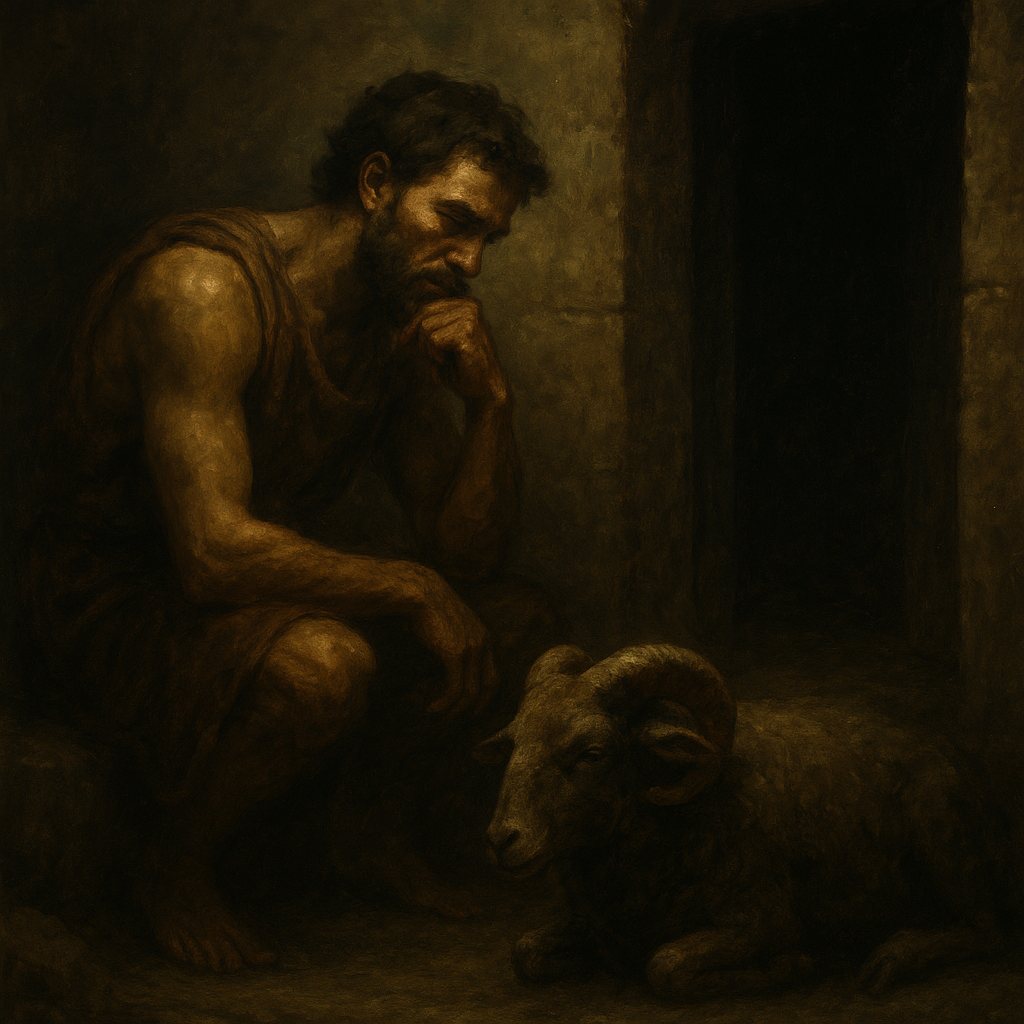
God may have been telling Cain that a sin offering was lying at the door, ready for him to take. The Hebrew word for “sin” in Genesis 4:7 is chatta’t, and the Bible uses that same word for “sin offering” many times. Read that way, God was offering Cain a way to be accepted after his failed offering. Cain refused it.
Cain, Abel, and Two Offerings
“And in process of time it came to pass, that Cain brought of the fruit of the ground an offering unto the LORD. And Abel, he also brought of the firstlings of his flock and of the fat thereof. And the LORD had respect unto Abel and to his offering: But unto Cain and to his offering he had not respect. And Cain was very wroth, and his countenance fell.” (Genesis 4:3-5)
Then God spoke to Cain directly:
“Why art thou wroth? and why is thy countenance fallen? If thou doest well, shalt thou not be accepted? and if thou doest not well, sin lieth at the door. And unto thee shall be his desire, and thou shalt rule over him.” (Genesis 4:6-7)
This is one of the hardest verses in Genesis. What is lying at the door, and whose desire is toward Cain?
Sin, or a Sin Offering?
The Hebrew word chatta’t can mean either sin or the sacrifice for sin. In Exodus 29:14, the priests burn the bullock’s flesh outside the camp, and the KJV says, “it is a sin offering.” The Hebrew word there is chatta’t. The same is true in Leviticus 4:3 and many other places.
The word “lieth” is rabats. The Bible uses it for animals lying down. Genesis 29:2 describes “three flocks of sheep lying by” a well, using that same word.
There is also a grammar clue. Chatta’t is a feminine noun, but “lieth” is masculine, and so are “his desire” and “rule over him.” A male animal fits that grammar well. E. W. Bullinger’s Companion Bible reads the verse this way. A sin offering lay at the door, and Cain could have taken it and offered it, but he chose not to. Bullinger was not the first. John Lightfoot proposed this reading in the 1600s, and Adam Clarke defended it in his commentary. Young’s Literal Translation renders the verse, “at the opening a sin-offering is crouching.”
The Other Reading
Most modern translations take the verse differently. They picture sin as a predator crouching at Cain’s door, wanting to master him. Supporters of that view point to Genesis 3:16, where God tells Eve, “thy desire shall be to thy husband, and he shall rule over thee.” Genesis 4:7 uses the same two Hebrew words for “desire” and “rule.”
Both readings are held by serious Bible teachers. You can weigh them for yourself. The sin offering reading explains why God would speak so gently to Cain and why He spoke of acceptance.
Sacrifice Before Moses
Whichever way you read Genesis 4:7, the rest of Scripture shows that God required blood sacrifice long before Mount Sinai.
After Adam and Eve sinned, “unto Adam also and to his wife did the LORD God make coats of skins, and clothed them” (Genesis 3:21). An animal died to cover them. God shed the first blood in the Bible.
Hebrews explains why Abel’s offering was accepted:
“By faith Abel offered unto God a more excellent sacrifice than Cain, by which he obtained witness that he was righteous.” (Hebrews 11:4)
Faith comes by hearing God’s word (Romans 10:17). Abel offered by faith, so God must have told him what to bring. Abel brought a lamb and its blood. Cain brought the work of his own hands. First John 3:12 says Cain’s works were evil and his brother’s were righteous.
The Lamb Slain From the Foundation of the World
Every animal sacrifice in Genesis pointed forward to Christ. Scripture says God planned the cross before creation:
“But with the precious blood of Christ, as of a lamb without blemish and without spot: Who verily was foreordained before the foundation of the world.” (1 Peter 1:19-20)
“The Lamb slain from the foundation of the world.” (Revelation 13:8)
Cain did not know the name of Jesus. He did know that God required blood, and God stood ready to accept him. The provision for sin came before the Law of Moses and before the tabernacle. It came before Abraham. It was in place from the first chapters of Genesis.
What This Means for You
God did not reject Cain and walk away. He asked Cain questions. He told him acceptance was still possible. Cain chose his own way, and his anger ended in murder.
The same offer stands before you. You do not have to earn God’s acceptance with your own work. The sacrifice for sin has already been made. Read Genesis 4 and Hebrews 11 side by side this week, and ask whether you are coming to God the way Abel did or the way Cain did.
About the Author
CK Quarterman is a USAF veteran, independent author, and publisher at CKQbooks. He writes the Malaterrestrials nonfiction series, which examines evil earthbound non-human intelligences through Scripture and history, along with the Watchers’ Universe and Sons of the Flood fiction series. Find his books at ckqbooks.com.
Truth · History · Scripture
Topics
Keep researching. Don't miss what's uncovered next.
Get first access to new Encyclopedia entries, Timeline updates, Watchers, Nephilim, Giants, Demons, Deliverance, and UFO/UAP research, plus new books and releases from CKQBooks. Free. Takes ten seconds.