
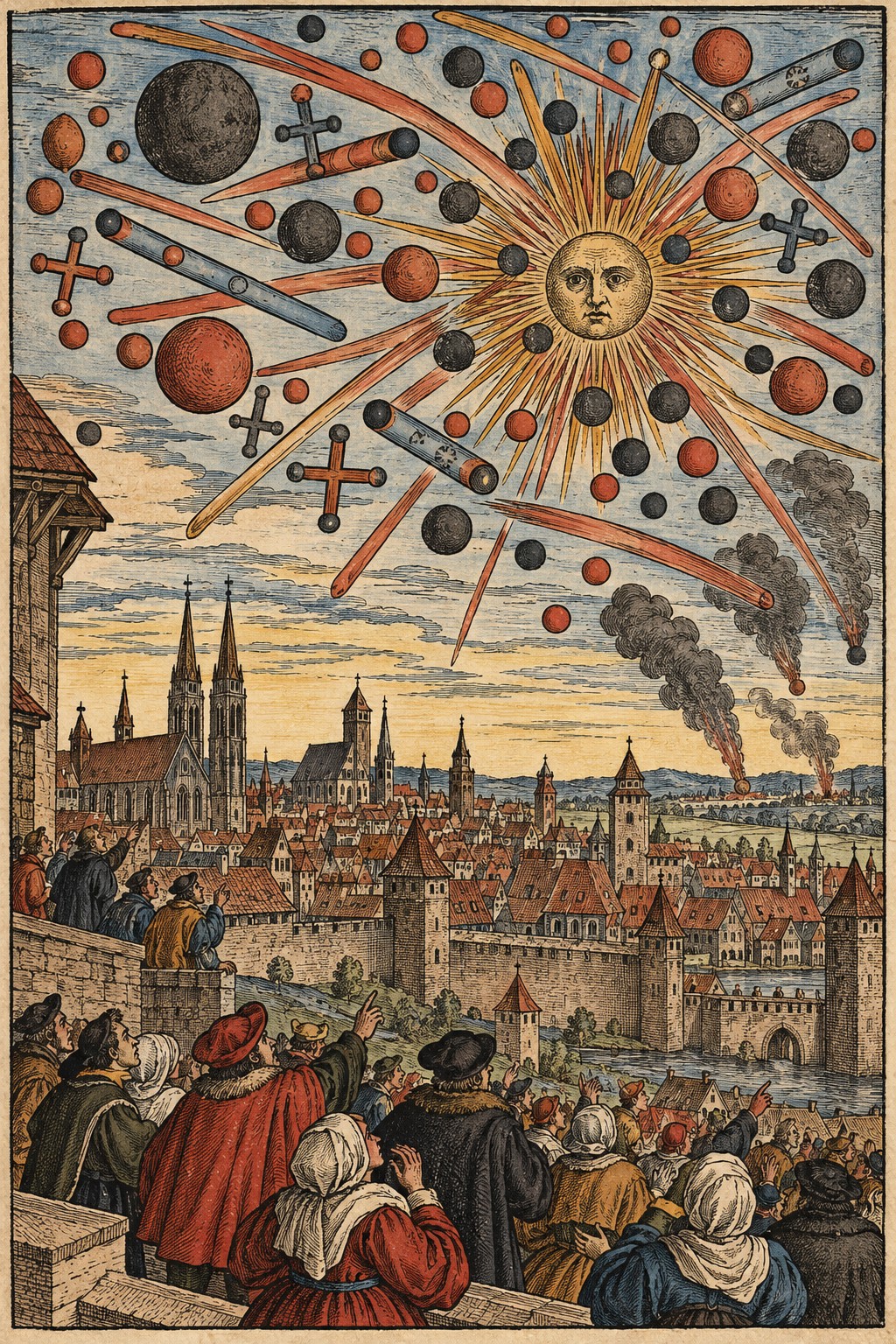
At dawn on April 14, 1561, many residents of Nuremberg, Germany, reported strange objects in the sky. A printer named Hans Glaser described them in a woodcut broadsheet.
Term: Broadsheet: a single printed sheet, often with a woodcut, that sold news, wonders, and moral warnings to the public in early modern Europe.
Term: Parhelion: an atmospheric optical effect, commonly called a sun dog, in which bright spots appear beside the sun.
Term: Hans Glaser: a Nuremberg printer, woodcutter, and letter painter who made the 1561 broadsheet.
What Happened at Nuremberg in 1561?
At dawn on April 14, 1561, many residents of Nuremberg, Germany, reported strange objects in the sky. A printer named Hans Glaser described them in a woodcut broadsheet. He wrote that globes, crosses, and rods fought around the sun for over an hour, then fell to earth in smoke. Skeptics think it was a halo display caused by ice crystals. No one has settled the question, and Glaser’s broadsheet is the main surviving record.
What the broadsheet says
Glaser says the sight occurred between 4 and 5 a.m., and that many men and women saw it, in the city, before the gates, and in the countryside. He describes two blood-red arcs like a last-quarter moon in the middle of the sun. Around the sun he sees dull and black globes, blood-red crosses, and rods, in groups of three in a line and four in a square.
The objects then fight. Globes fly out of the sun toward the ones outside, and globes outside fly into the sun. The battle lasts over an hour. When it is at its fiercest, the objects grow tired and fall from the sun to the earth as if burning, where they waste away with immense smoke. Afterward Glaser sees a very long, thick black spear, with its shaft pointing east and its point pointing west.
The original broadsheet is held by the Zentralbibliothek in Zurich. It measures about 26 by 38 centimeters. It went largely unmentioned in UFO writing until Carl Jung discussed it in his 1958 book on flying saucers.
How Glaser read it
Glaser did not call it a war between machines. He ended his text by saying only God knows what such signs mean. He called them signs sent to lead people to repentance, and he warned that those who mock them invite punishment. Broadsheets of that time mixed news with moral warning, and many printers saw celestial events as omens.
What retellings add
Modern retellings often describe hundreds of objects, tubes that release spheres, a black triangle, and crashed craft outside the city. The broadsheet does not say all of that. Its text speaks of globes, crosses, and rods, and its last object is a black spear. Some retellings also add scorched ground or animals refusing to eat grass. Those details do not appear in the printed text.
The natural explanation
Skeptics propose a display of parhelia, or sun dogs, and related halos. Ice crystals in the air can produce bright spots, arcs, crosses, and rings around the sun, and dawn is a common time for them. Some features, like the arcs and crosses, fit that explanation.
The idea has limits. The print does not match the classic pattern of a sun dog. A halo display also does not explain objects that fight, fall, and smoke. Researchers such as Jacques Vallée have been skeptical of a literal spacecraft reading, and Ulrich Magin has questioned whether the broadsheet works as objective reporting at all. The woodcut and text may have been shaped by the printer’s aims and by what readers expected to see.
Was there another case like it?
A broadsheet by Samuel Coccius describes an event at Basel, Switzerland, on August 7, 1566. It reports black spheres moving fast in the sky, colliding with each other, and turning fiery red. Like Nuremberg, it rests on one printed report.
What Nuremberg proves
It proves that a printer sold, and people bought, a report of a strange sight in 1561. It does not prove a spacecraft, and it does not prove a halo. A single printed source cannot settle what people saw.
In my book Disclosure: They Are Not Extraterrestrials, I present Nuremberg and Basel as very old reports of strange objects. Glaser called them signs and spiritual warnings, and that fits the pattern I describe in the book. I do not claim the woodcut proves my case. It shows that reports like these are older than airplanes. Disclosure is available on Amazon. You can find more of my work at ckqbooks.com.
Sources
Hans Glaser, broadsheet, April 1561, Zentralbibliothek Zürich (translation published by The Public Domain Review). Wikipedia, 1561 celestial phenomenon over Nuremberg. Carl Jung, Flying Saucers: A Modern Myth of Things Seen in the Skies (1958). Jacques Vallée, Passport to Magonia (1969).
CK Quarterman. CK Quarterman is a USAF veteran, independent author, and publisher at CKQbooks (ckqbooks.com). He writes nonfiction under the Malaterrestrials brand. The concept of malaterrestrials describes evil earthbound non-human intelligences, as distinct from the holy angels of heaven. Truth · History · Scripture.
Topics
Related CKQ Book

Disclosure
They Are Not Extraterrestrials
Keep researching. Don't miss what's uncovered next.
Get first access to new Encyclopedia entries, Timeline updates, Watchers, Nephilim, Giants, Demons, Deliverance, and UFO/UAP research, plus new books and releases from CKQBooks. Free. Takes ten seconds.