
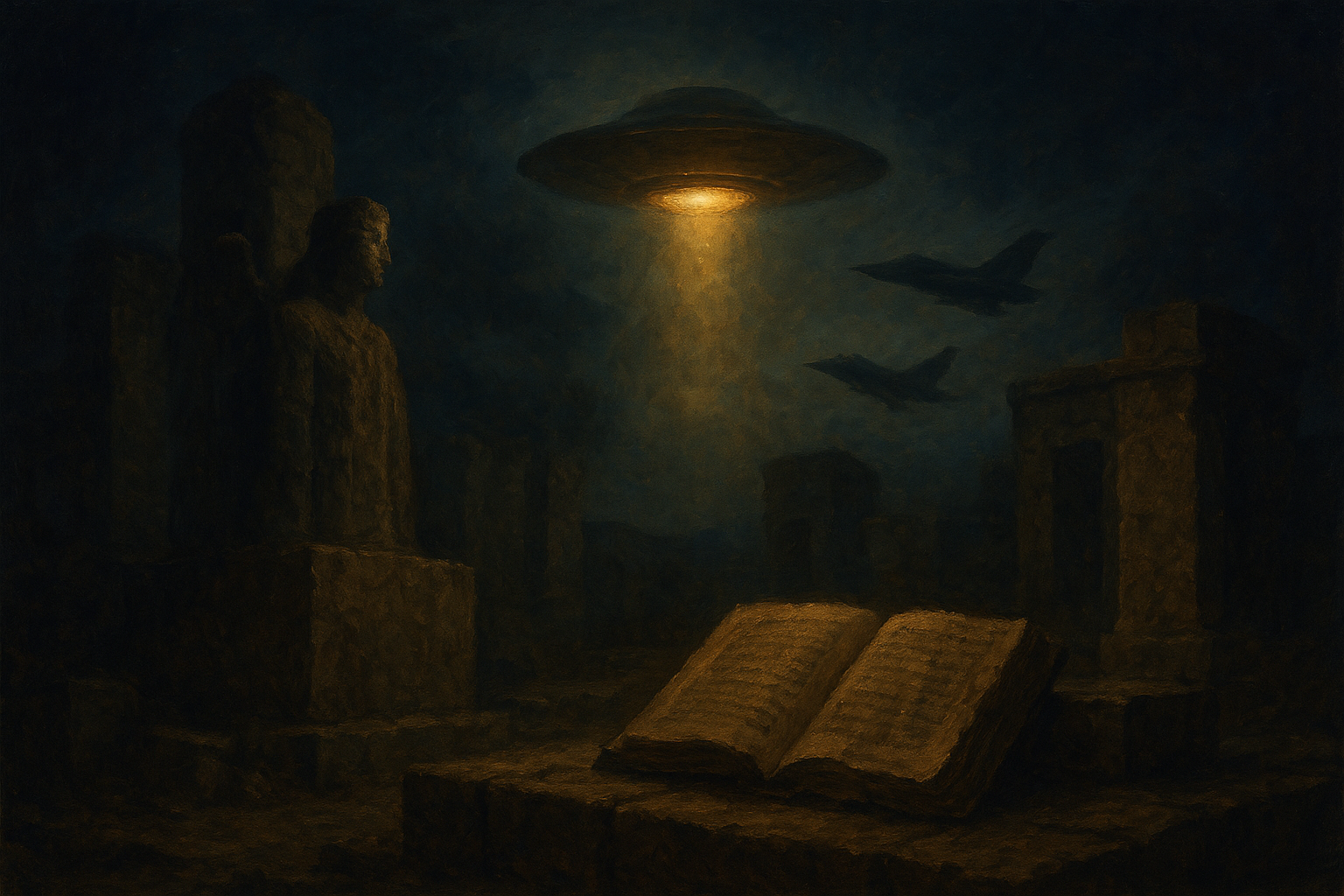
On the night of September 18 to 19, 1976, civilians in Tehran reported a bright object in the sky. The Iranian Air Force sent two F-4 fighters to investigate.
Term: F-4 Phantom II: a two-seat U.S.-built jet fighter flown by the Imperial Iranian Air Force in 1976.
Term: DIA: the Defense Intelligence Agency, the U.S. military intelligence agency that received the report.
Term: Defense attaché: a military officer assigned to a U.S. embassy who reports on the host country’s armed forces.
What Happened During the 1976 Tehran UFO Incident?
On the night of September 18 to 19, 1976, civilians in Tehran reported a bright object in the sky. The Iranian Air Force sent two F-4 fighters to investigate. The crews reported that instruments and communications failed as they approached the object, and that one jet lost its weapons controls when the pilot tried to fire a missile. Everything worked again when the jets pulled away. A U.S. intelligence report called it a classic case. Skeptics say the pilots chased the planet Jupiter and that the equipment problems had ordinary causes.
The sequence of events
According to the U.S. Defense Attaché report, callers in northern Tehran reported a bright, pulsating object. A senior Iranian officer reportedly saw it himself. The Iranian Air Force launched an F-4 from Shahrokhi Air Base. As that jet approached, its crew reported losing instrumentation and communications. The systems came back when the pilot turned away.
A second F-4 was launched. Its crew reported a radar return about the size of a large aircraft. They described a brightly lit object, and a smaller object that separated from it and moved toward them. The pilot tried to fire an AIM-9 missile at it. At that moment, the weapons panel and communications reportedly failed. A civilian airliner nearby also reported a radio failure. The report says another object descended toward the ground and lit up a wide area.
The U.S. report
The U.S. Defense Attaché in Tehran sent a report to the Defense Intelligence Agency, and an initial report went to the Joint Chiefs of Staff on September 19. The evaluation of the report called it an outstanding report and a classic case that meets the criteria for a valid study of the UFO phenomenon. The report was later released under the Freedom of Information Act.
That evaluation was of the report, not of the explanation. It said the case deserved study. It did not say what the object was.
The skeptical explanation
Philip Klass, a leading UFO skeptic, investigated the case in the late 1970s. He noted that Jupiter was very bright in the Tehran sky that night, and that the jets were sent north toward the direction of Jupiter. He argued that the crews began by chasing a bright star or planet, and that James Oberg, an aerospace writer, agreed that Jupiter was a likely source of the first light.
Klass also argued that the first F-4 was known for electrical problems and had been repaired about a month earlier. He said a technician at the base told him that only one jet reported failing equipment. Other investigators dispute parts of Klass’s account, including that point.
What remains unresolved
Skeptics must explain several things at once: two aircraft, a civilian airliner, ground witnesses, and radar. Supporters must explain why the raw radar data is missing. No definitive ordinary cause was ever established by Iranian or American authorities. Even Klass could say only that his explanation was likely.
The case is also old. The events happened in 1976, before modern recording systems, and the raw sensor data is not available to check today.
What Tehran shows
Tehran is one of the best-known cases of reported equipment interference near a UFO. It has trained military witnesses and an official U.S. intelligence report. It also has an unproven but plausible ordinary explanation. Both facts belong in the account.
In my book Disclosure: They Are Not Extraterrestrials, I mention Tehran among the cases where equipment reportedly failed near an object. The book’s argument is that this pattern appears in reports across many centuries. I do not claim Tehran proves it. Disclosure is available on Amazon. You can find more of my work at ckqbooks.com.
Sources
U.S. Defense Attaché report to the Defense Intelligence Agency, September 1976 (released under FOIA). Philip J. Klass, UFOs: The Public Deceived (1983). The Black Vault, The 1976 Iran Incident case file. Wikipedia, 1976 Tehran UFO incident.
CK Quarterman. CK Quarterman is a USAF veteran, independent author, and publisher at CKQbooks (ckqbooks.com). He writes nonfiction under the Malaterrestrials brand. The concept of malaterrestrials describes evil earthbound non-human intelligences, as distinct from the holy angels of heaven. Truth · History · Scripture.
Topics
Related CKQ Book

Disclosure
They Are Not Extraterrestrials
Keep researching. Don't miss what's uncovered next.
Get first access to new Encyclopedia entries, Timeline updates, Watchers, Nephilim, Giants, Demons, Deliverance, and UFO/UAP research, plus new books and releases from CKQBooks. Free. Takes ten seconds.