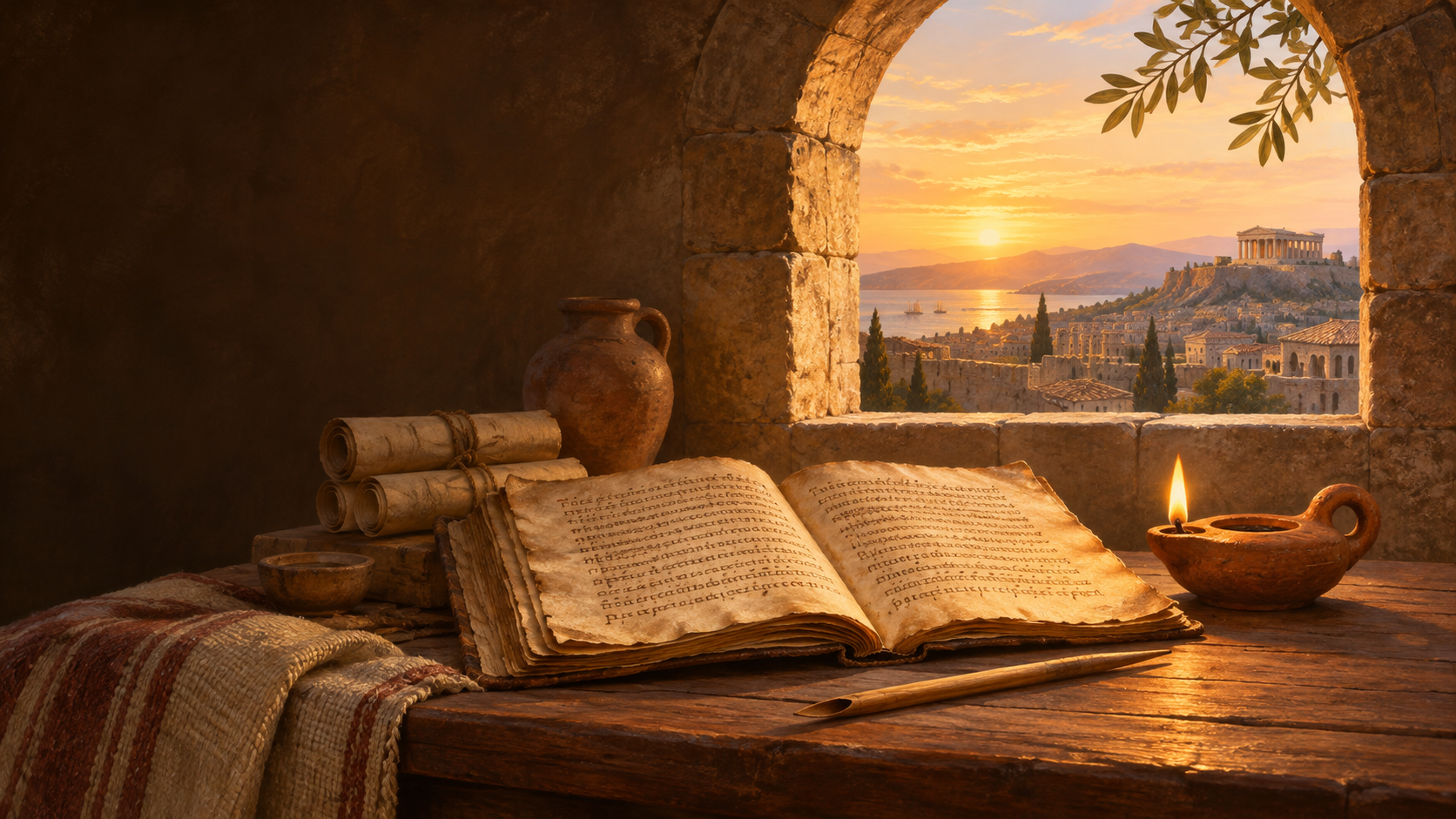
The Didache, also called The Teaching of the Twelve Apostles, is the earliest surviving Christian church manual, outlining moral teaching, baptism, prayer, and church leadership.
The Didache is a short early Christian handbook also known as The Teaching of the Twelve Apostles. No one knows who wrote it. Most scholars date it between AD 80 and 120, and some place parts of it even earlier. It likely comes from Syria or Palestine.
Early writers mentioned it, but the text itself was lost for centuries. In 1873 a Greek Orthodox metropolitan named Philotheos Bryennios found a copy in a manuscript dated 1056 in Constantinople. He published it in 1883.
Major Work: The Teaching of the Twelve Apostles
The Didache has 16 short chapters. It falls into four parts: moral teaching (chapters 1 through 6), worship practice (7 through 10), church life and leaders (11 through 15), and a closing warning about the last days (16).
It reads like instructions for new believers and the churches that received them. That is why many call it the earliest Christian catechism.
Christian Teaching and Moral Life
The book opens: “There are two ways, one of life and one of death, and there is a great difference between the two ways.” The way of life is to love God and love your neighbor. The Didache then quotes and expands on teachings from the Sermon on the Mount.
Its list of sins includes murder, adultery, theft, sorcery, and magic. Chapter 2 also forbids abortion and killing a newborn child. That is one of the earliest Christian statements on the subject.
Church Practice
Chapter 7 gives instructions for baptism in the name of the Father, the Son, and the Holy Spirit. Use running water if you can. If not, use other water, cold or warm. If you have neither in enough quantity, pour water on the head three times. Both the one baptizing and the one baptized should fast beforehand.
Chapter 8 tells believers to fast on Wednesdays and Fridays and to pray the Lord’s Prayer three times a day. Chapters 9 and 10 give thanksgiving prayers for the cup and bread, and only baptized believers may share the meal.
Testing Traveling Ministers
Chapters 11 through 13 give practical tests for traveling apostles and prophets. A true one may stay a day or two. If he stays three days, he is a false prophet. If he asks for money, he is a false prophet.
Chapter 15 tells churches to appoint bishops and deacons who are humble, not lovers of money, truthful, and tested.
How to Read the Didache Today
Read the whole Didache in about 20 to 25 minutes.
Compare chapter 1 with Matthew 5 through 7 and chapter 8 with Matthew 6:9 to 13.
Use Michael Holmes, The Apostolic Fathers, or the free Ante-Nicene Fathers, volume 7.
Use chapters 11 through 13 as a checklist when you evaluate teachers who ask for money.
About the Author
CK Quarterman is a USAF veteran, independent author, and publisher at CKQbooks. He writes the Malaterrestrials nonfiction series, which examines evil earthbound non-human intelligences through Scripture and history, along with the Watchers’ Universe and Sons of the Flood fiction series. Find his books at ckqbooks.com.
Truth · History · Scripture
Explore in the Encyclopedia
Gregory of Nazianzus
Gregory of Nazianzus (c. 329–390) was a Cappadocian bishop, preacher, and poet known as the Theologian, whose Five Theological Orations shaped Trinitarian doctrine.
Epistle of Barnabas
The Epistle of Barnabas is an anonymous early Christian letter, likely written between AD 70 and 130, that interprets the Old Testament as pointing to Christ and was highly valued by the early church yet excluded from the canon.
Cyril of Jerusalem
Cyril of Jerusalem (c. 313–386) was a fourth‑century bishop whose Catechetical Lectures provided the most complete record of early church instruction for new believers.
Clement of Rome
Clement of Rome (c. 35–99) was the third bishop of Rome and author of the early Christian letter First Clement, which addresses church unity, humility, and order.
Clement of Alexandria
Clement of Alexandria (c.150–215) was a Christian teacher in Alexandria who led the Catechetical School and authored the Protrepticus, Paedagogus, and Stromata, integrating faith with philosophy.
Basil the Great
Basil the Great (c.329–379), bishop of Caesarea, was a key defender of the Holy Spirit’s deity, a Trinitarian theologian, monastic rule author, and founder of the Basiliad public hospital.
Athanasius of Alexandria
Athanasius of Alexandria (c. 296–373) was the bishop of Alexandria who defended the deity of Christ against Arianism and authored key works such as On the Incarnation, Life of Antony, and Discourses Against the Arians.
Ambrose of Milan
Ambrose of Milan (c. 339–397) was a Roman governor who became bishop of Milan in a week, authored influential theological works, and mentored Augustine.
Augustine of Hippo
Augustine of Hippo: the fifth-century theologian whose rejection of the angelic reading in The City of God moved Western Christianity toward the Sethite view.
Keep researching. Don't miss what's uncovered next.
Get first access to new Encyclopedia entries, Timeline updates, Watchers, Nephilim, Giants, Demons, Deliverance, and UFO/UAP research, plus new books and releases from CKQBooks. Free. Takes ten seconds.