
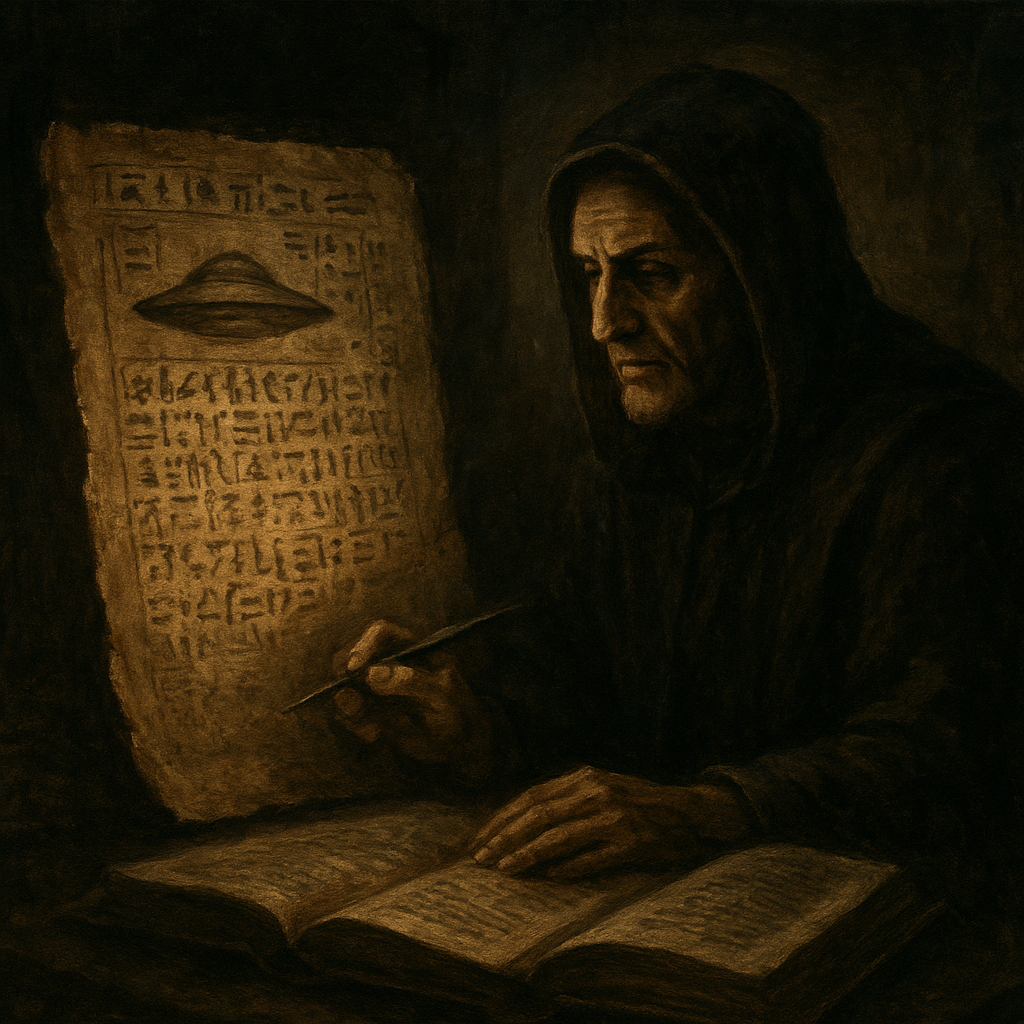
The Tulli Papyrus is one of the most cited pieces of ancient UFO evidence, and also one of the most contested. Alberto Tulli, director of the Egyptian section of the Vatican Museum, reportedly found it in a Cairo shop in 1933 and copied it.
Term: Tulli Papyrus: a document reportedly found in a Cairo antique shop in 1933 by Alberto Tulli, said to describe strange aerial phenomena during the reign of Thutmose III.
Term: Hieratic script: a cursive form of Egyptian writing used for everyday documents, distinct from formal hieroglyphics.
What Is the Tulli Papyrus?
The Tulli Papyrus is one of the most cited pieces of ancient UFO evidence, and also one of the most contested. Alberto Tulli, director of the Egyptian section of the Vatican Museum, reportedly found it in a Cairo shop in 1933 and copied it. A later translator said it described circles of fire in the sky around 1480 BC, during the reign of Thutmose III. Tulli's own successor at the Vatican suspected it was a fake, and other scholars who accept it as genuine read it as a meteor report, not a craft.
The discovery
Alberto Tulli said he found the document in an antique shop in Cairo in 1933. He did not purchase the original. Instead, he made a copy, which was later recopied by replacing the original hieratic script with hieroglyphics. The original document has never resurfaced and has never been independently examined.
The translation
Prince Boris de Rachewiltz later translated the copy and identified it as part of the annals of Pharaoh Thutmose III, describing circles of fire in the sky, roughly dated to 1480 BC. This translation is the source of the papyrus's fame in UFO literature.
The dispute
Tulli's own successor at the Vatican Museum, Gianfranco Nolli, suspected the papyrus was a fake. Egyptologist Etienne Drioton believed the document was genuine but read it as a description of a meteor, not a craft. Because the original was never independently examined, and because it survives only as a later copy of a copy, its authenticity cannot be settled either way with current evidence.
Why I include it with a caution
The Tulli Papyrus gets cited often in UFO literature as ancient evidence, so I address it directly rather than leaving readers to encounter stronger claims about it elsewhere. Even scholars who think it is a real ancient document do not agree that it describes a craft rather than a natural event.
What is solid and what is not
That a copy of a document with this description exists, and that reputable scholars disagree about its authenticity and meaning, is documented. Whether it describes anything unusual in the sky over ancient Egypt is not established. In my book Disclosure: They Are Not Extraterrestrials, I include it as a contested source and say so plainly. Disclosure is available on Amazon. You can find more of my work at ckqbooks.com.
Sources
de Rachewiltz, Boris, Translation of the Tulli Papyrus, cited in Thayer, Tiffany, Doubt: The Fortean Society Magazine (1953). Wikipedia, Tulli Papyrus. Leonard, R. Cedric, Translation of the Tulli Papyrus, cited in Ancient Origins, UFOs Over Ancient Egypt?
CK Quarterman. CK Quarterman is a USAF veteran, independent author, and publisher at CKQbooks (ckqbooks.com). He writes nonfiction under the Malaterrestrials brand. The concept of malaterrestrials describes evil earthbound non-human intelligences, as distinct from the holy angels of heaven. Truth · History · Scripture.
Topics
Related CKQ Book

Disclosure
They Are Not Extraterrestrials
Keep researching. Don't miss what's uncovered next.
Get first access to new Encyclopedia entries, Timeline updates, Watchers, Nephilim, Giants, Demons, Deliverance, and UFO/UAP research, plus new books and releases from CKQBooks. Free. Takes ten seconds.