
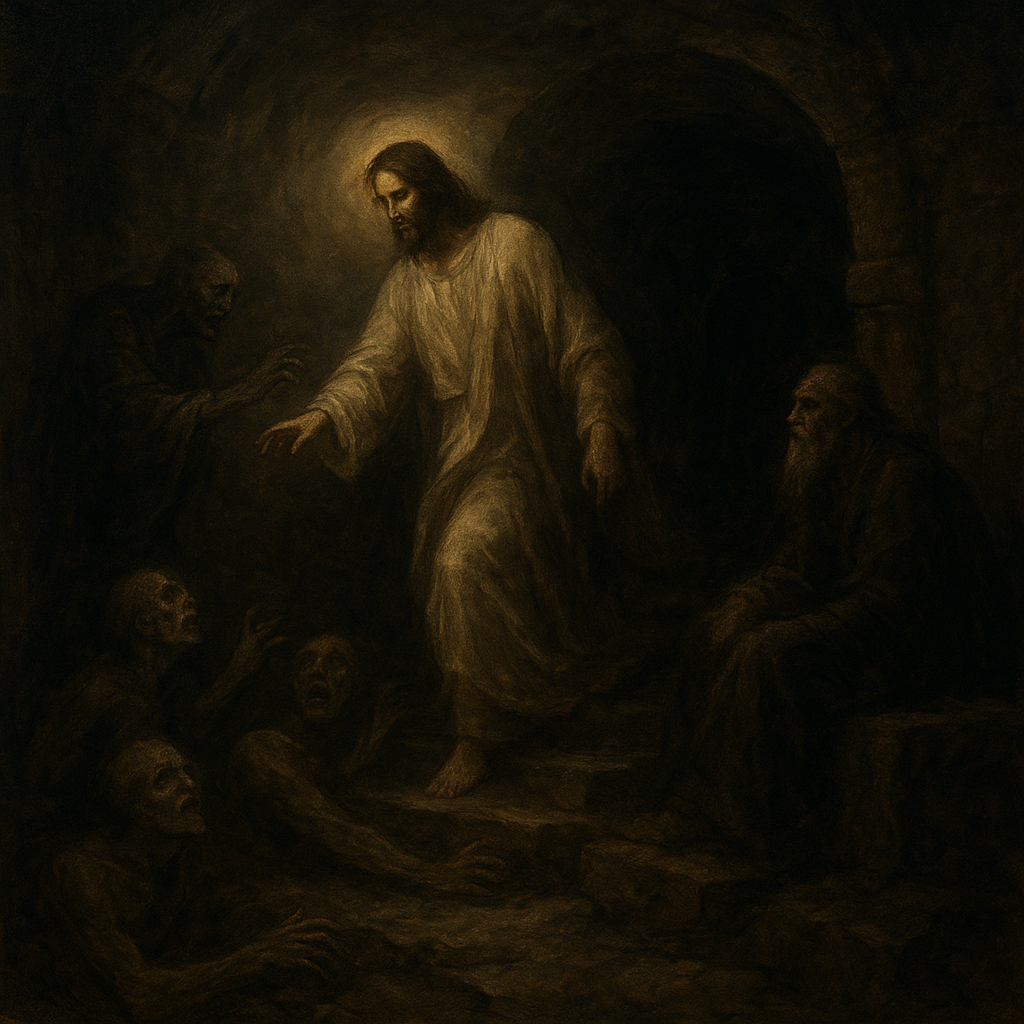
Explore why Jesus descended into Hades during the silent period between His crucifixion and resurrection, with Scripture from Acts, Matthew and Ephesians.
The Silent Period: The three days and three nights between Christ’s death on the cross and His resurrection, when His body lay in the tomb and His soul went into hades.
Hades: The Greek word for the realm of the dead, translated “hell” in Acts 2:27 and Luke 16:23. It matches the Hebrew word sheol in the Old Testament.
Gehenna: The Greek word Jesus used for the place of final punishment and unquenchable fire, also translated “hell” in the KJV.
Tartarus: The deepest prison of the underworld. Peter uses the word in 2 Peter 2:4 for the place where God holds the angels that sinned.
Substitutionary atonement: The teaching that Christ suffered and died in our place, taking the penalty for our sins on Himself.
Related fiction: the angels who sinned in the days of Noah are at the center of The Watchers’ War by CK Quarterman.
Where Did Jesus Go Between His Death and Resurrection?
Jesus went into hell. Peter says so plainly on the Day of Pentecost: Christ’s “soul was not left in hell, neither his flesh did see corruption” (Acts 2:31). His body lay in the tomb, but His soul descended into the realm of the dead. I call this the silent period. The Gospels say almost nothing about those three days, but the rest of Scripture says a great deal.
The Foundation: Acts 2:27-31
On the Day of Pentecost, Peter quoted Psalm 16 and applied it to Jesus:
“Because thou wilt not leave my soul in hell, neither wilt thou suffer thine Holy One to see corruption.” (Acts 2:27)
“He seeing this before spake of the resurrection of Christ, that his soul was not left in hell, neither his flesh did see corruption.” (Acts 2:31)
David wrote Psalm 16:10, but David died and stayed buried. Peter points out that David’s tomb was still in Jerusalem (Acts 2:29). So David was speaking as a prophet about Christ. God would not leave Christ’s soul in hell, and He would not let Christ’s body decay.
You cannot be left somewhere you never went. Peter’s words tell us Christ’s soul went into hell and came back out.
Three Days and Three Nights in the Heart of the Earth
Jesus gave the Pharisees one sign:
“For as Jonas was three days and three nights in the whale’s belly; so shall the Son of man be three days and three nights in the heart of the earth.” (Matthew 12:40)
Now listen to Jonah’s own prayer from inside the fish:
“Then Jonah prayed unto the LORD his God out of the fish’s belly, and said, I cried by reason of mine affliction unto the LORD, and he heard me; out of the belly of hell cried I, and thou heardest my voice.” (Jonah 2:1-2)
Jonah said he cried out of “the belly of hell.” The Hebrew word is sheol, the realm of the dead. Jesus chose Jonah as the picture of His own three days. Jonah went down to sheol and came back. Jesus went down into the heart of the earth and came back.
What Is Hell?
The English word “hell” in the KJV translates more than one word. Knowing the difference will help you read these passages clearly.
Hades is the realm of the dead. It is the word in Acts 2:27. Jesus described it in Luke 16:19-31. There the rich man was in torment, and the beggar Lazarus was carried by angels into “Abraham’s bosom,” a place of comfort. A great gulf separated them. Both men were conscious. They could see, speak, and remember. Hades is a real place.
Gehenna is the place of final judgment. Jesus used this word when He warned of being cast into hell (Matthew 5:30), of God destroying both soul and body in hell (Matthew 10:28), of the damnation of hell (Matthew 23:33), and of “the fire that never shall be quenched” (Mark 9:43). Revelation 20:14 says hades itself will one day be cast into the lake of fire.
Tartarus is the deepest prison. Peter writes that “God spared not the angels that sinned, but cast them down to hell,” using the Greek word tartaroo, “and delivered them into chains of darkness, to be reserved unto judgment” (2 Peter 2:4). He ties these angels to “the old world” and Noah in the next verse.
Abraham’s bosom was the resting place of the righteous dead before the cross. They waited there for the Messiah. Many believers, including me, understand that Christ brought them out when He rose, which Ephesians 4:8 calls leading “captivity captive.”
The Messianic Psalms
A Messianic Psalm speaks ahead of time about the suffering and reign of Christ. Peter showed us that Psalm 16 is one. I believe several of David’s other psalms also look ahead to Christ’s descent:
“The sorrows of hell compassed me about: the snares of death prevented me.” (Psalm 18:5)
“For great is thy mercy toward me: and thou hast delivered my soul from the lowest hell.” (Psalm 86:13)
“The sorrows of death compassed me, and the pains of hell gat hold upon me: I found trouble and sorrow.” (Psalm 116:3)
These psalms first describe David’s own brushes with death. Peter showed that David’s words in Psalm 16 reached beyond David to Christ. I read these psalms the same way. Christ went lower than David ever did.
Christ Descended to the Lower Parts of the Earth
Paul describes both directions of Christ’s journey:
“Wherefore he saith, When he ascended up on high, he led captivity captive, and gave gifts unto men. (Now that he ascended, what is it but that he also descended first into the lower parts of the earth? He that descended is the same also that ascended up far above all heavens, that he might fill all things.)” (Ephesians 4:8-10)
Before Christ rose above all heavens, He went down to the lowest place. Peter tells us what He did there:
“By which also he went and preached unto the spirits in prison; Which sometime were disobedient, when once the longsuffering of God waited in the days of Noah.” (1 Peter 3:19-20)
The word “preached” is the Greek kerusso. It means to proclaim like a herald. I believe these spirits are the angels that sinned in Noah’s day, the same angels Peter says are held in tartarus. Christ did not offer them salvation. He announced His victory to them.
Why Did Christ Descend?
Everything Christ did, He did for us and in our place. We call this substitutionary atonement. “For he hath made him to be sin for us, who knew no sin; that we might be made the righteousness of God in him” (2 Corinthians 5:21).
Christ took the sins of the world on Himself. He suffered what the Law required, and He was without sin, so He could offer Himself as the sacrifice. His descent was part of that suffering in our place. Death and hell could not hold Him. He came out holding “the keys of hell and of death” (Revelation 1:18).
How Other Christians Read These Passages
This is what I believe Scripture teaches. Devout believers have read some of these passages differently, and you should know their reasons.
Jesus told the thief, “To day shalt thou be with me in paradise” (Luke 23:43), and He said on the cross, “It is finished” (John 19:30). Some take these to mean His suffering ended at the cross and His soul went straight to paradise. Others answer that paradise was Abraham’s bosom, the comfort side of hades.
Some read “the lower parts of the earth” in Ephesians 4:9 as the earth itself, meaning Christ came down from heaven at His birth.
Some read 1 Peter 3:19 as Christ preaching through Noah to the people of Noah’s day, rather than to angels after the cross.
The belief that Christ descended is very old. The Apostles’ Creed, used in churches since the early centuries, says plainly, “He descended into hell.” Christians have long agreed that He went. They have disagreed about what He did there.
What Christ Purchased, He Now Gives
Christ’s work on the cross and in the grave is finished. He went to the lowest place and came out victorious. Ephesians 4:8 says that when He ascended, He “gave gifts unto men.” What He purchased in those three days, He now gives to His church through the Holy Spirit.
Read Acts 2, Ephesians 4, and 1 Peter 3 this week in one sitting. Notice how each passage moves from Christ’s descent to His victory, and from His victory to what He gives His people.
For real stories of how those gifts work today, read Gifts of the Spirit: Fifty Years of Prophecy, Healing, and Miracles by C. K. Quarterman.
About the Author
CK Quarterman is a USAF veteran, independent author, and publisher at CKQbooks. He writes the Malaterrestrials nonfiction series, which examines evil earthbound non-human intelligences through Scripture and history, along with the Watchers’ Universe and Sons of the Flood fiction series. Find his books at ckqbooks.com.
Truth · History · Scripture
CK Quarterman. CK Quarterman is a USAF veteran, independent author, and publisher at CKQbooks. He writes the Malaterrestrials nonfiction series, which examines evil earthbound non-human intelligences through Scripture and history, along with the Watchers’ Universe and Sons of the Flood fiction series. Find his books at ckqbooks.com. Truth · History · Scripture
Topics
Keep researching. Don't miss what's uncovered next.
Get first access to new Encyclopedia entries, Timeline updates, Watchers, Nephilim, Giants, Demons, Deliverance, and UFO/UAP research, plus new books and releases from CKQBooks. Free. Takes ten seconds.