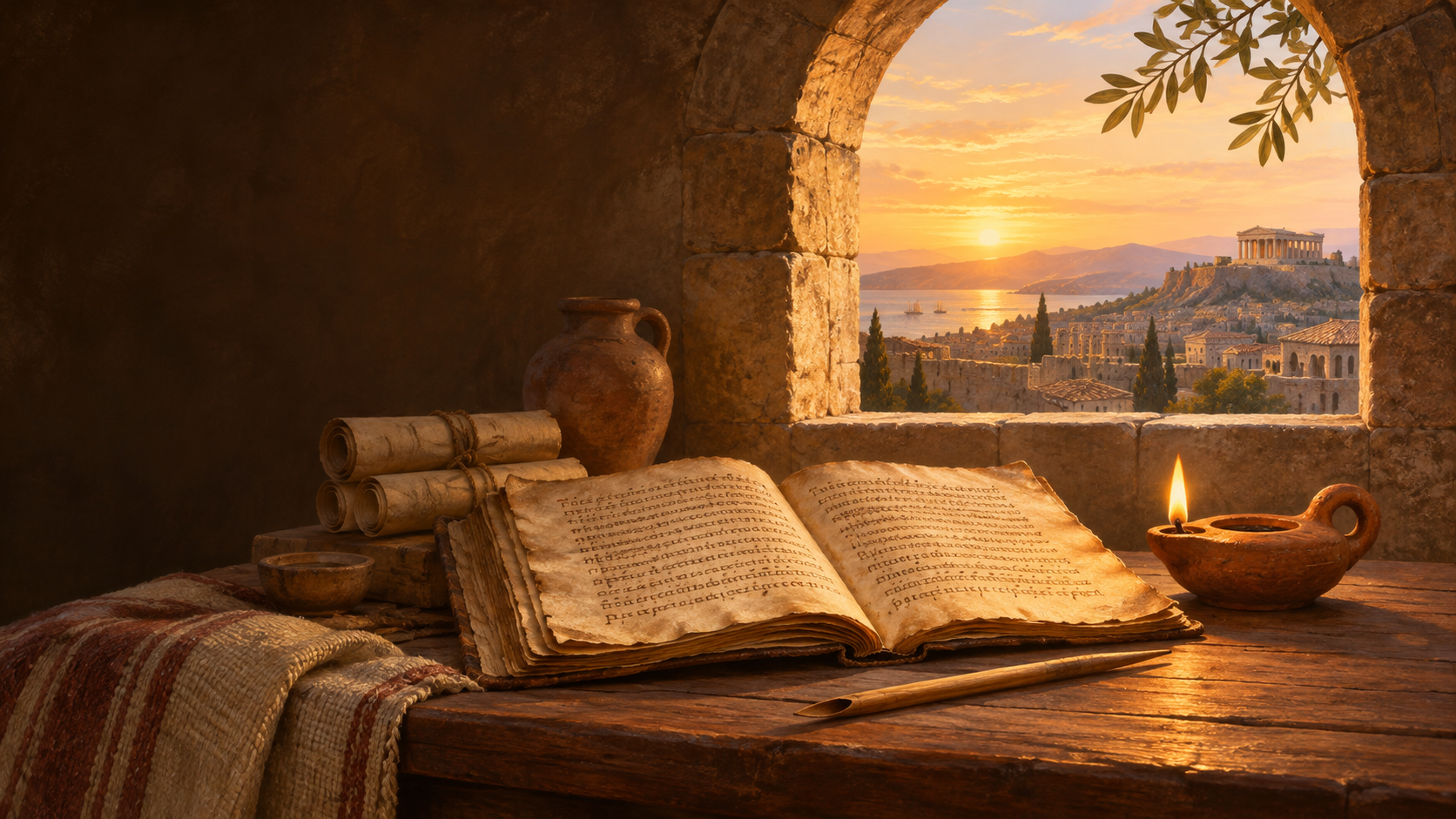
Justin Martyr, a second‑century philosopher, became Christianity’s first major defender, and his works explore faith, reason, prophecy, and even the fallen angels.
Justin Martyr was a second‑century Christian philosopher and the most important early defender of the faith. He was born in Flavia Neapolis in Samaria, the modern city of Nablus, to a Gentile family.
Justin studied several schools of philosophy before an old man he met by the sea pointed him to the Hebrew prophets. He became a Christian and taught in Rome. Around AD 165 he was beheaded with six companions for refusing to sacrifice to the Roman gods.
Major Works
Three of Justin’s works survive in full:
First Apology, addressed to Emperor Antoninus Pius around AD 155.
Second Apology, a shorter appeal to the Roman Senate written a few years later.
Dialogue with Trypho, a long debate with a Jewish teacher named Trypho, set in Ephesus.
Defense of Christianity
Christians in Justin’s day faced rumors of atheism, cannibalism, and immorality. Justin answered each charge. Christians reject the gods of Rome, he wrote, but they worship the true God. He asked the emperor to judge Christians by their actions and not punish them for the name alone.
First Apology chapters 61 through 67 describe how Christians baptized and how they worshiped on Sunday. They read the apostles’ memoirs and the prophets, heard a sermon, prayed, shared bread and wine, and collected gifts for orphans, widows, and the sick. This is the oldest full description of a Christian worship service outside the New Testament.
Faith and Reason
Justin did not throw out philosophy. He taught that every person has a seed of the Logos, the divine Reason. Where Greek thinkers such as Socrates said true things, they spoke by that seed. Christians, he argued, have the full Logos, who became man in Jesus Christ.
Justin never gave up his philosopher’s cloak. He treated Christianity as the true philosophy.
Fulfillment of Prophecy
Prophecy was Justin’s strongest argument. First Apology chapters 30 through 53 walk through Old Testament prophecies and show how Jesus fulfilled them. The Dialogue with Trypho runs 142 chapters and spends most of its length on the same theme.
Justin argued that prophecies written long before Jesus was born could not have been made up after the fact.
Justin on the Fallen Angels
In Second Apology chapter 5, Justin writes that angels God placed over the earth broke their assignment, slept with women, and fathered children. He says those children are the beings called demons. Justin adds that these angels taught humans to offer sacrifices, incense, and drink offerings. He saw the pagan gods as these same spirits.
How to Read Justin Martyr Today
Start with First Apology chapters 61 through 67. They take about 15 minutes and show you second‑century worship.
Then read Second Apology in full. It has 15 chapters.
Read the Dialogue with Trypho in sections. Chapters 1 through 8 tell his conversion story.
All three are free in the Ante‑Nicene Fathers, volume 1.
About the Author
CK Quarterman is a USAF veteran, independent author, and publisher at CKQbooks. He writes the Malaterrestrials nonfiction series, which examines evil earthbound non‑human intelligences through Scripture and history, along with the Watchers’ Universe and Sons of the Flood fiction series. Find his books at ckqbooks.com.
Truth · History · Scripture
Explore in the Encyclopedia
Augustine of Hippo
Augustine of Hippo: the fifth-century theologian whose rejection of the angelic reading in The City of God moved Western Christianity toward the Sethite view.
Ambrose of Milan
Ambrose of Milan (c. 339–397) was a Roman governor who became bishop of Milan in a week, authored influential theological works, and mentored Augustine.
Athanasius of Alexandria
Athanasius of Alexandria (c. 296–373) was the bishop of Alexandria who defended the deity of Christ against Arianism and authored key works such as On the Incarnation, Life of Antony, and Discourses Against the Arians.
Basil the Great
Basil the Great (c.329–379), bishop of Caesarea, was a key defender of the Holy Spirit’s deity, a Trinitarian theologian, monastic rule author, and founder of the Basiliad public hospital.
Clement of Alexandria
Clement of Alexandria (c.150–215) was a Christian teacher in Alexandria who led the Catechetical School and authored the Protrepticus, Paedagogus, and Stromata, integrating faith with philosophy.
Clement of Rome
Clement of Rome (c. 35–99) was the third bishop of Rome and author of the early Christian letter First Clement, which addresses church unity, humility, and order.
Cyril of Jerusalem
Cyril of Jerusalem (c. 313–386) was a fourth‑century bishop whose Catechetical Lectures provided the most complete record of early church instruction for new believers.
Epistle of Barnabas
The Epistle of Barnabas is an anonymous early Christian letter, likely written between AD 70 and 130, that interprets the Old Testament as pointing to Christ and was highly valued by the early church yet excluded from the canon.
Gregory of Nazianzus
Gregory of Nazianzus (c. 329–390) was a Cappadocian bishop, preacher, and poet known as the Theologian, whose Five Theological Orations shaped Trinitarian doctrine.
Gregory of Nyssa
Gregory of Nyssa (c. 335–395) was a Cappadocian bishop, younger brother of Basil the Great, whose writings shaped Trinitarian doctrine and Christian spirituality.
Hippolytus of Rome
Hippolytus of Rome (c. 170–235) was a Roman elder, early‑church writer and likely the first antipope, known for his Refutation of All Heresies and the debated Apostolic Tradition.
Ignatius of Antioch
Ignatius of Antioch was a second‑century bishop of Antioch who, while being escorted to martyrdom in Rome, wrote seven influential letters that shaped early Christian theology on Christ’s humanity, church unity, and the role of the bishop.
Irenaeus of Lyons
Irenaeus of Lyons (c. 130–202) was a third‑generation apostolic successor who served as bishop in Gaul and wrote Against Heresies to combat Gnostic teachings.
Jerome
Jerome (c. 347–420) was a Christian scholar, translator, and monk best known for producing the Latin Vulgate Bible and authoring extensive letters and works.
John Chrysostom
John Chrysostom (c. 347–407) was a renowned early‑church preacher and archbishop known for his extensive homilies on Matthew, John, and Acts, as well as his reforms that led to exile.
Keep researching. Don't miss what's uncovered next.
Get first access to new Encyclopedia entries, Timeline updates, Watchers, Nephilim, Giants, Demons, Deliverance, and UFO/UAP research, plus new books and releases from CKQBooks. Free. Takes ten seconds.