
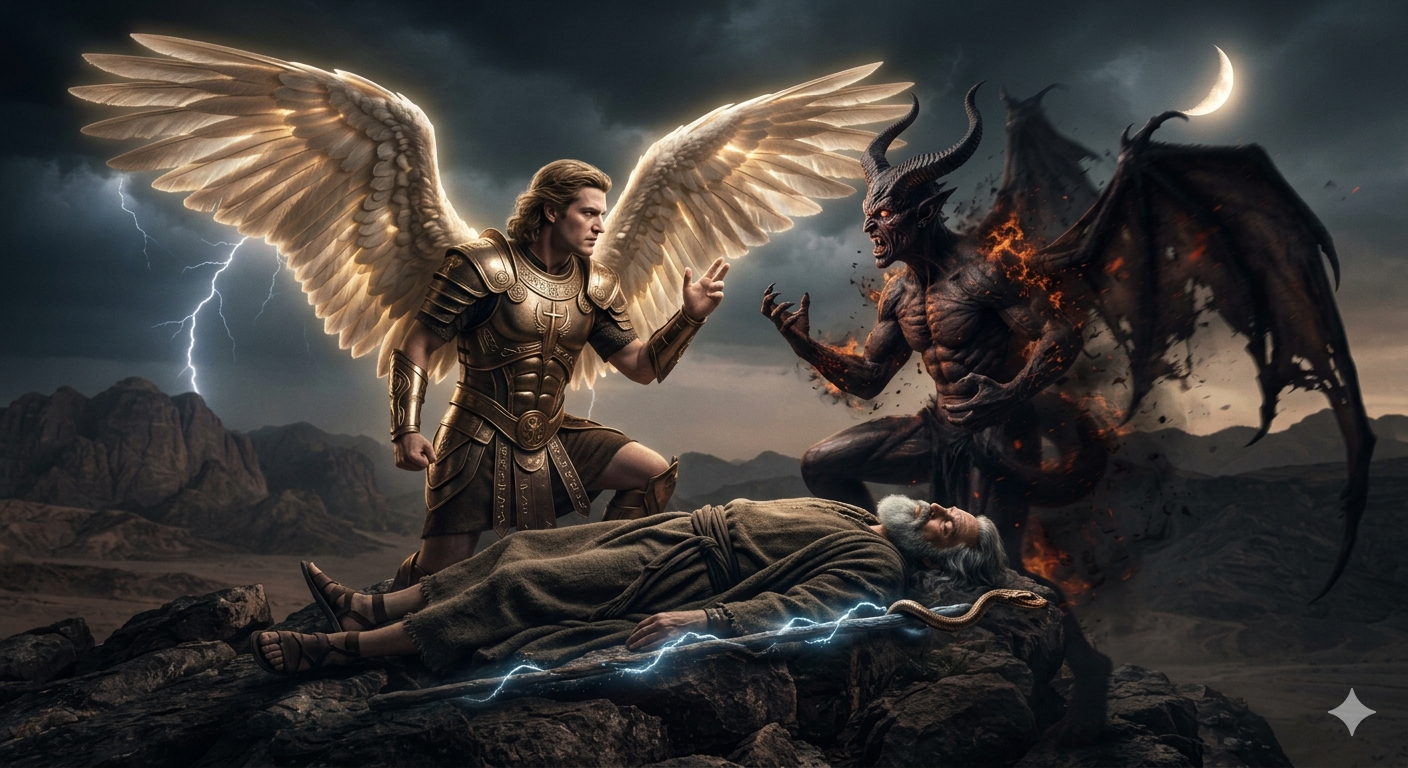
Jude records a dispute between Michael and Satan over Moses's body, while Deuteronomy hides his grave from Israel entirely — a look at what Scripture says and why the location may have needed to stay hidden.
Why Did God Hide the Location of Moses's Grave?
Scripture never states directly why God kept the location of Moses's grave hidden, but the pattern set earlier in Israel's history with the bronze serpent points toward an answer: whatever the people did not have access to, they could not turn into an idol.
The Dispute Over Moses's Body
Jude 1:9 gives us one of those details that is easy to read and move past without stopping. It says Michael the archangel was disputing with the devil over the body of Moses, but Jude never tells us what started the dispute or what Satan wanted. Michael's response is unusual too. He does not personally condemn Satan. He says, "The Lord rebuke you," and that is the entire exchange we get.
The strange part gets more interesting when you go back to the account of Moses's death. Deuteronomy 34 says Moses died in the land of Moab and that God buried him, but the location of the grave was never made known. Israel was never given a place where they could point and say, "This is where Moses is buried." Then Jude, writing centuries later, mentions a dispute over Moses's body as though his readers already knew the story.
They likely did. Jude appears to be drawing on an older Jewish tradition about Moses that circulated outside the books that became the Old Testament, connected to a work called the Assumption of Moses. That text survives today only in incomplete form, and the surviving portion does not contain the scene between Michael and Satan, so we cannot simply open the book and read the rest of the story Jude had in mind. Ancient writers proposed explanations, some tying Satan's objection to Moses's killing of an Egyptian, others to the idea that Moses's body was taken into God's presence rather than left in the ground. Neither idea comes from Jude himself, so neither should be treated as something Scripture states outright.
What Jude confirms is the confrontation itself. What he leaves out is why Moses's body mattered enough for Satan to dispute over it in the first place.
The Bronze Serpent in the Wilderness
Numbers 21 tells a different story about a different kind of danger. The Israelites grew impatient in the wilderness and spoke against God and against Moses. God sent venomous snakes into the camp, people were bitten, and many died. The people came to Moses, admitted they had sinned, and asked him to pray that the snakes be taken away. Moses prayed, and God told him to make a bronze serpent and set it on a pole. Anyone bitten who looked at it would live. Moses built exactly what he was told to build.
God did not command its destruction at that time. It was built for healing, and it did what it was made to do.
Hezekiah Destroys What He Built
Term: Nehushtan — the name Israel eventually gave to the bronze serpent Moses set up in the wilderness, after the people began worshipping it as an idol. King Hezekiah destroyed it once it carried that name.
That changed centuries later. By the time of King Hezekiah, Israel had started burning incense to the same bronze serpent and had given it a name, Nehushtan. What began as an instrument of healing had become an idol. Hezekiah broke it in pieces as part of a broader reform to remove idol worship from Judah, and 2 Kings 18:4 credits him with doing what was right in the eyes of the Lord.
So the object itself was never the problem. God commanded it built. The problem was what the people eventually did with it once it was in front of them long enough.
CKQ Commentary
That is the detail I keep coming back to when I read Jude's brief mention of Moses's body. Israel took a bronze snake, an object built at God's own command for a single act of healing, and turned it into something they burned incense to. It took Hezekiah generations later to tear it down.
Now put Moses next to that. Here is a man who spoke with God face to face, led a nation out of slavery, and had authority no other prophet in Israel's history could claim. If a bronze serpent could become an idol simply by staying in view, what would Israel have done with a marked, known, visitable grave belonging to Moses himself? I do not think that is a hard question to answer. They would have built a shrine. They would have prayed there. Given enough centuries, someone would have burned incense at it the same way they did at Nehushtan, and Moses would have needed his own Hezekiah to tear the site down.
I think that is a large part of why God buried Moses himself and told no one where. Not because the location needed to be a mystery for its own sake, but because Israel had already shown, with a far less significant object, exactly what they would do with a sacred site left in plain sight. Hiding the grave was not secrecy for secrecy's sake. It was prevention. Scripture never states this as the reason in so many words, so I offer it here as my own reading of the pattern, not as something the text spells out directly. But once you place Numbers 21, 2 Kings 18, and Jude 1:9 side by side, the pattern is hard to unsee. And it may be exactly what set the stage for the dispute Jude records. If Satan wanted Moses's body handled a certain way, and God's plan all along was to keep it hidden precisely so nothing like Nehushtan could happen to Moses, that would be a dispute worth having.
CK Quarterman. CK Quarterman is a USAF veteran, independent author, and publisher under the CKQbooks imprint (ckqbooks.com). He writes on the Malaterrestrials concept, non-human intelligences with terrestrial rather than extraterrestrial origins, documented across ancient and modern sources. Truth · History · Scripture.
Explore in the Encyclopedia
Keep researching. Don't miss what's uncovered next.
Get first access to new Encyclopedia entries, Timeline updates, Watchers, Nephilim, Giants, Demons, Deliverance, and UFO/UAP research, plus new books and releases from CKQBooks. Free. Takes ten seconds.