
A look at 1 Enoch 19:2, where the wives of the fallen Watchers are said to become “sirens,” and why that word points to ancient bird-women, not modern mermaids.
Did the Wives of the Fallen Watchers Become the Sirens of Greek Mythology?
The Greek textual tradition of 1 Enoch 19:2 says yes, the women who bore children to the Watchers were sentenced to become “sirens.” But the sirens in that verse are not the mermaids of later legend. They are the older Greek Seirēnes: bird-bodied women whose song lured sailors to their deaths. Whether that word reflects something original in the Enochic tradition, or a Greek translator borrowing a familiar category to describe something else, is a question scholars still can’t fully settle.
Term: Siren. In the Greek textual tradition of 1 Enoch, a class of female supernatural being tied to the judgment of the Watchers’ human wives. Distinct from the Nephilim (their offspring) and from the evil spirits described in 1 Enoch 15, which come from the Nephilim’s bodies after death. In Greek mythology, Sirens were originally bird-women, not mermaids; the fish tail came centuries later.
Genesis 6 tells the story in a handful of verses. Heavenly beings take human wives. Their children are called Nephilim. The book of 1 Enoch spends chapters filling in what Genesis leaves out, and it doesn’t stop with the children. It also tells you what happened to the wives.
1 Enoch 19:2 says they become “sirens.” That’s the word in R. H. Charles’s classic English translation, and it’s worth pausing on, because “siren” carries a lot of baggage for a modern reader. Say the word today and most people picture a woman with a fish tail sitting on a rock. That image is medieval. It’s not what a first-century reader of the Greek text would have pictured.
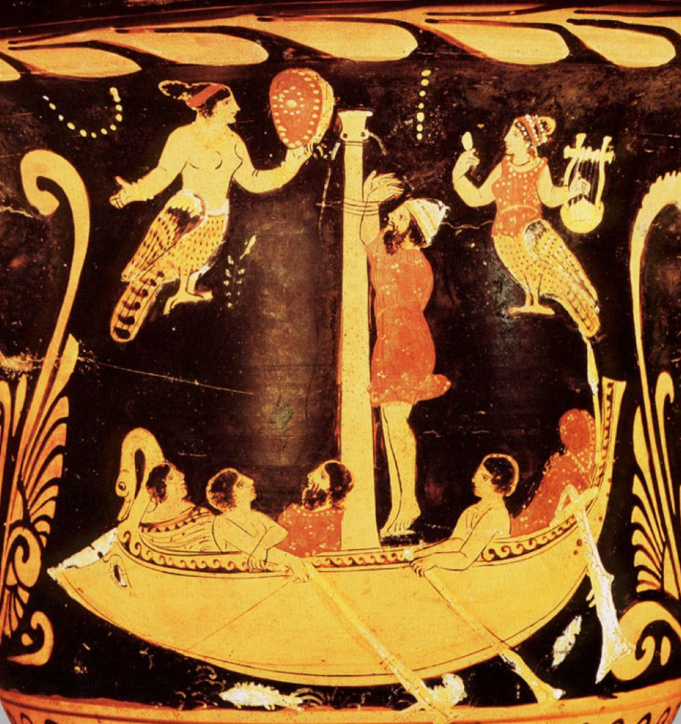
The original Greek Seirēnes were dangerous, yes, but they weren’t aquatic. Ancient art shows them as part woman, part bird. Their weapon was their voice. In Homer’s Odyssey, Odysseus has his crew stop their ears with wax and has himself tied to the mast, because hearing the Sirens’ song means walking toward your own death. That’s the creature 1 Enoch is invoking. Not a mermaid. A predator that kills through sound.
Classical art makes the bird form explicit. Attic vases depicting the Odyssey show Sirens as large birds with the heads of women, sometimes with human arms and breasts added in, often playing lyres or flutes as ships pass by. Terracotta figurines and marble statues carry the same design: avian bodies, wide wings, bird talons. Because Greeks associated Sirens with the passage into the afterlife, these figures also turn up as mourning statues on tombs. The fish tail didn't arrive until centuries later, when the myth moved into Western Europe during the Middle Ages and translators folded the bird-Siren together with Roman water nymphs and Germanic fish-tailed creatures, producing the mermaid image most people picture today, one that has almost nothing to do with what a Greek reader would have imagined.
So what does the verse actually tell you about the Watchers’ story? Read straight through, the sequence looks like this: the Watchers descend, take human wives, produce giants, judgment falls, the Watchers are imprisoned, and the wives become sirens. Three separate outcomes, three separate categories of being. The Watchers are rebellious heavenly beings. The Nephilim are their offspring. And according to 1 Enoch 15:8 to 12, when the Nephilim die, their spirits don’t simply vanish. They remain on the earth as evil spirits, and that passage is one of the oldest sources behind the idea that demons are the disembodied spirits of dead giants.
The sirens of 1 Enoch 19:2 are a fourth category, tied to the human wives rather than to the giants. That’s easy to miss if you lump every supernatural figure in the Watcher narrative into one bucket labeled “demons.”
Here’s where you have to be careful, though. It would be too strong to say the Book of Enoch teaches that the Watchers’ wives literally became the Sirens later sailors feared in Greek waters. The manuscript history won’t support a claim that direct. What you can defensibly say is narrower: the Greek textual tradition of 1 Enoch 19:2 links the judgment of the Watchers’ wives to a known class of Greek supernatural beings, and the exact relationship between that reference and Greek mythology’s own Sirens remains an open question. The word could reflect something original to the Enochic tradition. It could also be a Greek translator reaching for a familiar term to render an older, less familiar Semitic concept. Both readings stay on the table.
There’s a related thread worth naming even if this post doesn’t chase it down. The Dead Sea Scrolls and other ancient Jewish demonological texts use their own vocabulary for destructive wilderness spirits and female night beings, and those terms sometimes get flattened into “siren” or “demon” in translation in ways that erase real distinctions. That’s a separate rabbit hole from the Greek Siren tradition, and it deserves its own treatment rather than getting folded into this one.
What you’re left with is a genealogy, not a myth. Genesis 6 gives you the seed. 1 Enoch 6 through 16 expands it into a full narrative of rebellion and judgment. 1 Enoch 15 tells you where the demons came from. 1 Enoch 19 tells you what happened to the women. And somewhere on the far side of that verse, Greek sailors started telling stories about women whose song meant death.
C. K. Quarterman is a USAF veteran and the author behind CKQbooks.com, where he writes about the Watchers, the Nephilim, and the hidden history behind the Bible’s strangest passages under the Malaterrestrials banner. Truth · History · Scripture.
Topics
Explore in the Encyclopedia
Nephilim
The offspring of the "sons of God" and the "daughters of men" described in Genesis 6, traditionally understood as giants.
The Watchers
A class of angelic beings who, in 1 Enoch, descend to earth, take human wives, and teach forbidden knowledge.
Mount Hermon
The mountain on the northern border of ancient Israel identified in 1 Enoch as the descent point of the Watchers.
Azazel
A chief among the Watchers in 1 Enoch, blamed for teaching humanity metalworking, weaponry, and cosmetics.
Sirens
In the Greek textual tradition of 1 Enoch 19:2, the fate assigned to the human women who bore children to the fallen Watchers — distinct from the Watchers themselves and from the Nephilim, their giant offspring.
Keep researching. Don't miss what's uncovered next.
Get first access to new Encyclopedia entries, Timeline updates, Watchers, Nephilim, Giants, Demons, Deliverance, and UFO/UAP research, plus new books and releases from CKQBooks. Free. Takes ten seconds.