
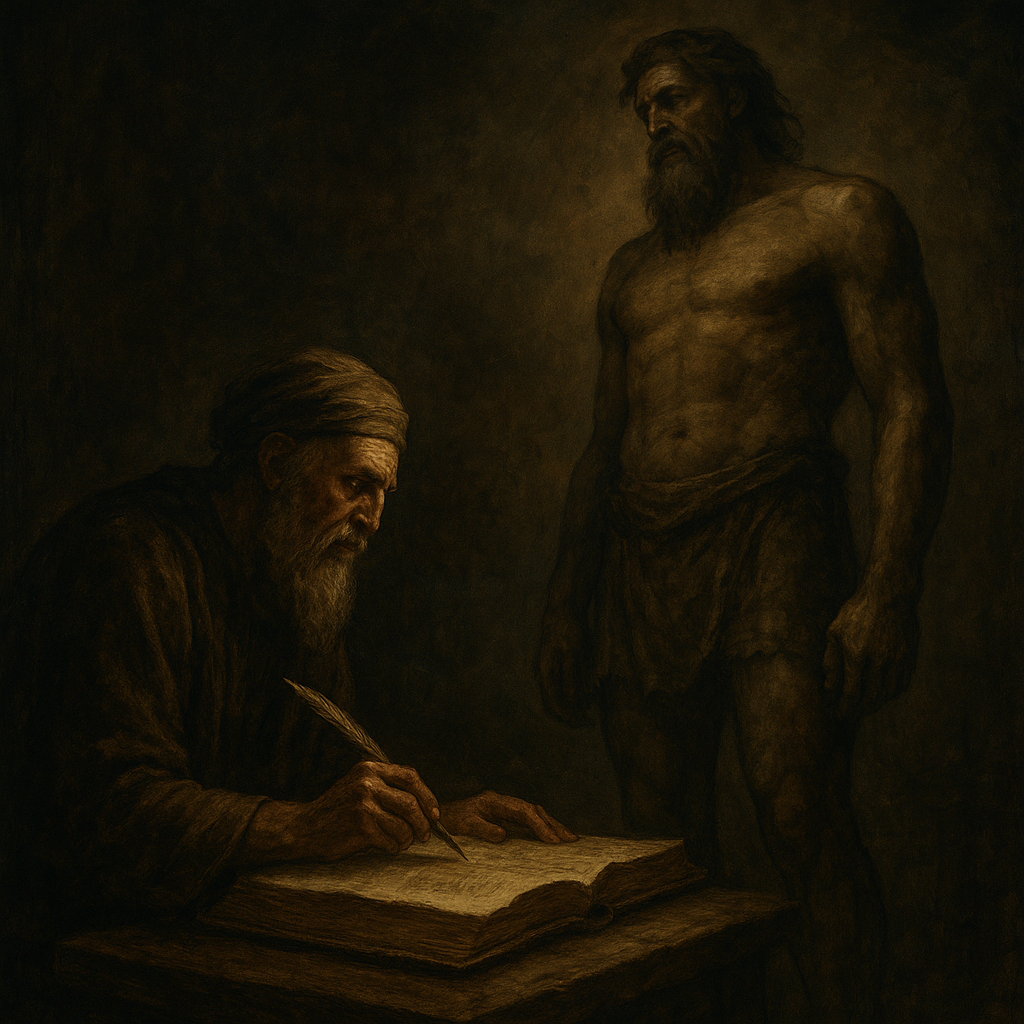
This post walks the math behind 1 Enoch's giant and checks it against the tallest giant the Hebrew Bible actually measures. It covers cubit standards, manuscript variants, and why a 450-foot being could not stand on its own legs.
A cubit is an ancient unit of length based on the human forearm, running from roughly 17.5 inches for a common cubit to about 21 inches for the longest royal and Babylonian cubits.
Using the standard short cubit of 18 inches, 3,000 cubits works out to 4,500 feet. Using the longer royal cubit at 20.6 inches, it comes to roughly 5,150 feet. Both numbers put the giant well above the tallest mountain in Ethiopia, the region that preserved the text. Most scholars read this as a corrupted or symbolic figure rather than a literal measurement.
The Cubit Was Never One Fixed Length
Ancient cultures ran several cubit standards at the same time. The common cubit measured about 17.5 to 18 inches, based on the forearm from elbow to fingertip. Egypt used a royal cubit near 20.6 inches for monumental construction, divided into 7 palms of 4 digits each. Babylonian sources sometimes used a long cubit close to 21 inches. The Hebrew Bible itself names two: a common cubit of 6 handbreadths, and a long cubit of "a cubit and a handbreadth" used for temple measurements in Ezekiel.
None of these standards changes the outcome much. Whichever cubit you pick, 3,000 of them lands somewhere between 4,500 and 5,150 feet. The cubit variance is not the problem. The number itself is.
Why Scholars Think the Number Is Corrupted
The Qumran fragments of the Book of Giants (4Q531 and related texts) preserve a figure of 300 cubits for a giant''s height in a parallel passage, not 3,000. That is exactly one-tenth of the Ethiopic figure. A tenfold shift is a known type of scribal error, especially in Hebrew and Aramaic, where letters doubled as numerals and a single miscopied character could move a number by a full order of magnitude.
At 300 cubits and the short cubit standard, the giant comes out to about 450 feet. Still far beyond anything physically viable, but consistent with the kind of numerical inflation found elsewhere in ancient literature describing giants and heroes, rather than requiring a being taller than any mountain in the region.
Could a 450-Foot Being Actually Stand?
Run the physics and the answer is no, not with a human body plan. The square-cube law explains why. Scale a 6-foot human up to 450 feet and you get a linear scale factor of 75.
Mass scales with volume, which scales with the cube of that factor. 75 cubed is 421,875. A 70-kilogram human scaled by that factor comes out to about 29.5 million kilograms, close to three Eiffel Towers in weight.
Bone and muscle strength scale with cross-sectional area, which scales with the square of the factor. 75 squared is 5,625. Divide the mass increase by the strength increase and you get 75, the same as the original scale factor. Every doubling in height doubles the stress on the skeleton relative to its ability to bear that stress.
Human bone carries a safety margin under normal standing load, but that margin gets divided by 75 at this scale. The skeleton would fail from standing alone, before any walking or running enters the picture. Robert Wadlow, the tallest verified human on record at 8 feet 11 inches, needed leg braces late in life from a scale factor of only about 1.5. A being at 450 feet is operating at a scale factor 50 times steeper than what already broke Wadlow''s legs.
A Real Biblical Son of a Giant: Goliath
The Masoretic Text gives Goliath''s height as "six cubits and a span," about 9 feet 9 inches at the short cubit. But the Dead Sea Scrolls and the Septuagint, both older witnesses than the Masoretic tradition, give "four cubits and a span" instead, about 6 feet 9 inches. Most textual scholars favor the shorter reading, since scribes were far more likely to inflate a hero''s height over centuries of copying than to shrink it.
That puts Goliath in the range most modern readers land on: somewhere close to 7 feet.
Goliath reads as a son of a giant rather than a giant in his own right for a specific textual reason. 2 Samuel 21:22 states that Goliath and three other warriors from Gath "were descended from the giant," using the Hebrew term rapha to tie them to the Rephaim lineage. The text marks Goliath as part of a bloodline, not as the origin point of it. At roughly 7 feet, he is also far short of Og''s 10.5 to 13.5 foot range, the closest thing the Bible offers to a full-blooded giant with a measured object attached to him. That gap in height lines up with the gap in the text: Goliath is descended from a giant, and his size reflects a diluted line rather than the ancestral extreme.
Working Backward: How Tall Was Goliath''s Father?
Goliath is tied to "the giant in Gath" through direct descent in 2 Samuel 21:22, not through a long genealogical chain. That points to a steep, single-generation model rather than a gradual decline across many generations, the kind of regression toward the population mean you see when a dominant trait crosses with a non-carrier.
Bronze Age skeletal evidence puts the average adult male in the Levant at about 5.5 feet. Goliath''s excess over that baseline is 1.5 feet. Under a filial regression model, where a child inherits roughly half of a single parent''s deviation from baseline, the father''s excess would run close to 3 feet.
That puts Goliath''s father at roughly 8.5 feet, using the regression model. The ceiling case, where the father carried the ancestral line at close to full strength rather than a diluted version, runs considerably higher.
Testing the Framework Against Og of Bashan
Og gives the best hard data point in the text. Deuteronomy 3:11 describes his iron bed at 9 cubits by 4 cubits, "after the cubit of a man," the common 18-inch standard. That bed measures 13.5 feet long. Allowing margin for headboard and footboard clearance, Og''s actual height likely ran somewhere between 10.5 and 13.5 feet, or roughly 7 to 9 cubits.
Compare that to the Enochic figure. At 3,000 cubits, the Ethiopic giant stands 375 times taller than Og. Even the corrected 300-cubit reading from the Book of Giants still puts that figure at 37.5 times Og''s height. Og is the tallest giant the biblical text measures against a physical object. Every number in the Enochic tradition, even after correcting for probable scribal error, describes something on a completely different order of magnitude.
What This Tells You
The cubit itself was never the source of the problem. Every standard in use across the ancient Near East puts the Enochic figure somewhere between 4,500 and 5,150 feet, and every one of those numbers fails basic structural physics before you even get to comparing it against the Bible''s own giants.
Og''s bed gives a real anchor, a giant sized against a described object. Goliath gives a textually contested but physically plausible number. The 3,000-cubit figure in 1 Enoch belongs to a different category of claim entirely, one that dwarfs the largest measured giant in the Hebrew Bible by more than an order of magnitude, even after accounting for likely scribal corruption. That gap is the strongest argument that these numbers were never meant to function as literal physical measurements. They read more like symbolic or cosmological language, describing beings the text places outside ordinary physical categories from the start.
CK Quarterman. CK Quarterman is a USAF veteran and the founder of CKQbooks, where he writes on the Malaterrestrials framework, the study of non-human intelligences with terrestrial rather than extraterrestrial origins. Find his books and research at ckqbooks.com. Now you know the name of the Unknown.
Explore in the Encyclopedia
Nephilim
The offspring of the "sons of God" and the "daughters of men" described in Genesis 6, traditionally understood as giants.
The Watchers
A class of angelic beings who, in 1 Enoch, descend to earth, take human wives, and teach forbidden knowledge.
Mount Hermon
The mountain on the northern border of ancient Israel identified in 1 Enoch as the descent point of the Watchers.
Anakim
A clan of giants dwelling in Canaan, descended from Anak, feared by the Israelite spies.
Rephaim
An ancient people of giant stature east of the Jordan, of whom King Og of Bashan was the last remnant.
Azazel
A chief among the Watchers in 1 Enoch, blamed for teaching humanity metalworking, weaponry, and cosmetics.
Og of Bashan
The giant king of Bashan defeated by Israel, described as the last remnant of the Rephaim.
Giants
A general term for the oversized clans and warriors of the ancient world tied to the Nephilim bloodline.
Sirens
In the Greek textual tradition of 1 Enoch 19:2, the fate assigned to the human women who bore children to the fallen Watchers — distinct from the Watchers themselves and from the Nephilim, their giant offspring.
Keep researching. Don't miss what's uncovered next.
Get first access to new Encyclopedia entries, Timeline updates, Watchers, Nephilim, Giants, Demons, Deliverance, and UFO/UAP research, plus new books and releases from CKQBooks. Free. Takes ten seconds.