
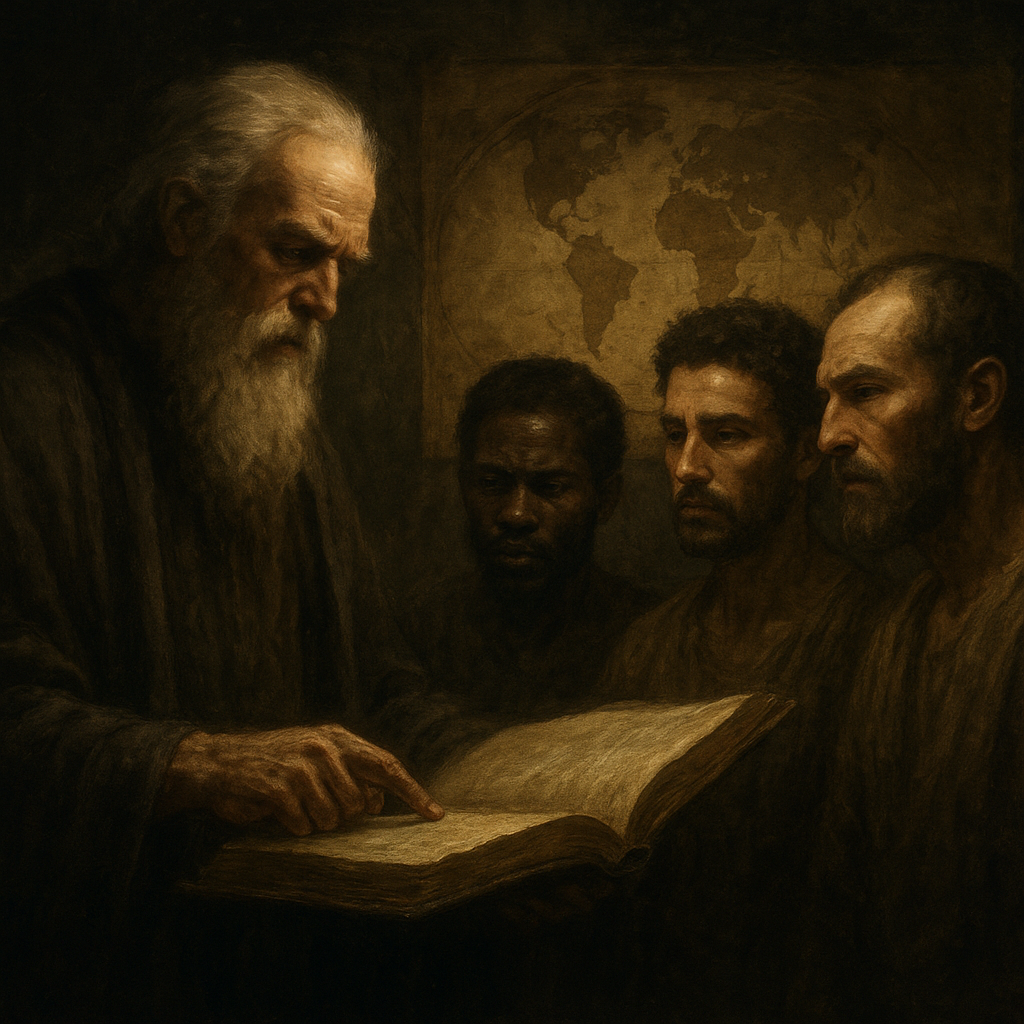
Genesis traces every person on earth back to Noah and his three sons. So where did human physical diversity actually come from, and does the Bible have anything to say about it?
Genesis does not describe pre-Flood humanity as divided into separate races the way that word gets used today. Every human being alive after the Flood descends from Noah, his wife, and his three sons and their wives, a total of eight people (Genesis 7:13, 9:19). Whatever physical diversity existed before the Flood, and whatever developed after it, traces back to that single family. The Bible is far more interested in a different kind of division running through the pre-Flood world, one that has nothing to do with skin color or physical features.
One Family, Not Many Origins
Genesis 5 traces a single genealogical line from Adam through Seth down to Noah. Genesis 6 through 9 makes it explicit that the Flood wiped out everyone outside Noah's immediate family, and that his three sons, Shem, Ham, and Japheth, became the ancestors of every nation listed afterward in Genesis 10, the so-called Table of Nations. The text is structured as a single tree with one root, not a forest of separate human origins scattered across the pre-Flood world.
That single-origin model doesn't rule out physical variation within Noah's line. Human populations develop visible differences over time through migration, isolation, and adaptation to different environments, a well-documented process that doesn't require separate origins to explain. Genesis simply doesn't spend any time describing what pre-Flood humans looked like beyond identifying them as human, made in God's image (Genesis 1:27, 5:1).
The Division Genesis Actually Cares About
What Genesis does spend real time on is a different kind of split entirely: the corruption introduced by the Watchers. Genesis 6:1-4 describes the "sons of God" taking human wives and producing offspring called Nephilim, a passage that ancient interpreters, including the authors of 1 Enoch and Jubilees, understood as fallen angels crossing a boundary they were never meant to cross. That union produced hybrid offspring, and it's that corruption, not human physical variation, that the text presents as the real crisis leading into the Flood judgment.
Genesis 6:5 follows immediately with God seeing that "the wickedness of man was great in the earth," and verse 12 adds that "all flesh had corrupted his way upon the earth." Whatever this corruption specifically involved, the text treats it as a departure from the created order serious enough to warrant wiping out nearly everyone alive. That is the line Genesis draws before the Flood: not a line between different human populations, but a line between what God created and what had been corrupted.
What This Means for the Question
So did different races exist before the Flood? Genesis doesn't frame pre-Flood humanity that way, and it doesn't give enough physical description to answer the question directly either way. What it does insist on is a single line of descent through Noah for everyone alive after the Flood, and a pre-Flood world whose real division wasn't about human physical variety but about a corruption introduced from outside humanity entirely. Modern ideas about race, built around visible physical traits, are simply a different category than what Genesis is describing. The text is telling a story about lineage and corruption, not about skin color or physical type.
CK Quarterman. CK Quarterman is a USAF veteran and the author behind CKQbooks, writing on the malaterrestrials concept, biblical mysteries, and the Watchers tradition. Find more at ckqbooks.com. Truth · History · Scripture.
Explore in the Encyclopedia
Nephilim
The offspring of the "sons of God" and the "daughters of men" described in Genesis 6, traditionally understood as giants.
Giants
A general term for the oversized clans and warriors of the ancient world tied to the Nephilim bloodline.
Hybrid Beings
Offspring of the union between the fallen and humanity — the conceptual heart of the Nephilim account and its modern echoes.
Antediluvian
The period of biblical history between the creation of Adam and the flood of Noah, covering Genesis 1 through 6. The term was coined by the English writer Thomas Browne in the seventeenth century.
Sirens
In the Greek textual tradition of 1 Enoch 19:2, the fate assigned to the human women who bore children to the fallen Watchers — distinct from the Watchers themselves and from the Nephilim, their giant offspring.
Keep researching. Don't miss what's uncovered next.
Get first access to new Encyclopedia entries, Timeline updates, Watchers, Nephilim, Giants, Demons, Deliverance, and UFO/UAP research, plus new books and releases from CKQBooks. Free. Takes ten seconds.