
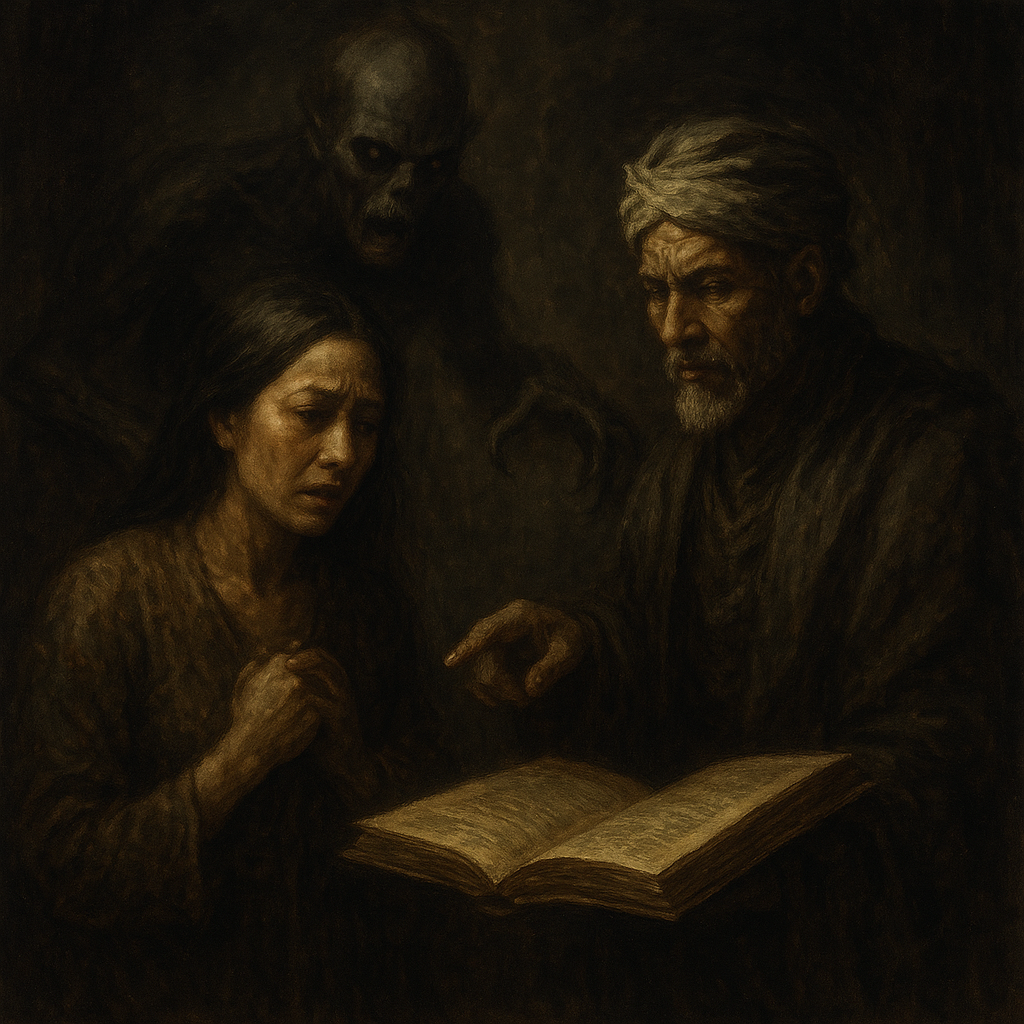
The Sumatran vampire legend that Kurt Koch describes in Occult ABC comes from a 1970s news report about a South Sumatran woman whose five husbands reportedly died of severe anemia. A traditional spiritual practitioner blamed an entity named Nagasjatingarong, described as a vampire that wanted the woman for itself.
Term: Tondi — the Toba Batak word for a person’s life force, spiritual essence, or soul substance. Early sources describe it as capable of leaving the body during illness, weakness, or misfortune.
Term: Tendi — the Karo Batak equivalent of tondi, the vital spiritual essence tied to a living person. It is distinct from spirits of the dead.
Term: Begu — spirit beings in Karo Batak belief, generally connected with death or the deceased. Begu should not be confused with tendi.
What Is the Sumatran Vampire Legend Kurt Koch Wrote About?
The Sumatran vampire legend that Kurt Koch describes in Occult ABC comes from a 1970s news report about a South Sumatran woman whose five husbands reportedly died of severe anemia. A traditional spiritual practitioner blamed an entity named Nagasjatingarong, described as a vampire that wanted the woman for itself. That report sits on top of a much older Batak tradition, documented as early as 1883, concerning tondi and tendi, the spiritual life force believed to inhabit every living person and to be vulnerable to hostile spirits.
Most people hear the word vampire and picture the familiar creature of European folklore: a dead man rising from his grave at night to drink the blood of the living. Sumatra preserves a different and considerably stranger trail. Early ethnographers documented beliefs concerning spirits, human vitality, the loss of the soul, and the possibility that unseen beings could interfere with that vital essence. Those records predate a sensational Sumatran vampire story that reached international newspapers in the 1970s and later appeared in Kurt E. Koch’s Occult ABC.
The central finding is clear but limited. Older sources establish a genuine Batak tradition involving tendi or tondi, often translated as soul, life force, or vital essence. They do not yet establish that the specific being called Nagasjatingarong was known in the nineteenth century. Keeping that distinction intact allows the historical material to remain useful without overstating what the sources prove.
Kurt Koch and the Vampire
Kurt E. Koch was a German Protestant minister, missionary, and author who wrote extensively about occultism from a Christian perspective. In Occult ABC, Koch included a section devoted to vampires.
He begins by acknowledging the traditional idea of the vampire, the dead supposedly leaving their graves and attacking the living. His main interest, however, was not the Dracula figure of popular fiction. He focused on blood and its relationship to practices that he regarded as occult, including blood pacts, Satanism, Voodoo, Macumba, and ritual activity.
Koch then presented case histories that he believed showed that some incidents described as vampirism might involve something other than folklore. One of those cases led to Sumatra.
The Woman Whose Husbands Died
Koch relates the story of a young woman in Sumatra who reportedly married five men. According to the account, all five husbands died from severe anemia. The woman’s family eventually sought the assistance of a traditional spiritual practitioner, who gave an extraordinary explanation.
The woman was supposedly possessed by an entity whose name Koch rendered as Nagasjatingarong. The entity was described as a vampire. It allegedly wanted the woman for itself and consequently drained the men who married her.
The account did not begin with Koch. A version circulated internationally as a news story during the mid 1970s and was attributed to Agence France Presse. A Washington Post report dated January 1, 1976, later reproduced by folklorist Jan L. Perkowski, placed the story in South Sumatra and repeated the claim that the husbands died of acute anemia. This establishes that the story circulated beyond Koch’s ministry literature, but it does not verify the deaths, diagnoses, or supernatural explanation.
Koch interpreted the report within his Christian understanding of spiritualism, occultism, possession, and demonic activity. That interpretation must be distinguished from both the newspaper account and the older religious traditions of Sumatra.
The Tendi and Tondi
Among Batak peoples of Sumatra, early researchers encountered a concept generally written tendi among the Karo Batak and tondi among the Toba Batak. A related form, tenduy, has also been reported among the Simalungun Batak.
English words such as soul, spirit, life force, and vital essence approximate the idea, but none captures it perfectly. The tendi was associated with the life and well being of the individual. It could be conceived as having a degree of independence from the person’s conscious personality. Its presence was associated with life, while its departure or disturbance could be associated with illness, weakness, or misfortune.
This vocabulary was not created by Kurt Koch or by reporters in the 1970s. It had been documented generations earlier.
Evidence from the Nineteenth Century
In 1883, physician and ethnographer Bernhard Hagen published Beiträge zur Kenntniss der Battareligion, a substantial study of Batak religion. His work belongs to a larger nineteenth century record of Batak beliefs involving spirits, death, sacrifice, ritual power, and the human spiritual essence.
Later scholarship citing Hagen reports a belief that spiritual potency was concentrated especially in the head, blood, and liver. Practices such as taking an enemy’s head or consuming blood were interpreted as ways of acquiring the victim’s tondi or strengthening one’s own vitality at the victim’s expense.
This evidence must be handled carefully. Early European observers sometimes wrote through colonial assumptions and occasionally sensationalized unfamiliar customs. Hagen did not label the belief vampirism. Still, the material documents a connection between blood, bodily life, and spiritual potency long before the South Sumatran newspaper story.
Neumann and the Karo Tradition
Missionary and ethnographer J. H. Neumann published De Begoe in de godsdienstige begrippen der Karo Bataks in 1902. That study addressed begu, spirit beings in Karo Batak belief, including spirits associated with the dead and practices intended to repel or manage them.
In 1904, Neumann published De tendi in verband met Si Dajang, an extended study devoted specifically to tendi and associated Karo traditions and incantations. By the beginning of the twentieth century, then, tendi was sufficiently established in the ethnographic record to receive sustained treatment of its own.
The distinction between tendi and begu is important. Tendi concerns the vital spiritual essence associated with a living person. Begu refers to a different class of spirit, often connected with death or the deceased. The terms should not be collapsed into one another, even though both belong to a worldview in which spiritual beings and human vitality can interact.
Johannes Warneck and the Tondi
In 1909, Johannes Warneck published Die Religion der Batak after missionary work among the Batak. His treatment is one of the most useful early sources for understanding tondi.
Warneck described tondi in terms that can be translated as life force, life substance, or soul substance. He explained that it could be conceived almost as a person within the person, possessing wishes and intentions that did not always correspond with the individual’s conscious will.
In this view, tondi belonged to the person during life but was not merely another word for personality. It could leave, wander, be disturbed, or require attention. The Batak conception was therefore more complex than a simple Western formula in which the body contains a single, passive soul.
When the Soul Leaves
Within this traditional worldview, illness was not necessarily understood as exclusively physical. A person’s vital spiritual component could become separated from the body. Modern researchers commonly describe this as soul loss.
Accounts derived from the older ethnographic record describe the tondi as capable of fleeing, being stolen, or being held captive by spirits. Ritual specialists could attempt to call it back, strengthen it, redeem it, or restore it to the afflicted person. The loss of vitality and the effort to recover it were therefore central concerns within the tradition.
Similar ideas occur in traditional cultures elsewhere, but the Batak evidence matters here because it comes from Sumatra and predates the later vampire report by many decades. This does not prove that the traditions are identical. It establishes a regional background in which spiritual interference with a person’s life essence was already intelligible.
Blood and Life
Across many cultures, blood has been regarded as intimately connected with life. The Bible makes this association explicitly in Leviticus 17:11, which states that the life of the flesh is in the blood.
Batak traditions likewise attributed unusual spiritual significance to blood and certain parts of the body. Later historical analysis, drawing upon early sources, describes tondi as spiritual potency distributed through the person. The blood, head, liver, heart, palms, and soles were among the parts associated with concentrated vitality in different accounts.
This gives the Sumatran material a partial resemblance to vampire traditions, but resemblance is not identity. In the Batak setting, the underlying concern was the possession, transfer, protection, or loss of life power. Literal blood drinking may appear in some accounts, yet the broader idea is spiritual vitality rather than an undead corpse feeding through fangs.
A Vampire Without Dracula
If a culture believes that a person possesses a spiritual life essence, that the essence can leave the body, and that spirits can interfere with it, then an entity blamed for weakness or death may easily be called a vampire by an outsider.
That label can mislead. The being does not necessarily have fangs, sleep in a coffin, rise from the dead, or drink literal blood. It may never have been human. What it consumes is life itself, or what the culture understands as the vital spiritual principle of life.
This may be the key to interpreting the South Sumatran story responsibly. The word vampire belongs largely to the Western retelling. The older regional framework is better described through tendi, tondi, spirits, soul loss, and the restoration of vitality.
Nagasjatingaron and Nagasjatingarong
Later vampire literature gives variations of the name, including Nagasjatingaron and Nagasjatingarong. Some modern reference works treat the spellings as separate entries, associating one with attacks upon the tendi and the other with the woman whose husbands reportedly died from anemia.
The distinction is not yet secure in early sources. The nineteenth and early twentieth century works document the antiquity of tendi and tondi, but they do not presently establish that the specific name Nagasjatingarong was used during that period.
It would therefore be inaccurate to project the named creature backward into nineteenth century Batak religion. The responsible conclusion is narrower: the later story appeared against a much older regional background of beliefs concerning human vitality, spirits, soul loss, and ritual recovery.
Three Layers of the Story
The evidence is easiest to understand when separated into three layers.
The first is the traditional Sumatran layer. It includes documented Batak beliefs concerning tendi or tondi, begu, spiritual vitality, sickness, death, and rituals intended to protect or restore the human spiritual essence.
The second is the modern news report. During the mid 1970s, a story circulated about a South Sumatran woman whose husbands allegedly died from anemia and an entity with a name rendered as Nagasjatingarong or Nagasjatingaron.
The third is Kurt Koch’s Christian interpretation. Koch placed the report within his larger framework of occultism, spiritism, possession, and demonic activity.
Keeping these layers separate prevents folklore, ethnography, journalism, and theology from being mistaken for one another.
A Christian Perspective
Scripture does not teach a doctrine of vampires. It does present a world containing spiritual beings, human beings, deception, forbidden spiritual practices, and conflict between the visible and invisible realms.
The Bible repeatedly warns against seeking supernatural knowledge or power through occult practices. Christians do not need to accept every traditional explanation of illness or spiritual experience in order to take those prohibitions seriously.
Koch went further by interpreting many cases gathered during his ministry as manifestations of demonic activity. Whether each case supports that conclusion is a separate historical and theological question. His Sumatran account is valuable as a trailhead, not as independent proof of the supernatural claim.
The Older Shadow Behind the Vampire
The evidence does not prove that vampires exist. It shows that the familiar Western vampire can be an inadequate label for older traditions about the loss or consumption of human vitality.
In Sumatra, the trail leads backward from a twentieth-century news report to nineteenth- and early twentieth-century documentation of tendi and tondi. From blood, the inquiry reaches life. From life, it reaches the soul. From the soul, it reaches spirits.
The resulting figure is not necessarily an undead man climbing from a coffin. It is something older and more unsettling: a spiritual predator believed capable of taking life without necessarily taking blood.
Whether the tradition is interpreted as folklore, anthropology, religion, or evidence of spiritual reality depends upon the worldview of the reader. The historical conclusion is more limited but supportable. Ideas underlying the story were present in Sumatra long before Kurt Koch wrote about its vampire.
Research Notes
1. The forms tendi and tondi belong to related Batak language traditions. They should be retained in italics or explained at first use rather than treated as interchangeable spellings without qualification.
2. The 1970s newspaper story proves circulation of the report, not the truth of its medical or supernatural claims. Phrases such as reportedly, allegedly, and according to the account are therefore necessary.
3. The word vampire is a comparative label applied by Western writers. The older Batak concepts should not be forced into the European Dracula tradition.
4. Claims about the concentration of tondi in blood or body parts rely partly on later scholarship interpreting early ethnographic reports. Any publication intended as formal scholarship should verify quotations and page numbers against the original language editions.
Selected Bibliography
Andaya, Leonard Y. “The Trans Sumatra Trade and the Ethnicization of the Batak.” Bijdragen tot de Taal Land en Volkenkunde 158, no. 3, 2002, pages 367 to 409.
Hagen, Bernhard. “Beiträge zur Kenntniss der Battareligion.” Tijdschrift voor Indische Taal Land en Volkenkunde 28, 1883.
Koch, Kurt E. Occult ABC. Grand Rapids, Michigan: Kregel Publications, English edition.
Neumann, J. H. “De Begoe in de godsdienstige begrippen der Karo Bataks.” Mededeelingen vanwege het Nederlandsche Zendelinggenootschap, 1902.
Neumann, J. H. “De tendi in verband met Si Dajang.” Mededeelingen vanwege het Nederlandsche Zendelinggenootschap 48, 1904, pages 101 to 145.
Perkowski, Jan L., editor. Vampires of the Slavs. Cambridge, Massachusetts: Slavica Publishers, 1976. Includes a reproduction of the January 1, 1976 Washington Post report.
Warneck, Johannes. Die Religion der Batak. Leipzig: Dieterich, 1909.
CK Quarterman. CK Quarterman is a USAF veteran and the founder of CKQbooks (ckqbooks.com). He writes on the malaterrestrials concept, connecting ancient history, scripture, and unexplained phenomena. Truth · History · Scripture.
Topics
Related CKQ Book
Sons of the Flood — Book One
Dispelling the Shadows in Your Life
Deliverance and Freedom from What's Been Oppressing You
Explore in the Encyclopedia
Keep researching. Don't miss what's uncovered next.
Get first access to new Encyclopedia entries, Timeline updates, Watchers, Nephilim, Giants, Demons, Deliverance, and UFO/UAP research, plus new books and releases from CKQBooks. Free. Takes ten seconds.