
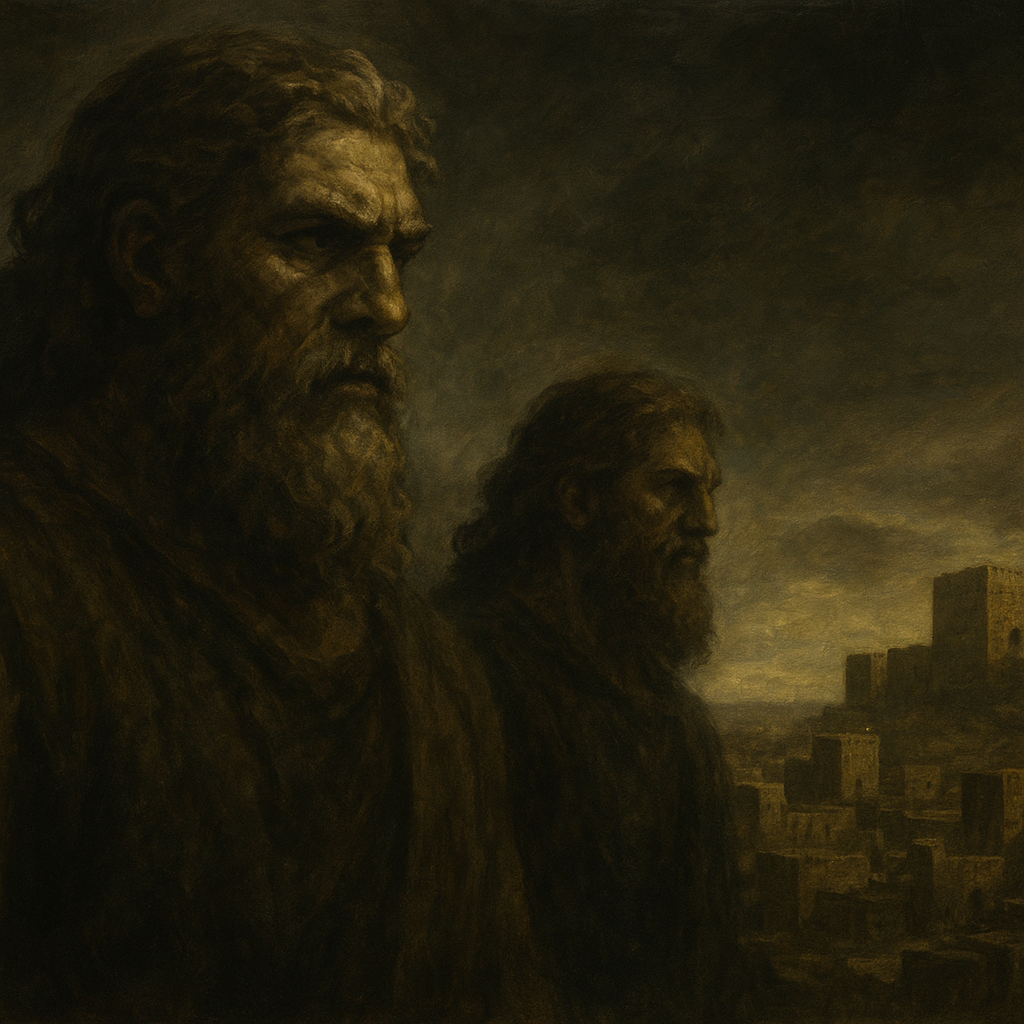
The Anakim giants survived Joshua’s conquest, retreating to Gaza, Gath, and Ashdod, where later Aegean Greek settlers built the Philistine cities, linking biblical giants to Greek culture.
Meta description: The Anakim giants survived Joshua's conquest and retreated to Gaza, Gath, and Ashdod, where Aegean Greek settlers, the Philistines, later built their cities on the same ground.
Term: Anakim — a tall, feared people living in the hill country of Canaan around Hebron, linked in the Old Testament to the Rephaim and to the Nephilim of Numbers 13:33.
Where Did the Anakim Giants Go After Joshua's Conquest?
Joshua 11:21-22 answers this directly. Joshua destroyed the Anakim from Hebron, Debir, Anab, and the whole hill country of Judah and Israel, but the text adds that some remained in Gaza, Gath, and Ashdod. Those three cities became part of the Philistine pentapolis. The Anakim were not wiped out. They retreated to the coastal plain, and the biblical record keeps producing giants from that same territory for centuries.
One Bloodline, Several Names
The Old Testament treats the Anakim, Rephaim, Emim, and Zamzummim as one population known by different regional names, not four separate tribes. Deuteronomy 2:10-11 says the Emim of Moab were tall as the Anakim and, like the Anakim, counted as Rephaim. A few verses later the same chapter applies the label Zamzummim to the giants of Ammonite territory, described the same way. Genesis 14:5-6 shows Chedorlaomer's army defeating the Rephaim, the Zuzim, and the Emim in a single campaign across the Transjordan, three names, one connected population.
Og, king of Bashan, is called the last remnant of the Rephaim in Deuteronomy 3:11, and his iron bed is measured at over thirteen feet. Rephaim functions as the umbrella term. Anakim, Emim, and Zamzummim are the regional labels beneath it.
The Giants Who Turn Up Later at Gath
2 Samuel 21:15-22 and 1 Chronicles 20:4-8 describe four giants from Gath killed during David's wars, each identified as a descendant of Rapha, the root behind the word Rephaim. Goliath, the best known giant in the Old Testament, also comes from Gath, roughly two hundred years after Joshua's campaign, in one of the three cities where the Anakim had survived.
Is There a Connection to Greek Mythology?
There is a mythological parallel, and it is worth treating carefully. The Septuagint translators rendered Nephilim as gigantes in Genesis 6, the Greek word behind giants in English. Greek mythology has its own giant tradition in the Gigantes, described by Hesiod as born from the blood of Uranus, hybrid beings who wage a losing war against the Olympian gods. The shape of the story, forbidden union between heaven and earth followed by catastrophic judgment, echoes the Nephilim account. Mainstream classicists generally treat this as two cultures independently landing on a similar theme rather than proof that one tradition borrowed from the other, so this thread belongs in the category of comparative mythology, not documented history.
The Documented Connection: Philistines Were Aegean Greeks
The stronger connection is archaeological, and it runs through the same three cities named in Joshua 11. The Philistines were not native to Canaan. Amos 9:7 and Jeremiah 47:4 both say they came from Caphtor, which modern scholarship identifies with Crete or the wider Aegean region. Excavations at Gath and Ashkelon have recovered early Philistine pottery that develops directly out of Mycenaean Greek ware, alongside Aegean-style hearths, bathtubs, loom weights, and architecture. The Philistines who settled in Gaza, Gath, and Ashdod were transplanted Greeks, arriving in the same cities where the Anakim had already taken refuge.
Goliath's story preserves that Aegean background in specific detail. His name and the name of the Philistine king Achish are not Semitic words, and scholars have traced possible links to names known from Crete and western Anatolia. 1 Samuel 17 describes his armor, a bronze helmet, scale mail, bronze greaves, in terms that match Late Bronze Age Greek equipment. His challenge for single combat, one champion decides the battle, is the same custom found in Homer's Iliad, not a Canaanite practice.
Why This Matters
The Anakim retreated to Gaza, Gath, and Ashdod after Joshua's conquest. Centuries later, Aegean Greek settlers built the Philistine culture in those same three cities. Goliath emerges from Gath carrying Greek arms and a Greek style of combat, in the one city the biblical text had already marked as a giant stronghold. The giants of the Old Testament and the Greeks of the Aegean migration do not just resemble each other in myth. At Gath, their histories occupy the same ground.
About the Author
CK Quarterman is a U.S. Air Force veteran and author under the CKQbooks imprint (ckqbooks.com), writing on UAP phenomena, biblical prophecy, and the Watchers tradition. He coined the term malaterrestrials to describe non-human intelligences operating covertly throughout history. Now you know the name of the Unknown.
Related CKQ Book
The Watchers Series — Book One
The Watchers Fallen
They Were Not Supposed to Walk Among Us
Explore in the Encyclopedia
Keep researching. Don't miss what's uncovered next.
Get first access to new Encyclopedia entries, Timeline updates, Watchers, Nephilim, Giants, Demons, Deliverance, and UFO/UAP research, plus new books and releases from CKQBooks. Free. Takes ten seconds.