
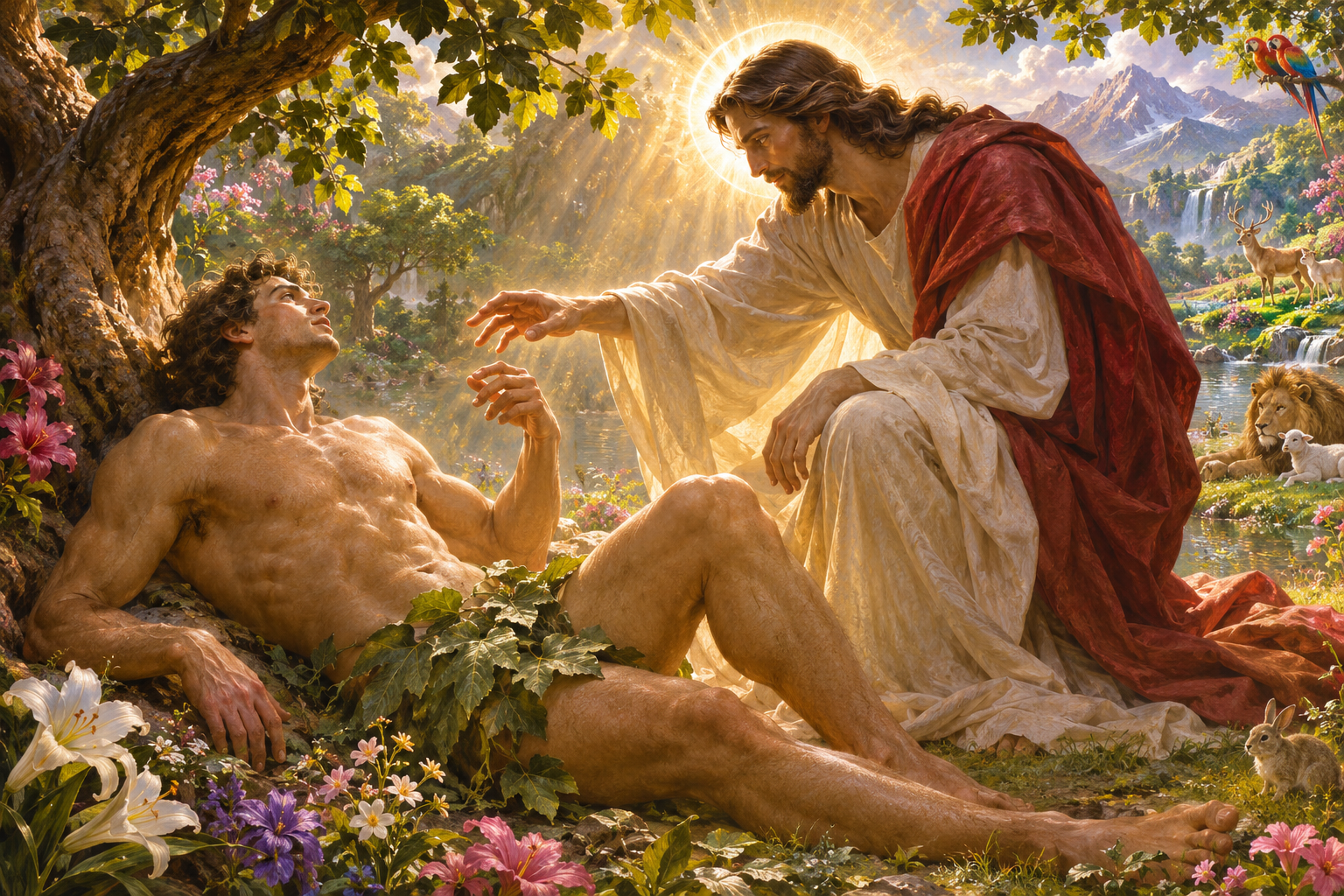
Exploring New Testament claims that the pre‑incarnate Christ created Adam and examining the Hebrew text, the author argues Jesus formed man and walked in the garden.
Pre-incarnate Christ: Jesus Christ as he existed and acted before his birth in Bethlehem.
Christophany: An appearance of the pre-incarnate Christ in the Old Testament, often identified with the angel of the LORD.
Did Jesus Create Adam?
Yes, according to the New Testament. John 1:3 says all things were made by the Word, and John 1:14 identifies the Word as Jesus. Colossians 1:16 and Hebrews 1:2 say the same of the Son. Genesis 2:7 says the LORD God formed Adam from the dust. Christians who hold the Trinity say all three persons act in creation, with the Son as the agent. Whether Jesus also walked with Adam in the garden is a separate question, and readers disagree.
What the New Testament Says
John 1:1-3 reads, “In the beginning was the Word, and the Word was with God, and the Word was God. The same was in the beginning with God. All things were made by him; and without him was not any thing made that was made.”
Colossians 1:15-17 calls the Son “the image of the invisible God” and says that “by him were all things created.” Hebrews 1:2 says God made the worlds by his Son. First Corinthians 8:6 says there is “one Lord Jesus Christ, by whom are all things, and we by him.”
Adam is part of “all things.” If the Son made everything, the Son made Adam.
What Genesis 2:7 Says
The verse says the LORD God formed the man from the dust of the ground and breathed into his nostrils the breath of life, and the man became a living soul. The Hebrew verb for formed is yatsar, the word for a potter shaping clay. The dust is aphar. The ground is adamah, and the man is adam, so the names sound alike in Hebrew.
The breath of life is nishmat chayyim. The living soul is nefesh chayyah. That phrase is also used of animals in Genesis 1:20, 1:24 and 2:19, where the King James Version translates it “living creature.” The Hebrew phrase does not separate man from animals. The difference in the account is how God made him: God formed man by hand and breathed into him directly.
Genesis 1:27 says God created man, using the verb bara. Genesis 1:26 uses asah, “make.” Genesis 2:7 says dust. The verbs do not mark a difference between creating from nothing and making from material. The dust was the material, and God supplied it.
Who Is the “Us” in Genesis 1:26?
Genesis 1:26 says, “Let us make man in our image, after our likeness.” Christian readers often see the Trinity here. Others read the plural as God addressing the divine council, the heavenly beings around his throne. Some scholars read it as a plural of deliberation or majesty. The verse does not name the speakers. The New Testament, not this verse, is what identifies the Son as the Creator.
Did Jesus Walk in the Garden?
Genesis 3:8 says Adam and Eve heard “the voice of the LORD God walking in the garden in the cool of the day.” Many readers take this as the pre‑incarnate Christ, in line with other Old Testament appearances of the angel of the LORD (Genesis 16:7-13 and Exodus 3:2-6).
Others point to John 1:18, “No man hath seen God at any time,” and read the passage as a theophany that does not identify which person of the Godhead appeared. Both readings agree that God was present and spoke.
Why Create Adam Knowing He Would Fall?
Scripture says God planned redemption first. First Peter 1:19-20 says Christ was foreordained “before the foundation of the world.” Revelation 13:8 speaks of “the Lamb slain from the foundation of the world.” Ephesians 1:4 says believers were chosen in him before the foundation of the world.
On this reading, God created man knowing the cost. The Creator who formed Adam is the one who later became a man and died for him.
My View
I believe Jesus formed Adam from the dust and breathed into him the breath of life. I believe the pre‑incarnate Christ walked in the garden. I read the evidence as pointing to a bodily resemblance between man and Christ, as well as a moral and spiritual one. The love in the account is plain to me: God made man knowing the cost, and he paid it himself.
Sources
Scripture quotations are from the King James Version.
About the author
CK Quarterman is a USAF veteran, independent author and publisher at CKQbooks (ckqbooks.com). He develops the malaterrestrials concept in his nonfiction and writes fiction in the Watchers’ Universe and Sons of the Flood series. Truth · History · Scripture.
Explore in the Encyclopedia
Divine Council
The divine council is the biblical assembly of heavenly beings that surround God’s throne, as described in passages such as Psalm 82, 1 Kings 22 and Daniel 7.
Garden of Eden
The Garden of Eden is the biblical garden God planted for Adam and Eve, described in Genesis 2–3, featuring the trees of life and knowledge and a river that divided into four heads.
Image of God
The image of God (imago Dei) is the likeness and likeness (tselem and demuth) that Genesis 1:26‑27 attributes to humanity, encompassing moral, functional, relational, and sometimes bodily aspects.
Keep researching. Don't miss what's uncovered next.
Get first access to new Encyclopedia entries, Timeline updates, Watchers, Nephilim, Giants, Demons, Deliverance, and UFO/UAP research, plus new books and releases from CKQBooks. Free. Takes ten seconds.