
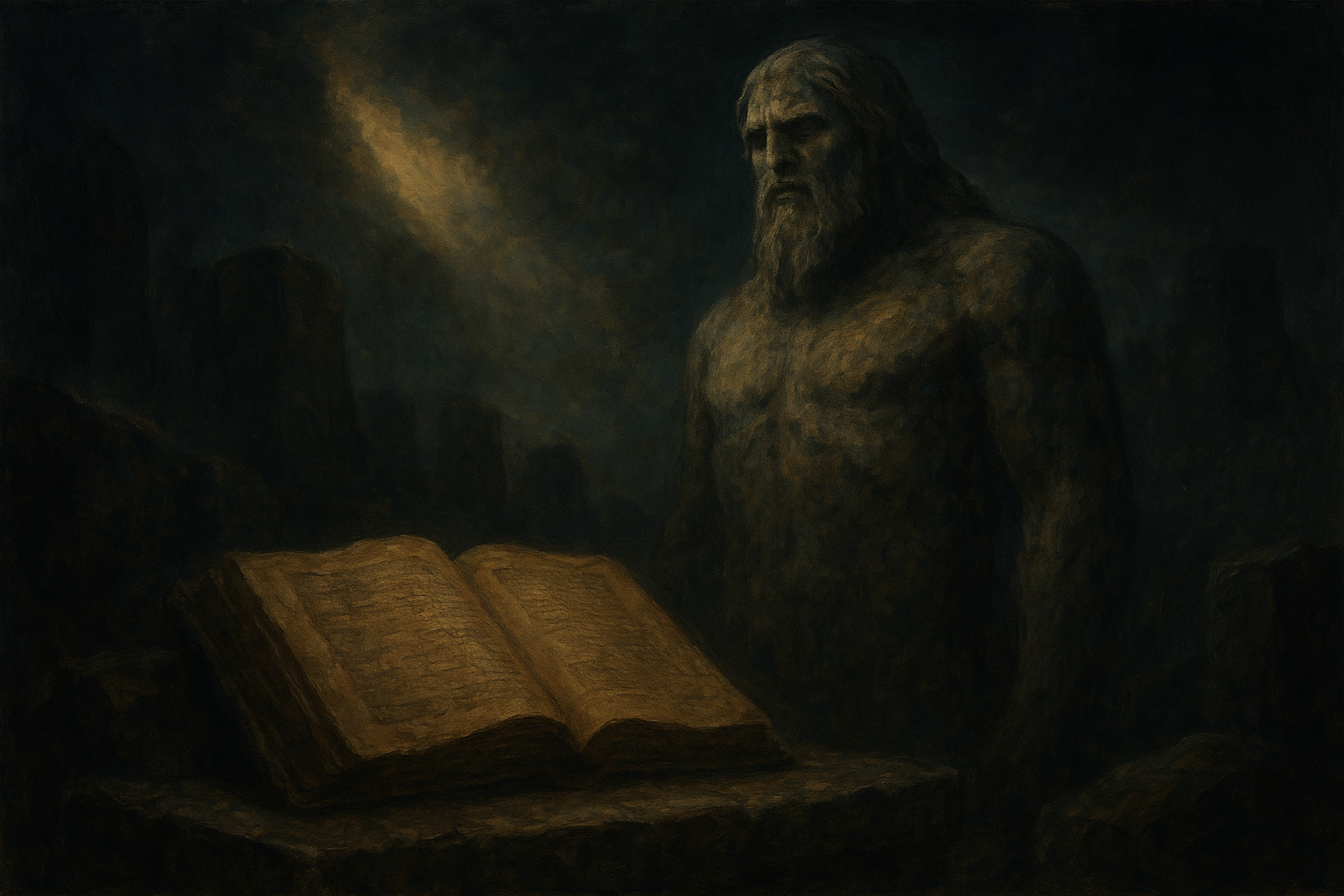
Explore whether Native American traditions truly speak of a race of tall white giants, examining 19th‑century sources, the Manta Ecuador account, and what archaeology reveals.
White giants legend: The claim that several Native American tribes share a tradition of a race of tall white people who were destroyed. The claim rests mainly on 19th‑century texts and later retellings.
Mound Builder myth: The 19th‑century belief that a lost non‑Native race built the large earthen mounds of North America. Researchers later showed that Native Americans built them.
Nephilim: A Hebrew term in Genesis 6:4 and Numbers 13:33 for giants or mighty beings. Its exact meaning is debated.
Did Native American Legends Describe White Giants?
Not in the way many websites say. Several Native traditions mention giants. The claim that tribes separated by great distances all remember a race of white giants does not hold up. The word “white” mostly comes from 19th‑century authors. The one account with a named early source, the Manta tradition from coastal Ecuador, describes giants but does not call them white.
The Comanche Account
In a book published in 1859, Nelson Lee quotes the Comanche chief Rolling Thunder describing “a race of white men, ten feet high” who built fortifications on mountain tops and were destroyed by the Great Spirit when they became proud. Many websites date the story to 1857. I could not confirm that date.
Treat this as a 19th‑century book’s account, not as Comanche testimony. Wikipedia says Lee’s narrative is regarded as a hoax, and it describes Comanche customs that do not match reality.
The Choctaw Account
Horatio Cushman’s 1899 history of the Choctaw records traditions of giants in Tennessee. Researcher Jason Colavito calls the book generally unreliable, though it preserves some myths. A Choctaw migration story does describe reaching a land of giants and fighting for territory.
The word “white” comes from a letter Henry Halbert wrote in 1878. He described the Nahullo as white, cannibal, and extinct. He also argued that the Mound Builders were a separate white race and that Native Americans had arrived recentl y. The word nahullo appears elsewhere in Choctaw tradition for beings with occult or superior power, so it is not simply a name for a giant race.
The Manta Account
This is the best documented. Pedro de Cieza de León recorded it in 1553 and Agustín de Zárate in 1555. It comes from the coast near Santa Elena, in what is now Ecuador. Giants arrived on rafts and were destroyed. Zárate says they were four times the size of a man and that divine justice removed them for “unnatural vice.” Cieza says fire from heaven destroyed them.
In 1543, the Spanish captain Juan de Olmos dug in the area and found large bones and teeth. Colavito describes them as megafauna remains. The Spaniards recorded the story in the decades after contact, so we cannot tell how much is older tradition and how much reflects Spanish interpretation. Zárate’s comparison to Sodom is his own.
The Paiute Account
Many websites describe red‑haired, ten‑foot cannibals called the Si‑Te‑Cah near Lovelock Cave, Nevada. The earliest source is Sarah Winnemucca Hopkins, in her 1882 book Life Among the Piutes. She describes a small tribe of cannibals with reddish hair who were burned in a cave after they refused to surrender. She mentions no giants and does not call them white.
Brian Dunning of Skeptoid found no mention of the Si‑Te‑Cah in the Paiute lore he reviewed. He says scholars use the name Saidaku for the earlier people. Guano miners began finding artifacts in the cave in 1911. Llewellyn Loud excavated in 1912 and published in 1929. He reported no giants.
Dunning also notes that dark hair often turns reddish after long burial, so red hair in a burial does not show the person had red hair in life.
Where the “White” Came From
In the 1800s many Americans could not accept that Native Americans had built the large mounds, so they proposed a lost white race. Halbert’s letter is an example. The Smithsonian’s Bureau of Ethnology concluded in 1894, in a report by Cyrus Thomas, that Native Americans built the mounds.
Colavito traces the white giants claims from 19th century texts through the writer Donald Yates to modern retellings, with the word “white” added along the way. You will also see a Navajo “Starnake” race of white giants. I found no Navajo source for it. Only blogs repeat it, and Yates himself suggests the name may be a corruption of Anakim, which is his own guess.
What Holds Up
• Several traditions mention giants, including the Choctaw migration story and the Manta account.
• The Manta account has named Spanish recorders in 1553 and 1555. It does not call the giants white.
• The Comanche, Navajo, and Paiute “white giant” versions rest on a questionable book, an unsourced blog claim, and a legend that Native sources do not support.
• No source I found shows archaeological evidence of ten‑foot people. Lovelock Cave produced none.
My View
I believe the Nephilim and the sons of Anak in Genesis 6:4 and Numbers 13:33 were real, and that traditions of giants in many parts of the world are consistent with that account. That is my reading of Scripture.
For more on the giants of Scripture, read The Watchers Fallen. For fiction built on the same subject, see The Giant’s Shadow: Pride the Destroyer, Book One of Sons of the Flood: The Deliverance Chronicles.
CK Quarterman. CK Quarterman is a USAF veteran and independent author. He publishes through CKQbooks (ckqbooks.com) and writes about Malaterrestrials, the evil earthbound intelligences behind UFOs, shadow figures, and unexplained encounters. Truth · History · Scripture
Related CKQ Book
The Watchers Series — Book One
The Watchers Fallen
They Were Not Supposed to Walk Among Us
Explore in the Encyclopedia
Elioud
The third generation of giant hybrids in Second Temple Jewish literature, descended from the Watchers through the great giants and the Naphil.
Nephilim
The Nephilim are the powerful, giant figures mentioned in Genesis 6:4 and Numbers 13:33, whose name is linked to the Hebrew verb “to fall” and has been interpreted as “giants” in ancient texts.
Giant Tribes
Giant Tribes in the Bible
Towns, cities or locations that were said to have had giants in them.
These cities and locations show evidence in the text of the Old Testament that they were home to the giants.
Keep researching. Don't miss what's uncovered next.
Get first access to new Encyclopedia entries, Timeline updates, Watchers, Nephilim, Giants, Demons, Deliverance, and UFO/UAP research, plus new books and releases from CKQBooks. Free. Takes ten seconds.