
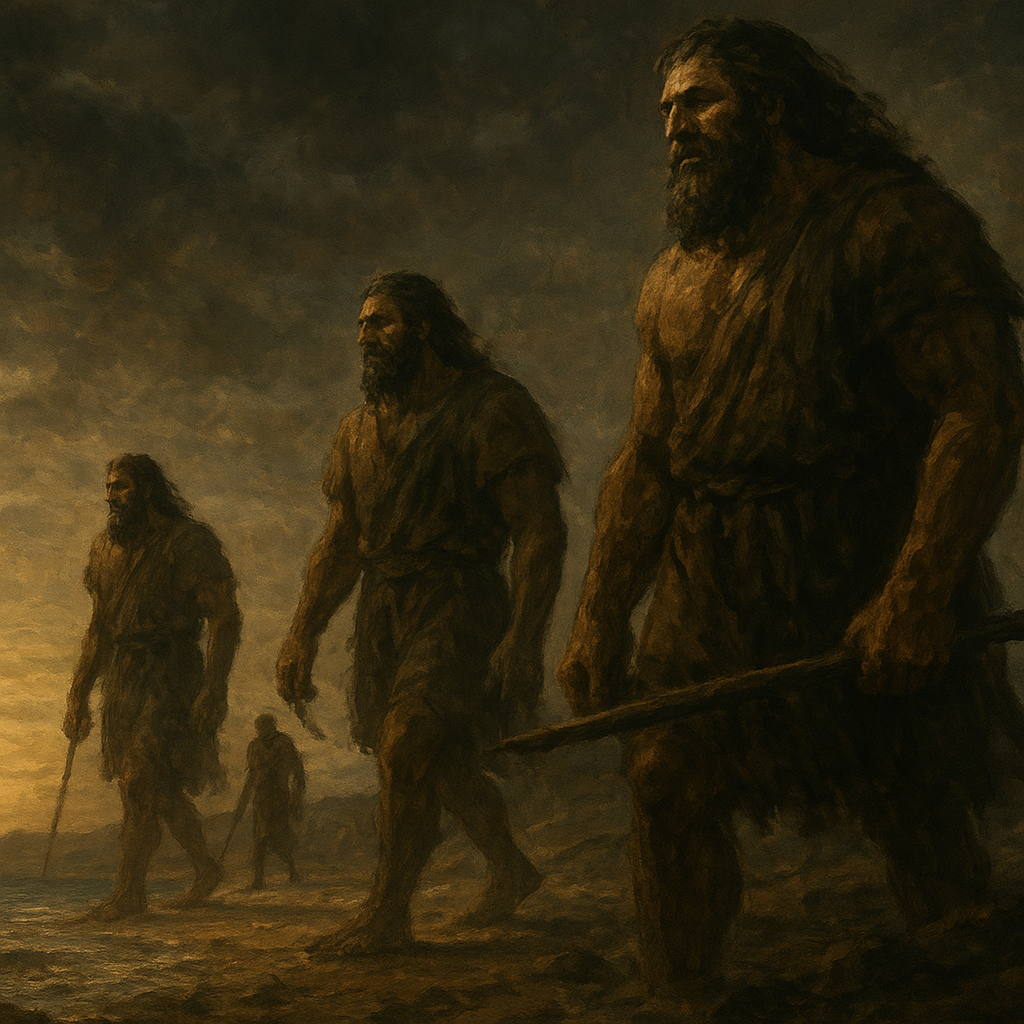
Ancient historians and biblical texts both suggest that after Joshua's conquest, the surviving Canaanite giant clans migrated westward, leaving traces of their presence along the North African coast.
Short answer: ancient historians and biblical tradition both point the same direction. When Joshua's conquest broke the giant clans of Canaan, the Bible describes survivors fleeing to Philistine territory, while separate Greco-Roman and Byzantine sources place a giant tradition, and even a Canaanite refugee inscription, on the Atlantic shore of North Africa near modern Tangier and Algeria.
Where Did the Giants Go From Canaan?
The Bible never says the giant clans of Canaan were wiped out to the last man. Numbers 13 has the scouts of Israel describing the sons of Anak as men so large that the Israelites felt like grasshoppers next to them. By the time Joshua's armies finish their campaign, the text is careful to note something specific: the Anakim are not gone from the earth. Joshua 11:22 says none were left in the land of the children of Israel, but adds that they remained in Gaza, in Gath, and in Ashdod, the Philistine cities on the coastal plain. That single verse is the seed of everything that follows. It tells us the giant lineages of Canaan didn't vanish at Jericho or Hebron. They scattered, and at least one branch of that scattering kept moving until it reached the far side of the Mediterranean world.
This piece traces that movement using sources most Nephilim researchers never touch: a Byzantine general's biographer, a Roman naturalist, a Greek geographer, and an Armenian historian, all writing centuries apart and none of them citing each other. When independent ancient writers converge on the same location for the same kind of story, that convergence is worth taking seriously, whatever you ultimately conclude about the giants themselves.
The Giants of Canaan: Anakim, Rephaim, and the Shadow of the Nephilim
Genesis 6 introduces the Nephilim as the offspring of the "sons of God" and human women, a race the text says existed "in those days, and also after that," meaning both before and after the Flood. Whatever position you take on that verse, the biblical writers plainly treat post-Flood giants as a real, named, and geographically specific population. Canaan is where the Bible locates them most densely. The Rephaim, the Anakim, the Emim, and the Zamzummim all appear as distinct giant peoples occupying the land before and during Israel's conquest. Og, king of Bashan, gets an iron bed nearly fourteen feet long recorded in Deuteronomy 3, offered almost as a museum exhibit, proof for a later reader who might doubt the claim.
Scholars who study these texts as literature point out that "Rephaim" and "Anakim" function almost as umbrella terms, applied to any population the Israelite writers regarded as unnervingly large or unnervingly old, the remnant of something that predated ordinary human memory. Whether that reflects an actual genetic lineage descending from the Watchers of Enoch tradition, a folk memory of an earlier and larger-boned population, or simply the terrified exaggeration common to conquest narratives everywhere, the pattern in the text is consistent. These are not incidental giants. They are named, tracked, and treated as a recurring problem for Israel to finish off, one that reappears in later stories such as David's fight with Goliath of Gath, himself explicitly tied to the giant lineage of the Philistine coast.
Joshua's Conquest and the Scattering of the Canaanite Peoples
Joshua 11:21 through 11:22 describes Joshua cutting off the Anakim from the hill country, from Hebron, Debir, Anab, and the mountains of Judah and Israel, destroying their cities utterly. Then comes the qualifying clause that historians of the giant tradition tend to skip past too quickly: none were left in Israel's territory, except that Anakim remained in Gaza, Gath, and Ashdod. That is a retreat, not an extinction. The giant clans didn't disappear from the earth in the space of one military campaign. They fell back to the coast, into Philistine cities that Israel never fully absorbed, and from a coastal Mediterranean position, further movement by sea or along the North African littoral becomes entirely plausible rather than speculative.
This is also the moment where a separate, non-biblical tradition picks up the thread: not about the Anakim by name, but about the broader Canaanite population Joshua displaced, some of whom, according to later historians, did not stop at Gaza at all. They kept going, along the African coast, past Egypt, past Cyrenaica, into what the ancient world called Numidia and Mauretania, the stretch of North Africa running from modern Libya through Algeria and Morocco to the Atlantic.
Procopius and the Stone Columns of Tigisis
The clearest ancient statement of this migration comes from Procopius of Caesarea, the sixth-century Byzantine historian who accompanied the general Belisarius during Emperor Justinian's campaign to retake North Africa from the Vandals. In his History of the Wars, Book IV, Procopius records a tradition current among the Moors of Numidia in his own day. He writes that a Canaanite people, driven from their homeland, built a fortress in Numidia, on the site where the city of Tigisis later stood, and that near a great spring in that city stood two columns of white stone, inscribed in the Phoenician language. Procopius reports the inscription's content directly: the people who raised the columns identified themselves as those who fled before the face of Joshua, whom the inscription calls "the robber, the son of Nun."
Notice what that inscription is doing. It isn't a vague folk memory of "invaders from the east." It names Joshua specifically, by the same title the book of Joshua gives him, son of Nun, and it frames the migration as a direct consequence of his conquest. Procopius is not a biblical apologist. He is a court historian writing a military and political history of Justinian's wars, recording local tradition the way any careful historian of his era would record an inscription he'd heard described or possibly seen reported to him. He had no theological stake in confirming the book of Joshua. The location he names, Tigisis, is usually identified with a site in what is now Algeria, squarely within the belt of North Africa that later chroniclers also connect to giants.
Moses of Khorene's Independent Testimony
If Procopius stood alone, a skeptic could reasonably suspect he was simply repeating a story shaped by biblically literate Christian informants in a Christianized empire, telling a Byzantine historian what they thought he wanted to hear. But he does not stand alone. The Armenian historian Moses of Khorene, writing from an entirely different tradition, a different language, and a different religious and political context, records the same two Phoenician columns at the same location. Moses of Khorene is generally dated earlier than Procopius, which means either both writers drew on a shared earlier source now lost to us, or the tradition of the Tigisis inscription was old and widely enough known by the time Procopius wrote that it had already reached Armenian historical circles independently. Either way, this is not a single, isolated claim. It is a tradition attested twice, by writers with no obvious reason to have copied one another, both placing the same displaced Canaanite population on the North African coast.
Antaeus of Libya: Myth, Memory, or Something Else
Move further west along that same coast, from Numidia into what the Greeks called Libya, broadly meaning the whole of North Africa west of Egypt, and a second, older tradition appears: the giant Antaeus. In Greek mythology, Antaeus is the son of Poseidon and Gaia, the earth goddess, and his strength is tied directly to contact with the ground his mother embodies. He forces travelers through his territory into wrestling matches, kills them, and famously loses only when Heracles lifts him off the earth and crushes him in midair, cutting him off from the source of his power. On its face this is standard Greek heroic myth. But ancient geographers didn't treat Antaeus as a purely literary figure confined to poetry. They treated him as a local historical memory with a fixed, physical location.
The tomb of Antaeus, according to Strabo's Geography and the later Roman writer Pomponius Mela, stood near the town of Tingis, the settlement that is now Tangier, Morocco, directly on the Atlantic-facing shore of North Africa. Local tradition held that the tomb was shaped like a reclining human figure and that disturbing the earth over it caused rain that would not stop until the disturbed portion was refilled, a detail that reads like the kind of protective taboo communities build around a site they consider genuinely dangerous to disturb, not merely a good story.
Sertorius and the Sixty-Cubit Skeleton at Tingis
The story becomes a datable historical event, not just literary geography, in the account of Quintus Sertorius, the Roman general who led a breakaway Roman state in Spain and North Africa during the 80s and 70s BC. According to Plutarch's Life of Sertorius, Sertorius was shown the mound at Tingis said to hold Antaeus's remains, and being skeptical of local legend, he had it opened. What his men found, in Plutarch's account, was a skeleton measuring sixty cubits in length, on the order of eighty-five to ninety feet by most reconstructions of the ancient cubit. Sertorius, by Plutarch's telling, was shaken by the discovery, made a sacrifice at the site, and had the mound resealed and restored with full honors rather than treating the find as a curiosity to be carried off.
Even in antiquity this account did not go unchallenged. Later classical commentators pointed out that Plutarch's sixty-cubit figure traces back to a writer named Gabinius, whose reliability was already questioned in his own lifetime, and argued that Plutarch had simply repeated a dubious secondhand number without independent verification. That ancient skepticism matters. It shows that even writers within the Greco-Roman tradition itself treated the giant-skeleton claim as an extraordinary one requiring scrutiny, not something ancient audiences swallowed uncritically simply because a respected biographer wrote it down.
Pliny the Elder and the Marvelous Legends of Lixus
The Roman naturalist Pliny the Elder, writing his Natural History a little over a century after Sertorius, adds a second, independent classical source and a second location. In Book V, describing the Atlantic coast of Mauretania, Pliny places the city of Tingi as originally founded by Antaeus, and describes Lixus, a short distance further down the coast, as the true site of Antaeus's palace, his combat with Hercules, and the gardens of the Hesperides. Pliny is notably more reserved than Plutarch. He explicitly declines to repeat what he calls the "marvellous legends" told by older writers about the place, flagging the material as tradition he won't personally vouch for even while recording that the tradition existed and naming its precise geography.
That reservation is itself informative. Pliny had no hesitation elsewhere in his encyclopedia about reporting genuinely bizarre claims when he judged them credible or at least worth preserving. His visible caution here signals that even by the standards of first-century Roman scholarship, the Antaeus material at Lixus was understood as folklore layered onto a real place, not settled fact, while the place itself, and its association with a giant tradition, was treated as geographically real and worth recording precisely.
Connecting the Threads: From Canaan to the Atlantic Shore
Set these accounts side by side and a single corridor emerges. Joshua's conquest displaces the giant clans of Canaan; the biblical text itself notes survivors falling back to the Philistine coast rather than being annihilated. Procopius and Moses of Khorene, independently of each other, record a Canaanite population that continued west along the North African coast into Numidia, leaving an inscription that names Joshua by title and frames the migration as flight from his campaign. Continue further west along that same coastline, into Mauretania, and Greek and Roman writers, again independently of the Numidian inscription tradition and of each other, record a giant figure permanently rooted in the geography of Tingis and Lixus, a giant whose remains a Roman general is said to have personally exhumed and measured within his own lifetime, at sixty cubits.
None of these writers were building a single connected argument. Procopius wasn't trying to explain Antaeus. Pliny wasn't trying to confirm the book of Joshua. Plutarch wasn't thinking about Phoenician inscriptions in Numidia. Each source is doing its own independent work, in its own genre, for its own audience, centuries apart. What ties them together is nothing more than geography and a recurring, insistent claim about unusually large human remains and unusually large human beings, distributed along a single stretch of coastline that biblical geography already has good reason to expect displaced Canaanite giant clans to have reached.
The Skeptical Counter-Argument: Fossils, Mastodons, and Euhemerism
A responsible account of this material has to include the strongest case against it. Modern paleontologists have pointed out that the coastal region around Tingis and Lixus sits on genuinely significant Neogene fossil beds, deposits from the Miocene and Pliocene epochs containing the remains of large extinct mammals, including early elephant relatives and other megafauna whose bones, especially long limb bones and skulls, can look startlingly humanlike to observers without training in comparative anatomy. The classicist and historian of science Adrienne Mayor has argued persuasively, across several ancient sites, that many of the giant-bone traditions of the Mediterranean world trace back to exactly this kind of accidental paleontological discovery, misread through the lens of existing hero and giant mythology rather than invented from nothing.
On this reading, the Antaeus tradition at Tingis and Lixus is a case of the ancient world doing genuine, if unrecognized, paleontology. Greek colonists arriving on the Libyan coast in the seventh century BC, already carrying a mythology full of giants and earth-born monsters, encountered real fossil bones eroding out of real cliffs and did what any pre-scientific culture confronted with anomalous evidence tends to do: they built an explanatory story around it, attached it to an existing god's lineage, Poseidon and Gaia, and gave it a name, Antaeus, and a location memorable enough to survive for a thousand years in written sources. Sertorius, on this account, did not uncover a ninety-foot human. He uncovered a genuine large fossil, correctly recognized as impressively large and incorrectly identified as human, embedded in a story his soldiers already half-believed before they ever put a shovel in the ground.
This explanation is coherent, well-supported by the geology, and almost certainly accounts for a meaningful share of the classical giant tradition generally. It is worth stating plainly rather than waved away, because a case for the Nephilim that can't survive contact with its strongest counter-argument isn't a case worth making. What it does not fully explain, however, is the separate Numidian tradition in Procopius and Moses of Khorene. That story involves no bones, no fossils, no skeleton to misidentify. It involves an inscription, in a specific ancient language, naming a specific historical figure by a specific title, attached to a specific act of migration. A fossil bed can generate a giant myth. It is considerably harder for a fossil bed to generate a two-column Phoenician inscription that happens to name Joshua, son of Nun, by the exact title the book of Joshua itself uses.
What This Means for the Nephilim Question
Put the two North African traditions in their proper places and a picture takes shape that is more interesting than either a flat "yes, giants were real and here is the skeleton" or a flat "it's just fossils and folklore." The biblical text describes a giant lineage in Canaan that was defeated but not eliminated, with named survivors falling back to a Mediterranean coastline. Two independent ancient historians, writing centuries apart in different languages and different empires, record a Canaanite population that continued that retreat along the North African coast and left behind a monument naming the very conqueror the Bible names. Further along that same coast, a giant tradition took root that Roman writers treated seriously enough to record precisely, argue over, and in at least one case, physically investigate, whatever the true nature of what Sertorius's men actually dug up.
Whether the Nephilim bloodline, the Anakim, and the Antaeus tradition are one continuous thread or three separate strands that later storytellers braided together after the fact is a question no single source answers on its own. But the geography lines up. The chronology lines up. And the pattern of independent, cross-cultural attestation, biblical, Greek, Roman, and Byzantine sources all pointing at the same narrow strip of African coastline, is not the kind of coincidence that dissolves easily under scrutiny. It is, at minimum, a corridor worth walking again.
Sources
Genesis 6:1-4; Numbers 13:33; Deuteronomy 3:11; Joshua 11:21-22.
Procopius, History of the Wars (Vandalic War), Book IV, chapter 10.
Plutarch, Life of Sertorius, chapter 9.
Pliny the Elder, Natural History, Book V.
Strabo, Geography, Book XVII; Pomponius Mela, De Chorographia, Book III.
Moses of Khorene, History of Armenia (on the Tigisis columns, as attested independently of Procopius).
Adrienne Mayor, The First Fossil Hunters: Paleontology in Greek and Roman Times.
CK Quarterman. CK Quarterman is a USAF veteran, author, and researcher who publishes under the CKQbooks imprint at ckqbooks.com. He developed the Malaterrestrials concept, a term for the evil earthbound non-human intelligences he connects to UFO reports. Truth · History · Scripture.
Related CKQ Book
The Watchers Series — Book One
The Watchers Fallen
They Were Not Supposed to Walk Among Us
Explore in the Encyclopedia
Antediluvian
The period of biblical history between the creation of Adam and the flood of Noah, covering Genesis 1 through 6. The term was coined by the English writer Thomas Browne in the seventeenth century.
Anakim
A clan of giants dwelling in Canaan, descended from Anak, feared by the Israelite spies.
Keep researching. Don't miss what's uncovered next.
Get first access to new Encyclopedia entries, Timeline updates, Watchers, Nephilim, Giants, Demons, Deliverance, and UFO/UAP research, plus new books and releases from CKQBooks. Free. Takes ten seconds.