
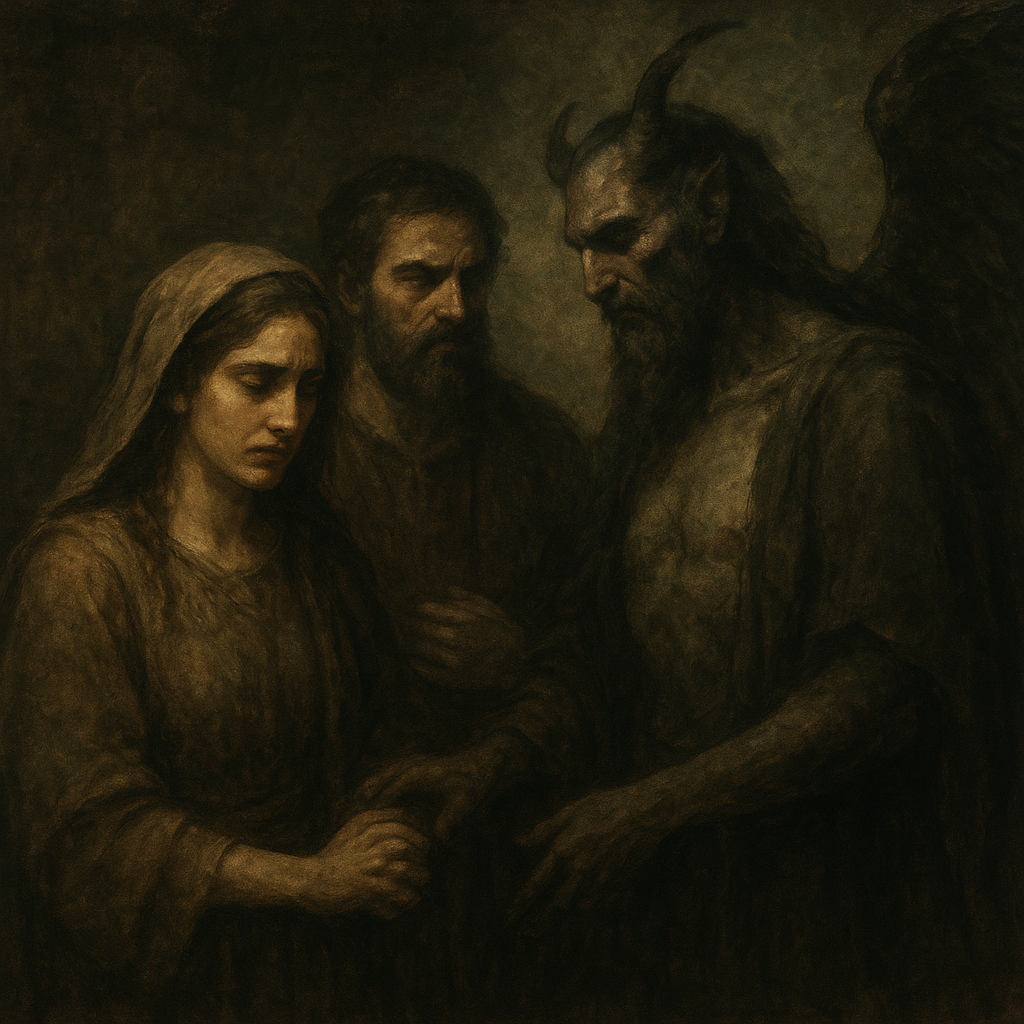
Explore Jewish tradition and Book of Enoch lore to uncover whether Naamah, sister of Tubal‑Cain, was married to the fallen angel Azazel, and what this means for Watcher mythology.
Was Naamah, Sister of Tubal-Cain, Married to the Fallen Angel Azazel?
Short answer: Jewish tradition, most directly the Zohar and Louis Ginzberg's Legends of the Jews, names a fallen angel as Naamah's husband. Some sources call him Azael, a variant of Azazel. Others call him Shamdon. The strongest evidence for the Azazel version is that Genesis credits her brother Tubal-cain with inventing metalworking, and the Book of Enoch credits Azazel with teaching that exact craft to humanity.
Watchers: the fallen angels described in the Book of Enoch who descended to Mount Hermon and taught forbidden knowledge to humanity, including metalworking, cosmetics, and enchantments. Azazel is named among their leaders.
Was Naamah, sister of Tubal-Cain, married to the fallen angel Azazel? That question sits at the center of one of the more overlooked threads in Watcher lore, and it starts with a single verse most readers skim past without a second look.
Was Naamah, Sister of Tubal-Cain, Married to the Fallen Angel Azazel?
Genesis 4:22 names Naamah as the sister of Tubal-cain and gives her no other role in the text. Later Jewish tradition fills that gap by marrying her to a fallen angel. The Zohar calls him Azael, a spelling variant of Azazel. Ginzberg's Legends of the Jews tells the same core story under the name Shamdon. Both versions agree on the outline: a fallen angel takes Naamah, and the demon Asmodeus is born from that union. Azazel is the most commonly repeated name across these sources, though not the only one.
What Genesis Actually Says About Naamah
The verse itself is brief. “And Zillah, she also bore Tubal-cain, an instructor of every artificer in brass and iron: and the sister of Tubal-cain was Naamah.” That is the whole entry. No husband, no children, no explanation for why she is named at all in a genealogy built almost entirely around men fathering sons.
Scripture rarely names a woman in a genealogy without a reason. Naamah's presence here, unexplained, is exactly the kind of gap that later rabbinic tradition tried to fill. Her brother, by contrast, gets a clear identity. He is the first metalworker named in the Bible, an instructor of brass and iron. That detail turns out to matter more than it looks like it should.
The Enoch Connection: Azazel Taught the Same Craft
The Book of Enoch names Azazel as one of the Watchers who descended to Mount Hermon and broke the boundary between heaven and earth. Enoch 8:1 lists what he brought down with him: “And Azazel taught men to make swords, and knives, and shields, and breastplates, and made known to them the metals of the earth and the art of working them.”
Weapons, armor, metallurgy. That is the same craft Genesis hands to Tubal-cain, in a different book, from a different literary tradition. Two independent sources credit the same skill to two different figures who, according to later legend, shared a household. That is not proof of a direct teacher‑student relationship between Azazel and Tubal-cain, but it is a strong enough parallel that Jewish tradition built an entire marriage story around it.
What Jewish Tradition Says About Naamah's Husband
The tradition is not tidy. The Zohar identifies Azael, a variant of Azazel, as Naamah's husband. Ginzberg's Legends of the Jews gives the same figure the name Shamdon and describes Naamah as a woman who “led the angels astray with her beauty,” bearing the demon Asmodeus from that union. Other retellings widen the cast further, linking Naamah to Shemhazai, the second Watcher named in Enoch's account, after her sister Ishtahar rejects his advances. One passage in the Zohar names two different angels pursuing her at once, Uzza and Azael, rather than settling on a single husband.
Read across all of it, the pattern that survives is simple: a fallen angel took Naamah, and Azazel is the name that shows up most often. The disagreement over his exact name is normal for oral and rabbinic tradition passed down and reworked over centuries. It does not erase the core claim. It just means you should present the Azazel identification as the leading tradition, not the only one.
Does the Timeline Actually Line Up?
A natural follow‑up question is whether the generations line up chronologically with the two hundred Watchers described in Enoch 6 and 7. Here you run into a real limit in the text. Genesis 5 gives ages at each generation for the line from Seth to Noah, which is how traditional chronologies are built. Genesis 4, the line that produces Tubal-cain and Naamah, gives no ages at all. There is no birth year for the Cainite Lamech and no age at which he fathered Tubal-cain.
That means the timeline cannot be calculated from Scripture with precision. What can be said honestly is that the Cainite line and the Watcher narrative both sit within the same broad pre‑Flood era described in Genesis 6, and nothing in the text rules out Tubal-cain and Naamah living during the window before the Flood when Enoch places the Watchers' activity. Treat this as a plausible overlap, not a proven one.
The Bottom Line
Three separate threads converge on the same claim. A Hebrew genealogy names Tubal-cain as the first metalworker. An Enochic text names Azazel as the angel who taught that exact craft to humanity. Centuries of rabbinic legend, working independently of both, conclude that a fallen angel, most often identified as Azazel, married into that same family. None of the three sources set out to agree with each other. They converge anyway, and that convergence is what keeps this thread alive in Watcher research generations after the Zohar first wrote it down.
About the Author
CK Quarterman is a U.S. Air Force veteran and the author and publisher behind the CKQbooks imprint, where he writes nonfiction and fiction exploring UAP phenomena, biblical prophecy, and the Watchers tradition. He coined the term “malaterrestrials” to describe the non‑human intelligences he argues have operated covertly throughout history. Read more at ckqbooks.com. Now you know the name of the Unknown.
CK Quarterman. CK Quarterman is a USAF veteran, author, and researcher who publishes under the CKQbooks imprint at ckqbooks.com. He developed the Malaterrestrials concept, a term for the evil earthbound non-human intelligences he connects to UFO reports. Truth · History · Scripture.
Explore in the Encyclopedia
The Watchers
A class of angelic beings who, in 1 Enoch, descend to earth, take human wives, and teach forbidden knowledge.
Antediluvian
The period of biblical history between the creation of Adam and the flood of Noah, covering Genesis 1 through 6. The term was coined by the English writer Thomas Browne in the seventeenth century.
Keep researching. Don't miss what's uncovered next.
Get first access to new Encyclopedia entries, Timeline updates, Watchers, Nephilim, Giants, Demons, Deliverance, and UFO/UAP research, plus new books and releases from CKQBooks. Free. Takes ten seconds.