
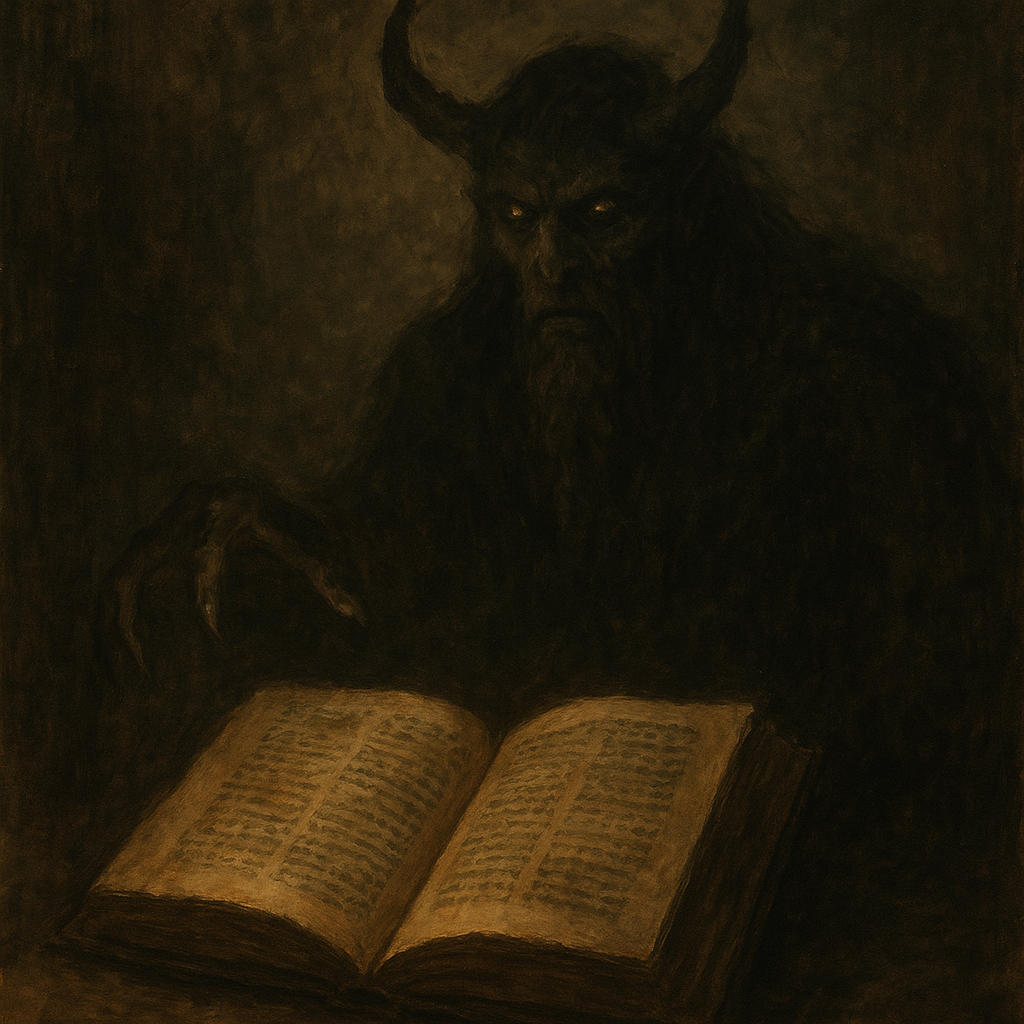
Two ancient Jewish texts, 1 Enoch and Jubilees, explain that demons are the lingering spirits of the giant offspring of the Watchers, bound after the flood.
Are Demons the Spirits of Dead Giants?
Short answer: Two ancient Jewish texts, 1 Enoch and Jubilees, say yes. 1 Enoch 15 explains that when the giants born of the Watchers died in the flood, their hybrid nature meant their spirits had nowhere to go, so they remained on earth as evil spirits. Jubilees 10:1-11 picks up the story afterward: those spirits keep attacking Noah's descendants until God has 90 percent of them bound, leaving 10 percent free under a figure named Mastema.
Keywords: demons spirits of dead giants, 1 Enoch 15 evil spirits, Jubilees 10 Mastema, Nephilim demons origin, Watchers giants afterlife.
In the Hebrew Bible itself, the Old Testament never explains where demons come from. It mentions them (Leviticus 17:7, Deuteronomy 32:17, Psalm 106:37) without tracing their origin. That gap gets filled in two Jewish texts written between roughly the third and second centuries B.C.: 1 Enoch, specifically the Book of the Watchers section, and Jubilees, a retelling of Genesis and Exodus.
Both texts trace demons back to the giants of Genesis 6, the offspring of the Watchers (fallen angels) and human women. Both agree the giants died, mostly in the flood, and that their deaths didn't end them. Instead, something in them, described as spirit, survived the body's destruction and kept operating on earth as what we'd call demons or evil spirits. 1 Enoch explains why that happened. Jubilees explains what happened to those spirits next.
1 Enoch 15: Why the Giants' Spirits Couldn't Simply Die
1 Enoch 15 frames this as God speaking directly to Enoch, who then delivers the message to the fallen Watchers. God's argument runs on a category problem. The Watchers were created spiritual, holy, and immortal, meant to stay in heaven. Humans were created mortal and physical, meant to marry, reproduce, and eventually die. The Watchers broke the boundary between the two categories, and their offspring, the giants, ended up as something that didn't fit either category cleanly.
The text lays out the logic across verses 3 through 7: the Watchers, being spiritual and eternal, had no business taking wives and fathering children the way mortal men do. Verse 4 states that though the Watchers were holy and possessed eternal life, they defiled themselves with human blood and lusted after flesh and blood the way those who die and perish do. Verse 6 draws the contrast directly: the Watchers were made spiritual and eternal, not subject to death, while verse 5 notes that ordinary human wives were given to men specifically so children could be born and die on earth as intended.
Verse 8 is where the text states its conclusion outright: the giants, produced from spirit and flesh together, would be called evil spirits on earth, and the earth would be their dwelling place. Verse 9 adds that these evil spirits proceed from the giants' bodies, since their origin traces back to the holy Watchers. Verse 10 sets the geography: spirits that originate in heaven belong in heaven, but spirits born on earth belong on earth, which is why the giants' spirits, unlike their angelic fathers, are stuck here permanently rather than facing judgment in the heavens.
Verses 11 and 12 describe what these earthbound spirits actually do: they afflict, oppress, destroy, attack, and cause trouble, all without needing food, since they no longer have working physical bodies, yet somehow still experience hunger and thirst. The text specifically says they rise up against both men and women, since they proceeded from human mothers as much as angelic fathers.
The underlying logic, in plain terms: a giant was half eternal spirit, half mortal flesh. When the mortal half died, normal human death (body decays, that's the end for a mere mortal, or the spirit goes to Sheol) didn't apply cleanly, because part of the giant's nature was never mortal to begin with. And full angelic judgment didn't apply either, because part of the giant's nature was never fully divine. The giants fell into a gap in the created order, and 1 Enoch resolves that gap by making them permanent earthbound spirits, which is to say, demons.
Jubilees 10:1-11: What Happened to Those Spirits After the Flood
Jubilees picks up generations later, after Noah and his family have survived the flood. It doesn't re-explain the mechanism the way 1 Enoch does. It assumes the reader already knows the giants' spirits survived, and tells the next part of the story: those spirits start actively harassing Noah's grandchildren.
Jubilees 10:1 opens with exactly that: in the third week of that jubilee, unclean demons began to lead astray the children of Noah's sons, deceiving and killing them. Verse 2 has Noah's sons coming to their father to report it. Noah responds by praying (verses 3 through 6), asking God to shut these spirits away so they can't harm his descendants.
That's where a new character enters the story: Mastema, called the chief of the spirits, functioning in Jubilees roughly the way Satan functions in later Jewish and Christian texts. In verse 8, Mastema makes a direct appeal to God: let some of these spirits stay free and under his command, because otherwise he has no way to carry out judgment and correction on wicked humanity. Mastema's own words, in the classic R.H. Charles translation, argue that he needs a portion of them left to him, since it's their whole purpose to corrupt and lead astray, and human wickedness is severe enough to warrant it.
God's answer, in verse 9, is a compromise: nine-tenths of the spirits are bound and sent down to the place of condemnation, while one-tenth remains active on earth, subject to Mastema. Verses 10 through 11 add a practical detail: God has an angel teach Noah the medicinal use of herbs specifically so his family has some defense against the spirits still at large, and Noah writes it all down and passes it to his son Shem.
That 90/10 split is unique to Jubilees. It doesn't appear in 1 Enoch, and it functions as an explanation for something the audience already sees for themselves: demonic activity clearly still exists in the world, but it's limited rather than total. Jubilees answers the obvious follow-up question (if God dealt with these spirits after the flood, why do they still afflict people?) by saying he only removed nine of every ten, not all of them.
How the Two Texts Fit Together
Read in sequence, the two texts form a single continuous account rather than two competing ones. 1 Enoch 15 supplies the origin and mechanism: giants are hybrid beings, their deaths don't fully remove them from the earth, and their surviving spirits become what people experience as demons. Jubilees 10 supplies the sequel: those spirits don't go away on their own, they actively trouble Noah's descendants, God intervenes to bind most of them, and a chief spirit named Mastema is left in charge of the fraction still operating.
Put together, they answer three separate questions the Old Testament itself leaves open: what are demons, where did they come from, and why does evil spiritual activity persist rather than having been fully resolved in the past. Later Jewish and Christian demonology, including material that shows up in the New Testament's own assumptions about unclean spirits, draws heavily on exactly this framework, even where it isn't cited by name.
Are 1 Enoch and Jubilees Scripture?
Neither book is part of the Hebrew Bible or the Protestant or Catholic Old Testament canon. The Ethiopian Orthodox Tewahedo Church is the one major tradition that holds both 1 Enoch and Jubilees as canonical scripture. For everyone else, they sit in the category scholars call pseudepigrapha, Jewish religious writing from roughly the same era as parts of the Old Testament, influential and widely read at the time, but not treated as inspired scripture by the rabbinic tradition or by most of Christianity.
That said, their influence on the biblical world is well documented rather than speculative. The New Testament book of Jude quotes 1 Enoch directly and names Enoch as its source in Jude 1:14-15. Copies of both 1 Enoch and Jubilees turned up among the Dead Sea Scrolls at Qumran, confirming they were in active circulation and regarded seriously by at least some Jewish communities in the centuries before and after Jesus. So while neither text carries canonical weight in most traditions, both represent real, historically attested Jewish thinking about where evil spirits came from, thinking that the New Testament writers themselves were clearly familiar with.
The Short Version
1 Enoch 15 explains why the giants became demons: born of both spirit and flesh, their deaths didn't send them to Sheol like ordinary men or to heavenly judgment like angels, so their spirits stayed on earth. Jubilees 10:1-11 explains what happened next: those surviving spirits kept attacking Noah's family, God bound nine-tenths of them, and left one-tenth free under a chief spirit named Mastema, accounting for why demonic activity still exists rather than having ended at the flood. Neither text is scripture in most traditions, but both were read seriously in the centuries around the New Testament, and Jude quotes 1 Enoch by name.
CK Quarterman is a U.S. Air Force veteran and independent author and publisher writing under the CKQbooks imprint (ckqbooks.com). His nonfiction and fiction explore UAP phenomena, biblical prophecy, the Watchers tradition, and the Nephilim, built around the concept he calls malaterrestrials, non-human intelligences he argues have operated covertly throughout history. Now you know the name of the Unknown.
CK Quarterman. CK Quarterman is a USAF veteran, author, and researcher who publishes under the CKQbooks imprint at ckqbooks.com. He developed the Malaterrestrials concept, a term for the evil earthbound non-human intelligences he connects to UFO reports. Truth · History · Scripture.
Explore in the Encyclopedia
Se’irim
Goat-form spirit beings named in four passages of the Hebrew Bible. Israel was forbidden to sacrifice to them, and they are described as inhabiting wilderness and ruins.
Shedim
Shedim are spirit beings mentioned twice in the Hebrew Bible to whom Israel offered sacrifices, including child sacrifice; the biblical text treats them as demonic.
Keep researching. Don't miss what's uncovered next.
Get first access to new Encyclopedia entries, Timeline updates, Watchers, Nephilim, Giants, Demons, Deliverance, and UFO/UAP research, plus new books and releases from CKQBooks. Free. Takes ten seconds.