
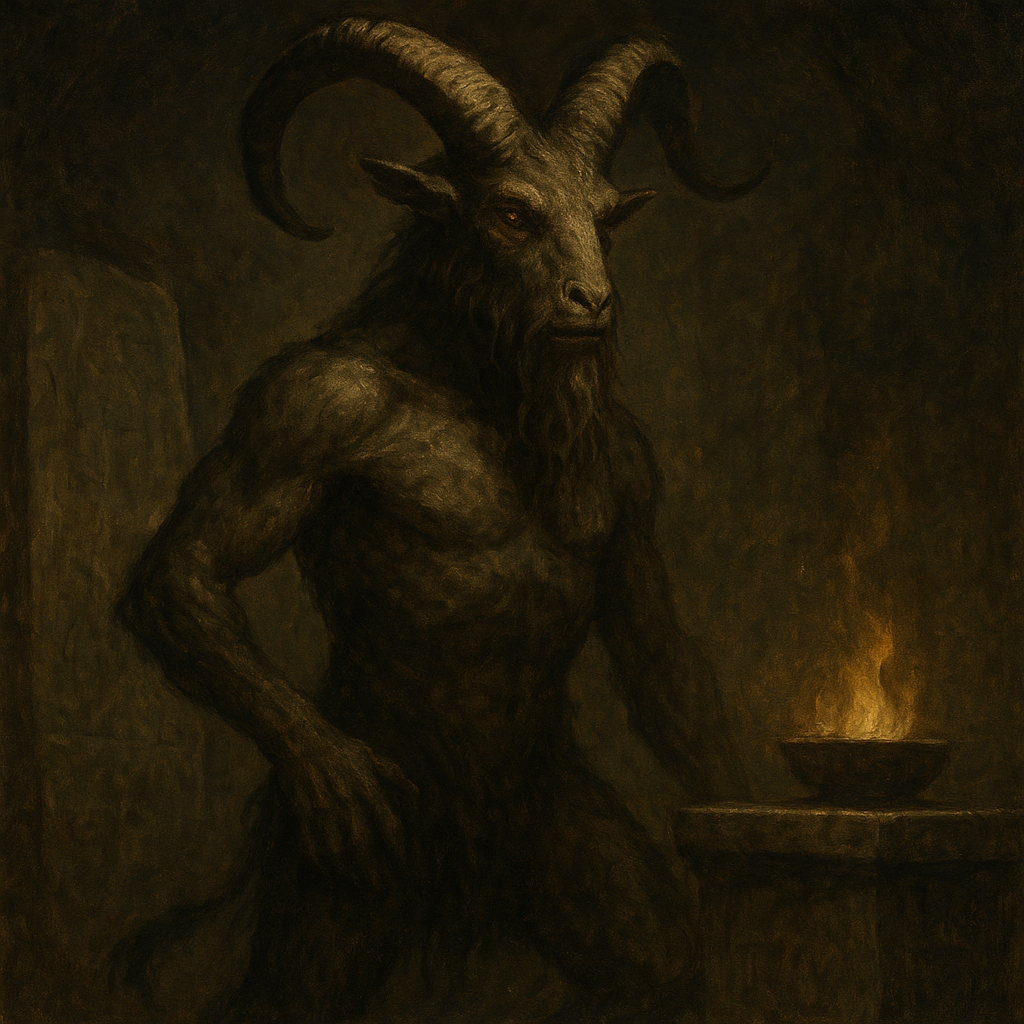
The se’irim are goat-form spirit beings named in Leviticus 17:7, 2 Chronicles 11:15, Isaiah 13:21, and Isaiah 34:14. Israel was forbidden to sacrifice to them.
Term: Se’irim: The plural of the Hebrew word sa’ir, meaning “hairy one” or “male goat.” In four Bible passages the word refers to goat-form demons or spirits that people worshipped or that lived in desolate places.
Term: Azazel: The name attached to the live goat sent into the wilderness on the Day of Atonement in Leviticus 16. In 1 Enoch, the name of a rebellious Watcher bound in the desert.
Term: Nephilim: The giant offspring of the sons of God and human women in Genesis 6:4. In 1 Enoch, the spirits of the dead giants become evil spirits on the earth.
Who Are the Se’irim in the Bible?
The se’irim are goat-form spirit beings named in Leviticus 17:7, 2 Chronicles 11:15, Isaiah 13:21, and Isaiah 34:14. Israel was forbidden to sacrifice to them. They appear in the wilderness and in ruined cities, and Jewish and early Christian readers understood them as demons. No ancient text describes them as ordinary animals, and none links them to Bigfoot or the Yeti.
What the Bible Says About the Se’irim
Four passages use the word in a way that points beyond an ordinary goat.
Leviticus 17:7 tells Israel to stop offering sacrifices to the goat demons “after whom they go whoring.” The law sits inside a rule that every sacrificial animal must be brought to the tabernacle, not killed in open fields.
Second Chronicles 11:15 says Jeroboam appointed his own priests for the high places, for the goat demons, and for the calves he made.
Isaiah 13:21 describes the ruins of Babylon. Wild animals, owls, and ostriches live there, and goat demons dance. Isaiah 34:14 describes the ruins of Edom. Desert animals and hyenas meet, goat demons call to each other, and Lilith finds a place to rest.
The pattern is consistent. The se’irim are objects of forbidden worship in the first two passages and inhabitants of desolate places in the second two.
One Hebrew Word, Two Meanings
Sa’ir is the ordinary Hebrew word for a male goat. In Leviticus 16:8, the two Day of Atonement goats are called se’irim. In the next chapter, Leviticus 17:7 uses the same word for the goat demons. Context decides whether the word means an animal or a spirit.
English translations hide the connection. The King James Version renders the word as “devils” in Leviticus 17:7 and as “satyrs” in Isaiah 13:21. Modern versions such as the NASB use “goat demons” in both places. A reader who only has the KJV has no way to see that the passages belong together.
What the Jewish Commentators Said
Rashi says the word means demons and points to Isaiah 13:21 as proof. Ibn Ezra agrees. He adds that they were called se’irim because insane people see them in the form of goats. He also reads the words “no more” in Leviticus 17:7 as evidence that Israel sacrificed to them while in Egypt.
The Zohar gives a fuller picture. It says the Egyptians sacrificed in fields and on mountains, evil beings gathered at those rites, and people saw them as hairy. Israel learned the practice during slavery. Early translations such as the Targums, the Peshitta, and the Latin Vulgate also understood the word as demons.
The commentators never describe a creature that a hunter could track. They describe spiritual beings that appear hairy.
The Hint That Ties the Se’irim to Azazel
Ibn Ezra left a cryptic note on Leviticus 16:8, the verse where Azazel first appears. He says the secret of Azazel becomes clear when you reach thirty-three. Ramban explained that he meant 33 verses forward. Count from 16:8 and you land on Leviticus 17:7, the ban on sacrificing to the goat demons.
Commentators split on what that connection means. Ramban and the kabbalist Bahya ben Asher treated Azazel and the goat demons as real demonic forces. Others read the ban in 17:7 as proof that the scapegoat could not have been an offering to a demon. Ramban himself is direct on this point. He says the goat was not an offering to Azazel.
That matches the reading in the Azazel post. Leviticus 17:7 forbids sacrifice to the goat demons. The scapegoat carried confessed sin into their territory but was not a gift to them. The atonement was finished at the altar before the second goat left the camp.
What Jerome Recorded
Jerome’s Life of Paul the First Hermit, written in the late fourth century, describes Anthony meeting a satyr in the Egyptian desert. The creature spoke and asked Anthony to pray for the satyrs to Christ. Jerome then added that a being of that kind was brought alive to Alexandria under Emperor Constantine, and that its body was preserved in salt and taken to Antioch for the emperor to see.
The Catholic Encyclopedia notes that the Greek versions make the satyr a demon, while the Latin version treats him as a harmless mortal. This is hagiography, not eyewitness reporting. It still shows that fourth-century Christians treated these beings as real inhabitants of the desert.
Where the Book of Enoch Fits
First Enoch 15:8 to 12 says the giants born of the Watchers become evil spirits on the earth, and the earth is their dwelling. They afflict, oppress, and cause trouble for people. Enoch never names the se’irim.
Linking the two takes two steps. The first is that the se’irim are demons, which the Jewish commentators support. The second is that Enoch explains where demons came from. Each step is reasonable. Neither is stated in a single text, so the link is an interpretation.
Could the Se’irim Explain Bigfoot, the Yeti, and Dogmen?
Some Christian writers argue that they could. The idea has some support. The se’irim are hairy, live in wild and ruined places, and were seen by people. Enoch supplies an origin for earthbound spirits tied to the giants. Modern reports describe hairy beings in remote areas.
Three things weaken it. First, the ancient sources treat the se’irim as spirits, not animals. Ibn Ezra ties seeing them to insanity, and the Zohar says they appear hairy. That points to spiritual encounters, which is a different claim from an undiscovered primate. Second, the word means goat and hairy. It does not point to an ape or a wolf, and Esau is also called hairy in Genesis 25:25 without being a monster. Third, the modern legends are recent. The name Bigfoot dates to 1958, when a Humboldt Times editor shortened a logger’s nickname after large tracks turned up at Bluff Creek, California. The name Abominable Snowman dates to 1921 and came from a journalist’s mistranslation. The Michigan Dogman began as a 1987 April Fools’ song by a radio DJ named Steve Cook, who says he invented it and also says he believes people saw something.
Older wild-man traditions do exist, such as the Sts’ailes Sasq’ets. The Bible does not describe any of them.
Here is a fair way to state it. If the se’irim are real spirit beings that appear as hairy creatures in wild places, some modern encounter reports might involve the same kind of being. That is a hypothesis. The Bible does not say it, and the se’irim are not giants.
What to Remember
The se’irim are goat-form spirits, forbidden objects of sacrifice, and residents of ruins and wilderness. A medieval Jewish hint ties them to Azazel, and Ramban says the scapegoat was never an offering to him. Enoch supplies a likely origin for demons, but does not name the se’irim.
CK Quarterman. CK Quarterman is a USAF veteran, independent author, and publisher at CKQbooks (ckqbooks.com). He writes nonfiction under the Malaterrestrials concept and fiction on the Watchers and the Nephilim. Truth · History · Scripture.
Topics
Explore in the Encyclopedia
Se’irim
Goat-form spirit beings named in four passages of the Hebrew Bible. Israel was forbidden to sacrifice to them, and they are described as inhabiting wilderness and ruins.
Shedim
Shedim are spirit beings mentioned twice in the Hebrew Bible to whom Israel offered sacrifices, including child sacrifice; the biblical text treats them as demonic.
Keep researching. Don't miss what's uncovered next.
Get first access to new Encyclopedia entries, Timeline updates, Watchers, Nephilim, Giants, Demons, Deliverance, and UFO/UAP research, plus new books and releases from CKQBooks. Free. Takes ten seconds.