
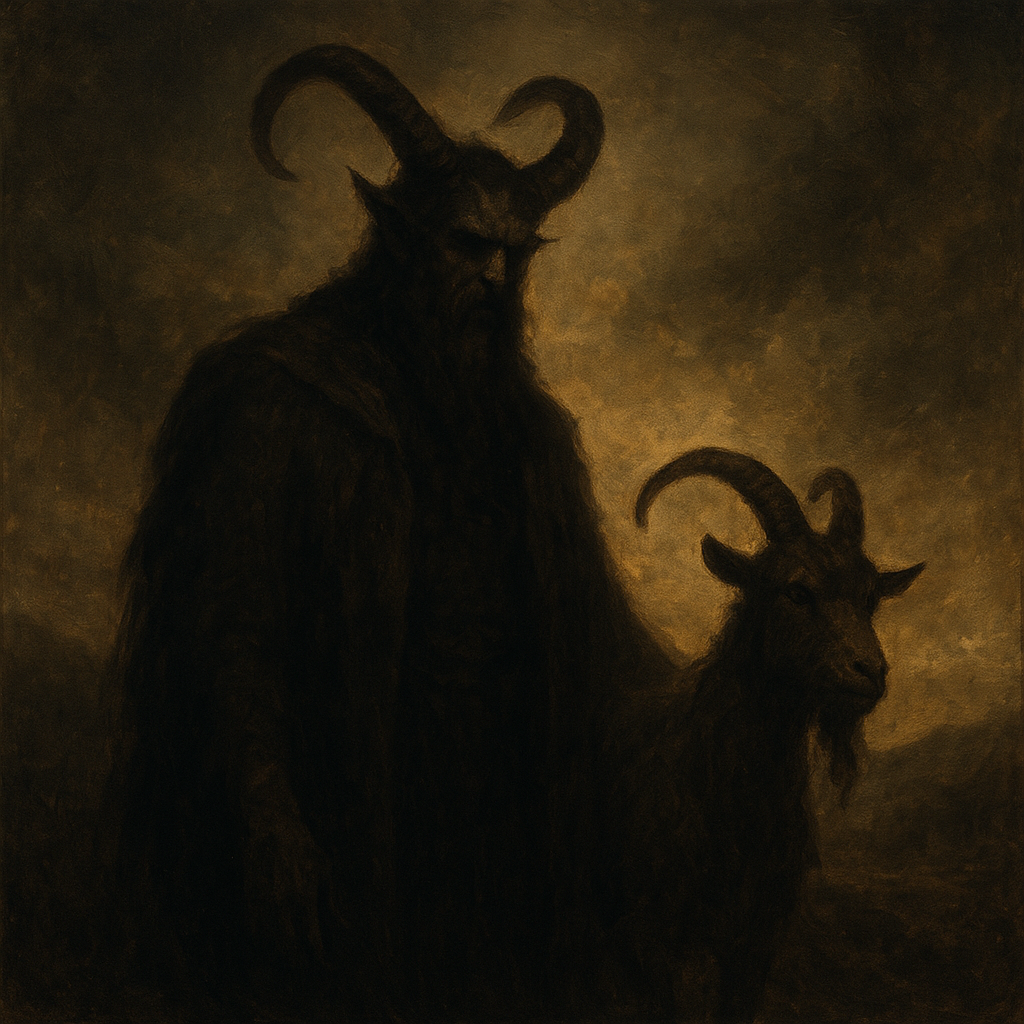
Azazel is a name in Leviticus 16, tied to the Day of Atonement goat that was sent alive into the wilderness. Leviticus never calls him a fallen angel.
Term: Azazel: In Leviticus 16, the word attached to the live goat sent into the wilderness on the Day of Atonement, with its meaning still debated. In 1 Enoch, the name of a rebellious Watcher who taught humanity forbidden arts and was bound in the desert place called Dudael.
Term: Watchers: The angelic beings of 1 Enoch who left their place in heaven, took human wives, and taught humanity forbidden knowledge before the Flood.
Term: Scapegoat: The English name for the live goat of Leviticus 16 that carried the confessed sins of Israel out of the camp and into the wilderness “for Azazel.”
Who Is Azazel in the Bible?
Azazel is a name in Leviticus 16, tied to the Day of Atonement goat that was sent alive into the wilderness. Leviticus never calls him a fallen angel. The Book of Enoch does. There, Azazel is a rebellious Watcher who taught humanity forbidden arts and was bound in the wilderness as punishment.
What Leviticus 16 Says About Azazel
Once a year, on the Day of Atonement, the high priest took two goats from the congregation of Israel. He cast lots over them. One lot was for the LORD. The other was for Azazel (Leviticus 16:8).
The goat for the LORD was killed as a sin offering. The goat for Azazel stayed alive. The high priest laid both hands on its head and confessed Israel's sins over it. Then a man appointed for the task led the goat away into the wilderness, to a land cut off from the camp (Leviticus 16:21 and 16:22).
That is the whole ritual. Two goats, one lot each, one death and one removal.
What Leviticus Does Not Say
Leviticus does not describe Azazel. It does not say the goat was sacrificed to Azazel. The text never says the goat was killed. It was sent away alive, carrying the nation's confessed sin.
This is why scholars still disagree on the word. The ancient Greek translation read it as “the one sent away,” which gives us the word scapegoat. Other readers take Azazel as the name of a rugged, remote place. Others take it as the name of a being that lived in the wilderness. All three readings fit the grammar. Leviticus alone can't prove any of them.
Where the Book of Enoch Takes Over
The fallen angel most people picture comes from 1 Enoch, an ancient Jewish text. In chapter 8, Azazel teaches humanity to make swords, knives, shields, and breastplates. He also teaches them to make bracelets, ornaments, and cosmetics, including using antimony to darken the eyes.
In chapter 10, God sends the angel Raphael to bind Azazel's hand and foot. Raphael is told to open the desert at a place called Dudael, throw Azazel into the darkness there, and cover him with rough rock until the day of judgment. On that day he is thrown into the fire.
Then comes a line worth reading slowly. God says the whole earth has been corrupted by the works Azazel taught, and that all sin is to be charged to him (1 Enoch 10:8).
How the Two Texts Connect
Put the texts side by side and you see three shared pieces. Both place Azazel in the wilderness. Both tie him to the removal of sin. Both show a figure sent away from the community into a desolate place.
The Jewish tradition noticed this early. The Mishnah, in tractate Yoma, says the goat was taken to a cliff in the wilderness and pushed off. The place is named Beit Hadudo, which sounds very close to Dudael. Whether the name is a coincidence or a deliberate echo is still argued, but it shows that Jewish readers linked the goat ritual with the Enochic story.
The wilderness itself supports the link. Leviticus 17:7 forbids Israel from offering sacrifices to the goat demons, a name that shows the desert was believed to be occupied territory. Isaiah 13:21 and 34:14 place wild spirits in ruined, empty land. In Matthew 12:43, Jesus says an unclean spirit passes through dry places looking for rest. Scripture treats the wilderness as the unseen enemy's natural home.
A Different Take on the Scapegoat
Yet notice what the ritual actually assigns. The goat for the LORD dies. That goat pays for sin. The second goat pays for nothing. It carries the confessed sin out of the camp and away from the people. The atonement is finished at the altar before the second goat leaves.
Read with Enoch in view, the second goat shows where sin ends up after atonement. It is sent back to the wilderness, the territory of the Azazel who brought it in. The nation is cleansed, and the sin is removed from the camp. Azazel is not paid. He is not honored. The goat is not a gift to him. Enoch says the charge for all of it is his.
What to Remember
Leviticus 16 names Azazel and does not explain him. The Book of Enoch explains him. Second-temple Jewish readers understood the two together
CK Quarterman. CK Quarterman is a USAF veteran, independent author, and publisher at CKQbooks (ckqbooks.com). He writes nonfiction under the Malaterrestrials concept and fiction on the Watchers and the Nephilim. Truth · History · Scripture.
Topics
Explore in the Encyclopedia
Se’irim
Goat-form spirit beings named in four passages of the Hebrew Bible. Israel was forbidden to sacrifice to them, and they are described as inhabiting wilderness and ruins.
Shedim
Shedim are spirit beings mentioned twice in the Hebrew Bible to whom Israel offered sacrifices, including child sacrifice; the biblical text treats them as demonic.
Keep researching. Don't miss what's uncovered next.
Get first access to new Encyclopedia entries, Timeline updates, Watchers, Nephilim, Giants, Demons, Deliverance, and UFO/UAP research, plus new books and releases from CKQBooks. Free. Takes ten seconds.