
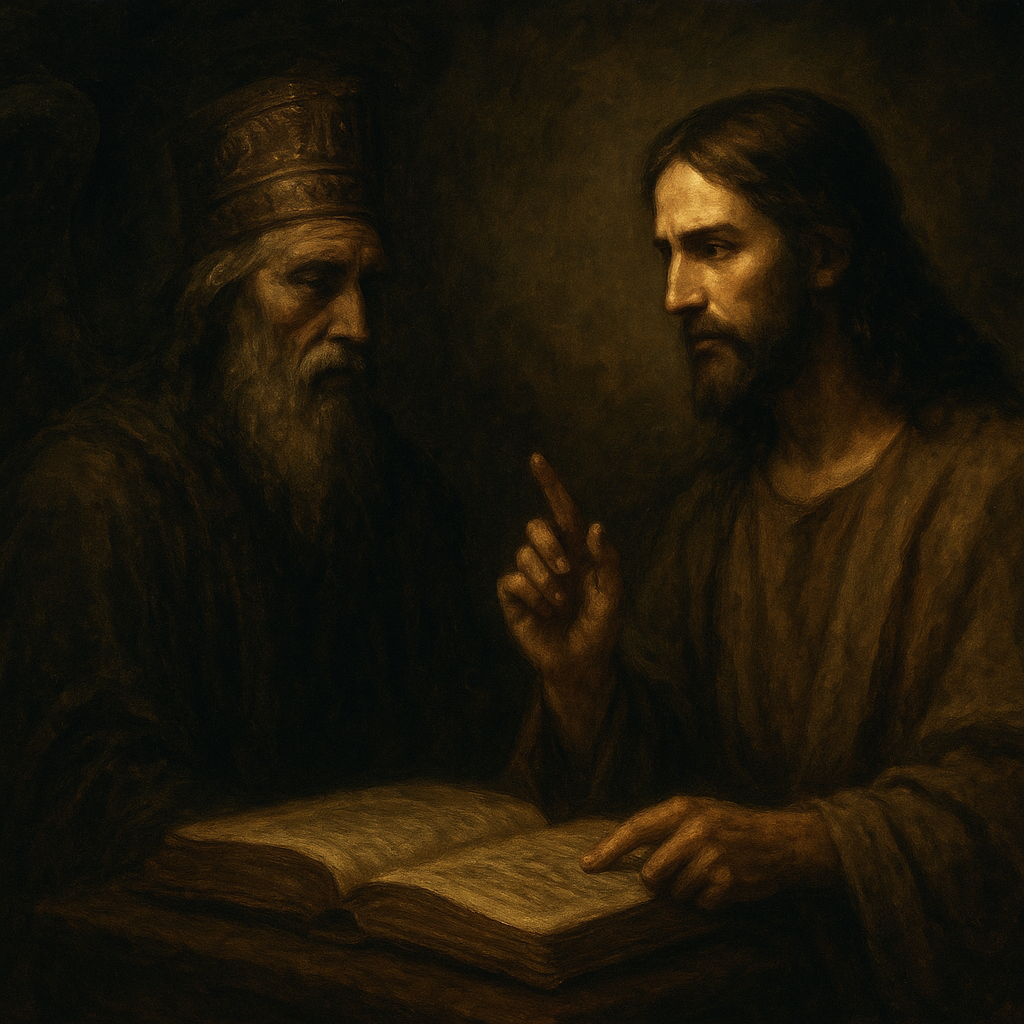
The article explains how Jesus’ reference to angels not marrying draws directly from the Book of Enoch, revealing early Jewish teachings about the Watchers and Nephilim.
When the Sadducees tried to trap Jesus with a question about marriage in the resurrection, he gave them an answer that assumed something his audience already understood:
“Jesus answered and said unto them, Ye do err, not knowing the scriptures, nor the power of God. For in the resurrection they neither marry, nor are given in marriage, but are as the angels of God in heaven.” (Matthew 22:29-30, KJV)
Jesus doesn't explain why angels don't marry. He states it as a fact everyone in the room already knows. That raises a question worth asking: where does that fact come from? It isn't spelled out anywhere in Genesis, Exodus, or the Psalms. The doctrine that angels are non-marrying beings by nature shows up in exactly one place in the literature available to a first-century Jewish audience. That place is the Book of Enoch.
The Watchers and the Reason Marriage Wasn't Theirs
1 Enoch tells the story of the Watchers, angelic beings who left heaven to take human wives. Genesis 6:1-4 gives the short version of this event. Enoch expands it into a full narrative, and chapter 15 gives the reasoning behind why what the Watchers did was a violation of their nature, not just a moral failure.
God's rebuke to the Watchers reads:
“You were formerly spiritual, living an eternal life, immortal for all the generations of the world. Therefore I did not appoint wives for you, for the dwelling of the spiritual ones is in heaven.” (1 Enoch 15:6-7)
The verse before it explains why marriage exists for humans at all: God gave men wives so that they could bear children and continue the human race on earth. Marriage is tied to mortality and reproduction. Angels don't die, so they were never given that provision in the first place. Taking a wife wasn't just forbidden to them. It was structurally incompatible with what they are.
That is the doctrine Jesus references in Matthew 22:30. He isn't inventing a new teaching. He's applying an established one, and the only text that spells out that teaching in full is Enoch.
Why This Matters for Reading the Gospels
The Gospels were written for an audience steeped in a wider body of literature than just the Hebrew Bible. First-century readers knew Enoch, knew the Watcher story, and knew the doctrine that came out of it. When Jesus says “as the angels of God in heaven,” he's using a shared reference point, the way a modern speaker might say “you can't take it with you” without footnoting where that idea comes from.
This matters for anyone trying to understand what the biblical writers actually believed about non-human intelligences. The angels in the Gospels aren't abstract theological placeholders. They're beings with a specific nature, a specific origin, and specific limits, and those limits are defined most clearly in a text that never made it into the standard Protestant canon.
Enoch isn't required reading to understand the Gospels. But it is background reading. Jesus's listeners had it. Jude and Peter had it, and quoted from it directly, which is worth its own separate account. Understanding what Enoch says about the Watchers, their nature, and their fall gives you the missing half of a conversation the New Testament writers were already having.
Related reading: the New Testament writers who quoted 1 Enoch by name, and what that means for how the early church read apocryphal texts.
Related CKQ Book
The Watchers Series — Book One
The Watchers Fallen
They Were Not Supposed to Walk Among Us
Explore in the Encyclopedia
The Watchers
A class of angelic beings who, in 1 Enoch, descend to earth, take human wives, and teach forbidden knowledge.
Giants
A general term for the oversized clans and warriors of the ancient world tied to the Nephilim bloodline.
Hybrid Beings
Offspring of the union between the fallen and humanity — the conceptual heart of the Nephilim account and its modern echoes.
Sirens
In the Greek textual tradition of 1 Enoch 19:2, the fate assigned to the human women who bore children to the fallen Watchers — distinct from the Watchers themselves and from the Nephilim, their giant offspring.
Fallen Watchers
The Fallen Watchers are the two‑hundred angels described in 1 Enoch who descended on Mount Hermon, swore an oath to take human wives, and taught humanity forbidden skills, led by Semjaza with Azazel receiving the greatest blame.
Nephilim
The Nephilim are the powerful, giant figures mentioned in Genesis 6:4 and Numbers 13:33, whose name is linked to the Hebrew verb “to fall” and has been interpreted as “giants” in ancient texts.
Keep researching. Don't miss what's uncovered next.
Get first access to new Encyclopedia entries, Timeline updates, Watchers, Nephilim, Giants, Demons, Deliverance, and UFO/UAP research, plus new books and releases from CKQBooks. Free. Takes ten seconds.