
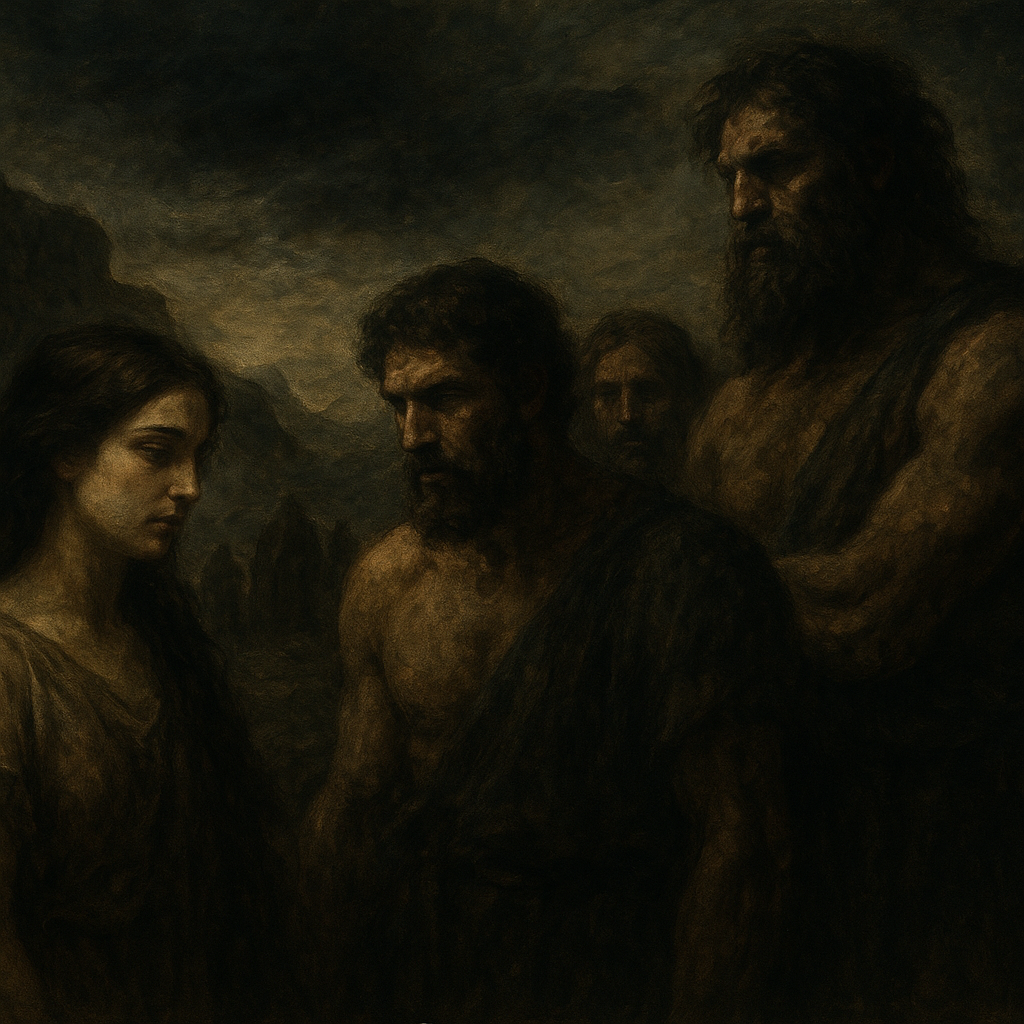
Genesis 6:1 to 4 says that as people multiplied on the earth, the sons of God saw that the daughters of men were beautiful and took wives for themselves. Their offspring were the Nephilim, described as mighty men of old, men of renown.
Term: Sons of God: bene elohim in Hebrew, a phrase used elsewhere in the Old Testament for angelic beings in God’s heavenly court.
Term: Nephilim: beings named in Genesis 6:4 as the offspring described in the passage, translated giants in some versions.
Term: Watchers: the term the Book of Enoch uses for the angels who came down and took human wives.
The fiction side of this story is told in Sons of the Flood, beginning with The Giant’s Shadow.
What Does Genesis 6 Say About the Sons of God?
Genesis 6:1 to 4 says that as people multiplied on the earth, the sons of God saw that the daughters of men were beautiful and took wives for themselves. Their offspring were the Nephilim, described as mighty men of old, men of renown. The passage comes right before God's decision to send the Flood. Christians read it in three main ways, and the view that sons of God means angelic beings has the strongest support from how the phrase is used elsewhere in the Old Testament.
What the text says
Genesis 6:1 to 4 says that when men began to multiply, the sons of God saw the daughters of men, that they were fair, and took them wives of all which they chose. Verse 3 says the Lord's Spirit would not always strive with man, and set his days at 120 years. Verse 4 says there were giants, or Nephilim, in the earth in those days, and also after that, when the sons of God came in unto the daughters of men, and they bore children who became mighty men of old, men of renown.
The three main readings
The Sethite view holds that sons of God means the godly line of Seth intermarrying with the ungodly line of Cain. The royal or dynastic view holds that it refers to ancient kings who claimed divine status. The angelic or Watcher view holds that sons of God refers to angelic beings, called bene elohim in Hebrew, who took on human form and had children with human women.
The case for the angelic view
The phrase sons of God, bene elohim, appears elsewhere in the Old Testament, in Job 1:6, 2:1, and 38:7, where it refers to members of God's heavenly court, generally understood as angels. The Book of Enoch, an ancient Jewish text, tells this story in detail, naming the leader of the fallen angels Semjaza and describing 200 Watchers who came down on Mount Hermon. Jude 1:6 and 2 Peter 2:4 refer to angels who left their proper estate and are kept in chains until judgment, which many scholars connect to this same event. Early Jewish and early Christian writers largely held the angelic view before it fell out of favor in later centuries.
The objections
Matthew 22:30 says that in the resurrection, people neither marry nor are given in marriage, but are as the angels in heaven, which some read as meaning angels cannot procreate. Defenders of the angelic view reply that the verse describes heavenly angels in their normal state, not fallen angels who took physical form to do this. Critics of the Sethite view point out that the text does not describe two competing human lines anywhere else in Genesis, and that offspring of two human lines would not obviously be called giants or men of renown.
What is solid and what is not
The text of Genesis 6:1 to 4 is not disputed. Its meaning is genuinely debated among careful readers of Scripture, and I hold the angelic view, alongside many scholars, ancient and modern. In my book Disclosure: They Are Not Extraterrestrials, I treat this passage, along with 2 Thessalonians 2, as the foundation the rest of the book builds on. Disclosure is available on Amazon. You can find more of my work at ckqbooks.com.
Sources
Genesis 6:1 to 4, Job 1:6, 2:1, 38:7, Jude 1:6, 2 Peter 2:4, Matthew 22:30 (King James Version). Book of Enoch, chapters 6 to 16.
CK Quarterman. CK Quarterman is a USAF veteran, independent author, and publisher at CKQbooks (ckqbooks.com). He writes nonfiction under the Malaterrestrials brand. The concept of malaterrestrials describes evil earthbound non-human intelligences, as distinct from the holy angels of heaven. Truth · History · Scripture.
Topics
Related CKQ Book

Disclosure
They Are Not Extraterrestrials
Explore in the Encyclopedia
The Watchers
A class of angelic beings who, in 1 Enoch, descend to earth, take human wives, and teach forbidden knowledge.
Mount Hermon
The mountain on the northern border of ancient Israel identified in 1 Enoch as the descent point of the Watchers.
Azazel
A chief among the Watchers in 1 Enoch, blamed for teaching humanity metalworking, weaponry, and cosmetics.
Sirens
In the Greek textual tradition of 1 Enoch 19:2, the fate assigned to the human women who bore children to the fallen Watchers — distinct from the Watchers themselves and from the Nephilim, their giant offspring.
Elioud
The third generation of giant hybrids in Second Temple Jewish literature, descended from the Watchers through the great giants and the Naphil.
Fallen Watchers
The Fallen Watchers are the two‑hundred angels described in 1 Enoch who descended on Mount Hermon, swore an oath to take human wives, and taught humanity forbidden skills, led by Semjaza with Azazel receiving the greatest blame.
Keep researching. Don't miss what's uncovered next.
Get first access to new Encyclopedia entries, Timeline updates, Watchers, Nephilim, Giants, Demons, Deliverance, and UFO/UAP research, plus new books and releases from CKQBooks. Free. Takes ten seconds.