
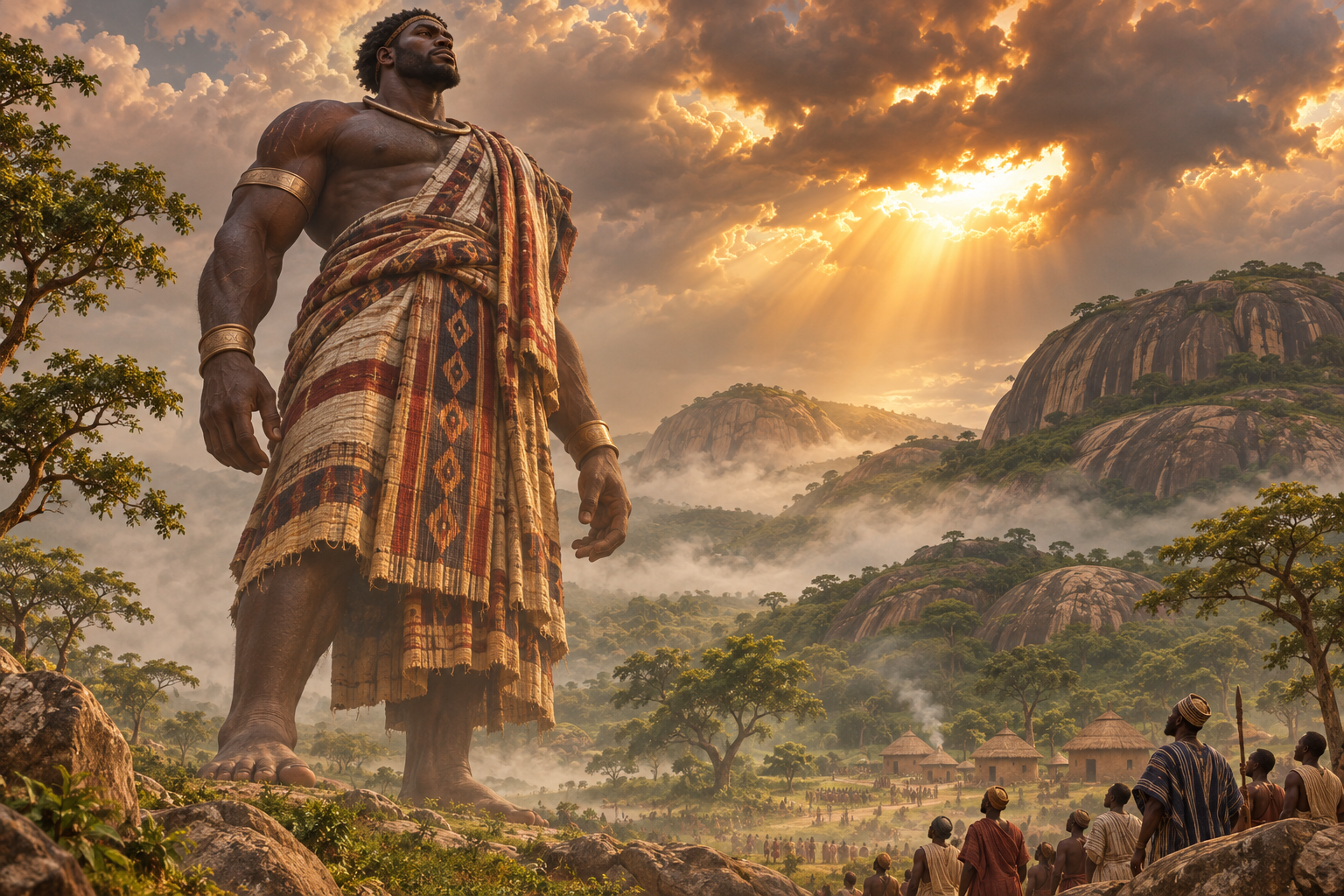
Is There a Connection Between the Igala Giant Onoja Oboni and the Nephilim?
The article examines the six‑fingered Igala giant Onoja Oboni, his legendary walls and tower, and evaluates evidence for and against a link to the biblical Nephilim.
## Is There a Connection Between the Igala Giant Onoja Oboni and the Nephilim?
I do not know. No source I found says there is a connection, and I am not stating one. I am asking the question.
The link is a set of shared motifs: a six-fingered giant, a walled stronghold, and a tower built toward heaven. Those motifs fit a Nephilim reading. They do not prove one. This post lays out what the Igala tradition says, what North Africa records about displaced Canaanites and giants, and where the question holds up and where it breaks down.
## Who Are the Igala?
The Igala are an ethnic group in central Nigeria, in West Africa. Most live in eastern Kogi State, near the point where the Niger and Benue rivers meet. Their royal capital is Idah, on the Niger. They speak Igala, and they are the seventh largest ethnic group in Nigeria.
The Igala kingdom is ruled ceremonially and culturally by the Attah. Traditionally the Igala worship a supreme being called Ojo, along with ancestors and other spiritual beings. Many Igala today are Muslim or Christian.
Ogurugu, the community tied to Onoja Oboni, lies in Enugu State, southeast of the main Igala territory. It is an Igala‑speaking community among the Igbo.
## Who Was Onoja Oboni?
Oral tradition describes him as a warrior, hunter, and strategist. The Ogurugu account says both of his parents were Igala and that he was born and raised in Ogurugu. The traditions credit him with these features and deeds:
Six fingers on each hand and six toes on each foot. In Igala, Oboni is a name given to a child born with extra digits.
A giant’s size and strength, with 500 wives and 1,000 drummers.
Building the walls around Ogurugu alone. Their remains are still visible.
Trying to stop the River Niger with his bare hands.
Trying to build a tower to the heavens to fight the beings there. The tower collapsed and killed many people.
Spreading Igala influence into Igboland through hunting, conquest, slave raiding, and trade.
His death carries its own tradition. His father had driven him away, so no one dug his grave. He dug it himself and buried himself. The soil over the grave is said to swell once a year and then return to normal. Ogurugu holds an annual festival in his honor in the forest in front of the grave. A cow is usually slaughtered, and women may not attend.
Ogurugu also keeps two sites tied to him. One is the okpe, a hilly fortress. The other is the unyi egu, a sacred grove.
## Did He Really Live?
Historians disagree. The sources give him different parents. Some make him a son of Eri. Others make him a grandson of Aganapoje, a member of an Idah royal family, or a descendant of a priestly sub‑clan. One Ogurugu source places his birth between the 1380s and 1420s. Other writers place his influence in the 18th century. A gap of about 300 years suggests either more than one man or a tradition that grew over a long time.
Austin Shelton treated him as a probable historical figure. Adiele Afigbo doubted Shelton’s work. The walls and the fortress at Ogurugu are real places, but I found no archaeological dating that ties them to one man. My sources are a Daily Trust feature and a local Ogurugu blog. They record what the community says. They are not independent proof.
## Where Did the Giants of Canaan Go?
Joshua 11:22 says the Anakim were cut off from the hill country, and that only in Gaza, Gath, and Ashdod did some remain. The Bible does not say where the rest went.
Procopius of Caesarea, a sixth‑century Byzantine historian, gives one answer in his History of the Wars (the Vandalic War, Book IV). He records that Canaanites fleeing Joshua built a fortress in Numidia, on the site of the later city of Tigisis, in what is now Algeria. Two white stone columns stood there near a spring, inscribed in Phoenician: “We are they who fled from before the face of Joshua, the robber, the son of Nun.” The Armenian historian Moses of Khorene mentions the same two columns independently.
Procopius says Canaanites. He does not say giants. The step from Canaanites to the Anakim is an inference from Joshua 11:22.
The giant tradition on that coast is separate. Plutarch says the Roman general Sertorius opened a mound at Tingis (modern Tangier) and found the skeleton of the giant Antaeus, reportedly 60 cubits long. Pliny the Elder places the Antaeus tradition at Tingi and Lixus, and he calls the stories “marvellous legends.” Skeptics, following Adrienne Mayor, say the bones were fossils of large extinct animals. That explanation fits the Antaeus bones. It does not address the Tigisis inscription.
## The Distance Problem
Tigisis and Tangier sit on the Mediterranean and Atlantic coasts of North Africa. The Igala homeland is almost due south, across the Sahara. By my estimate the distance is about 3,200 to 3,500 kilometers, or 2,000 to 2,200 miles. Trans‑Saharan trade routes did connect North Africa to the Niger region, so contact was possible. No source I found says it happened.
## What Supports the Question
A six‑fingered giant. 2 Samuel 21:20 describes a man of Gath with six fingers on each hand and six toes on each foot, twenty‑four in all, who descended from the giants. Gath is one of the cities where the Anakim remained.
Walls. Numbers 13 and Deuteronomy 1 record the spies’ report of great, fortified cities in Canaan, and Deuteronomy 1:28 says the cities were walled up to heaven. Oboni is a giant who builds walls.
A tower toward heaven. The collapse of Oboni’s tower and the war against the beings in heaven echo Babel in Genesis 11.
Trade routes. The Sahara did not seal off West Africa from the north.
## What Weighs Against It
Time. Joshua’s conquest lies more than two thousand years before even the earliest dates given for Oboni.
No documented line. I found no source that traces any people from Numidia or Mauretania to the Niger and Benue region.
A natural explanation. Polydactyly occurs in humans, and the Igala custom of naming such a child Oboni shows the trait is well known locally. A six‑fingered man needs no outside origin.
Common motifs. Giants, walls, and towers appear in the stories of many peoples. Separate storytellers can reach the same themes.
Source quality. The Oboni material is oral tradition recorded by a newspaper and a local blog.
Local origins. Igala and Ogurugu accounts give Oboni Igala parents and place him in an Igala setting.
## My View
I hold that the giants of Genesis 6:4 came from fallen angels, and that a second contact began at Shinar and produced the post‑Flood giant clans, including the Anakim and the Rephaim. Genesis 11 says the people scattered from Shinar across the earth. The question I am asking is whether any trace of that scattering reached the Niger.
I am asking whether there is a connection. I am not saying there is one. The six fingers, the walls, and the tower toward heaven are the reasons I think the question deserves to be asked.
If you know Igala or Ogurugu oral tradition, an archaeological report on the Ogurugu walls, or a source that links Igala origins to North Africa or Canaan, I want to see it. What do you know about Onoja Oboni?
Scripture References
Sources
InterpretationDaily Trust feature on Igala communities in Enugu State and Onoja Oboni; The Need for the Ogurugu Narrative in the Quest for the Historical Onoja Obonyi (ogurugu.blogspot.com); Wikipedia entries on Igala people and Igala Kingdom; Procopius, History of the Wars, Book IV; Plutarch, Life of Sertorius; Pliny the Elder, Natural History, Book V; Adrienne Mayor, The First Fossil Hunters; CK Quarterman (CKQbooks)
Keep researching. Don't miss what's uncovered next.
Get first access to new Encyclopedia entries, Timeline updates, Watchers, Nephilim, Giants, Demons, Deliverance, and UFO/UAP research, plus new books and releases from CKQBooks. Free. Takes ten seconds.