
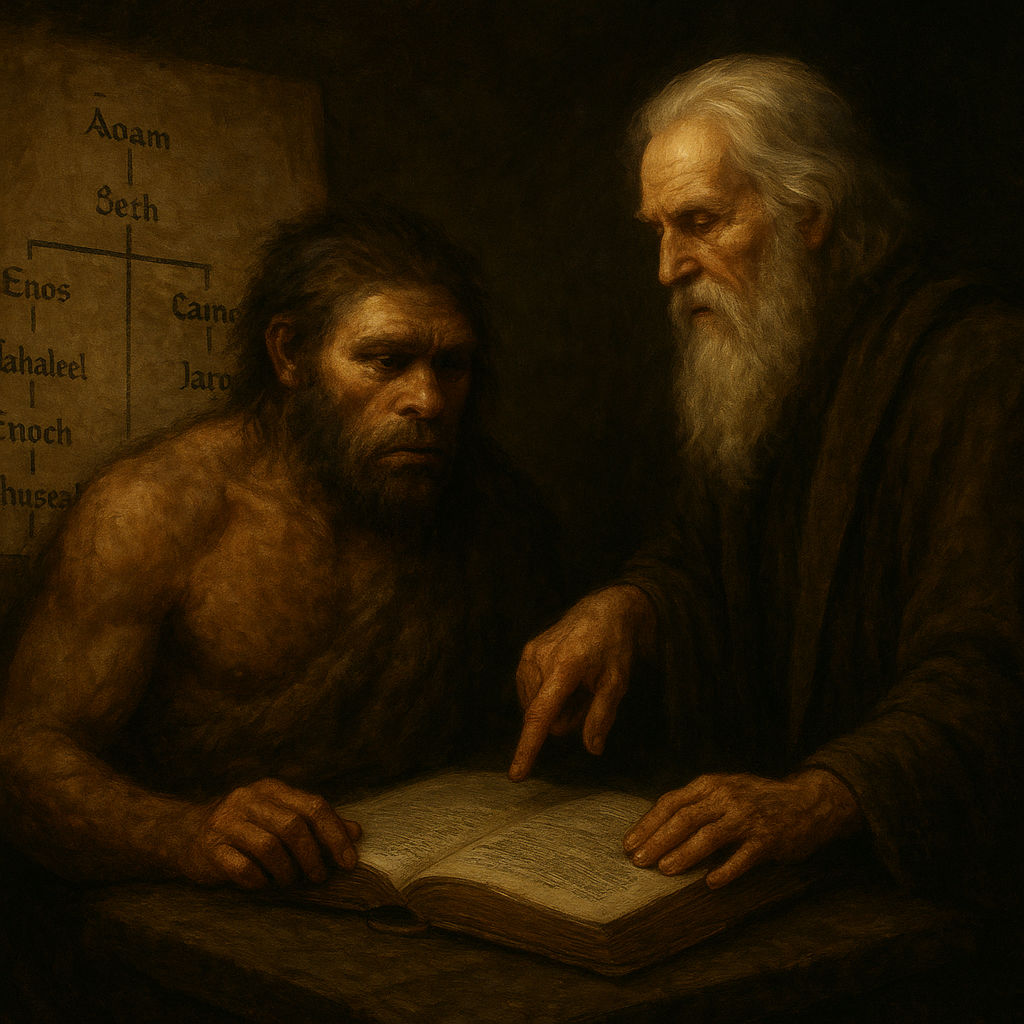
Neanderthal DNA shows up in most people alive today. Here is how that fact sits alongside the Genesis genealogies and why it is a real open question, not a settled one.
Not comfortably, and anyone who tells you they have this fully worked out is overselling it. Neanderthals appear in the genetic and fossil record hundreds of thousands of years before any reasonable reading of the Genesis genealogies, even a long one. That gap is real, and it deserves an honest answer instead of a forced one.
What the Science Actually Shows
Neanderthals split from the ancestors of modern humans somewhere between 550,000 and 765,000 years ago. They interbred with our ancestors much later, in a window starting around 50,500 years ago and lasting about 7,000 years, right before Neanderthals disappeared. That interbreeding left a mark. Most people whose ancestry traces outside Africa carry somewhere between 1 and 4 percent Neanderthal DNA today, and even African populations carry a smaller but real amount, around half a percent, likely from later migration back into Africa. Some of those inherited genes are still doing something. Research using UK Biobank data tied thousands of Neanderthal-derived variants to modern traits, including immune response and metabolism.
Why the Watchers Tradition Doesn't Close the Gap
None of that lines up neatly with a young Genesis chronology that runs from Adam through the Flood in a matter of generations. It is tempting to reach for the Watchers tradition to close that gap, since the Book of Enoch describes the Elioud, or Nephilim, as hybrid offspring of the Watchers and human women, and it is a short step from there to wondering whether Neanderthals were somehow that same lineage. I do not think that connection holds up, and it is worth being direct about why.
The Enochian tradition describes the Elioud as a late development, arriving not long before the Flood and tied directly to the corruption that brings on the judgment. It is not describing a population that persists for tens of thousands of years afterward. On top of that, the destruction of the Elioud in that tradition is total. Their bodies die, and their spirits are said to become the restless spirits described later in Enoch. That is a story about an ending, not about a bloodline that continues into the deep past through Neanderthals or any other archaic group. Stretching the Elioud tradition to cover Neanderthals asks it to do something the text was never describing in the first place.
What the Genetics Actually Suggest
The genetic evidence points the same direction. Neanderthal DNA that survives in modern humans looks like ordinary inheritance between two closely related populations. It shows up in genes tied to skin, immune function, and metabolism, the kind of variation you would expect from two human populations that adapted to different environments over a long stretch of time and then interbred. There is nothing in the genetic record that marks Neanderthal ancestry as categorically different from human ancestry, the way you would expect if it traced back to something outside the normal created order.
Where That Leaves the Question
So where does that leave the question? Honestly, it stays open. Young Genesis chronologies have to account for Neanderthals somehow, whether through a longer view of the genealogies, a different reading of what Genesis is claiming to describe, or some other explanation entirely. That is a real conversation happening among people who take both the text and the science seriously, and it deserves more room than a tidy answer gives it. What the evidence does not support is folding Neanderthals into the Watchers and Nephilim narrative specifically. That story is about something else, a late corruption judged by the Flood, not a hidden explanation for an archaic human species that predates Adam's line by hundreds of thousands of years on any reading of the record.
CK Quarterman. CK Quarterman is a USAF veteran and the author and publisher behind CKQbooks, where he writes on UAP phenomena, biblical prophecy, and the Watchers tradition under the malaterrestrials framework. Learn more at ckqbooks.com. Now you know the name of the Unknown.
Explore in the Encyclopedia
Nephilim
The offspring of the "sons of God" and the "daughters of men" described in Genesis 6, traditionally understood as giants.
The Watchers
A class of angelic beings who, in 1 Enoch, descend to earth, take human wives, and teach forbidden knowledge.
Mount Hermon
The mountain on the northern border of ancient Israel identified in 1 Enoch as the descent point of the Watchers.
Azazel
A chief among the Watchers in 1 Enoch, blamed for teaching humanity metalworking, weaponry, and cosmetics.
Giants
A general term for the oversized clans and warriors of the ancient world tied to the Nephilim bloodline.
Hybrid Beings
Offspring of the union between the fallen and humanity — the conceptual heart of the Nephilim account and its modern echoes.
Antediluvian
The period of biblical history between the creation of Adam and the flood of Noah, covering Genesis 1 through 6. The term was coined by the English writer Thomas Browne in the seventeenth century.
Sirens
In the Greek textual tradition of 1 Enoch 19:2, the fate assigned to the human women who bore children to the fallen Watchers — distinct from the Watchers themselves and from the Nephilim, their giant offspring.
Keep researching. Don't miss what's uncovered next.
Get first access to new Encyclopedia entries, Timeline updates, Watchers, Nephilim, Giants, Demons, Deliverance, and UFO/UAP research, plus new books and releases from CKQBooks. Free. Takes ten seconds.