
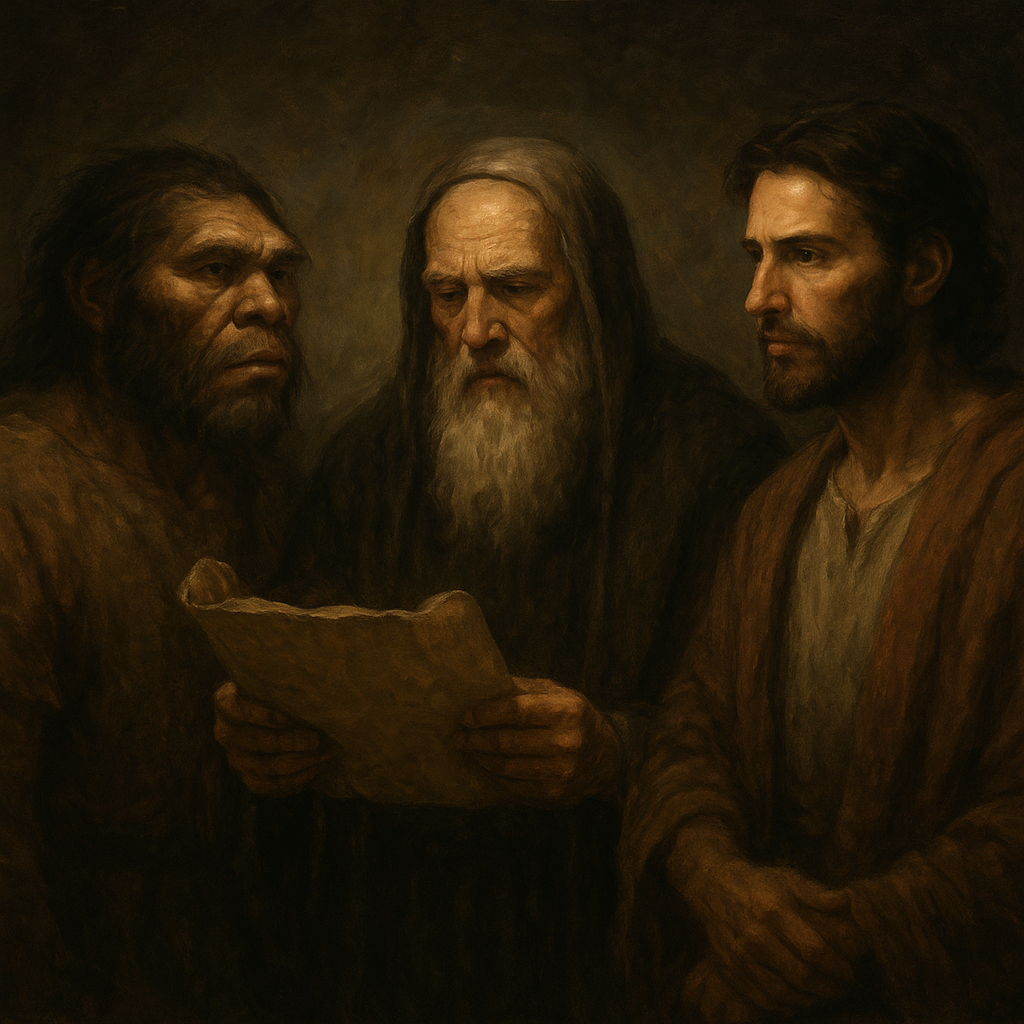
If Neanderthals predate Adam by hundreds of thousands of years, where do they fit in a biblical framework? Here are three positions people actually hold, laid out honestly.
There is no single answer inside a framework that takes Genesis seriously. Neanderthals appear in the fossil and genetic record hundreds of thousands of years before any reading of the Genesis genealogies, short or long, places Adam. That leaves a real gap, and three main positions have developed to address it. None of them is the default answer. Each one changes something structural about how you read early Genesis, so it is worth understanding what you are actually accepting or rejecting with each one.
Position One: Pre-Adamites
This view holds that God created human-like beings before Adam, and that those beings, not Adam, account for the archaic fossil record, including Neanderthals. Adam, on this view, is not the first physical human on earth. He is a later, specific creation, set apart for a covenant relationship with God that the earlier beings did not have. This lets someone hold a fairly short timeline for Adam and the genealogies while still leaving room for a much older archaic human record standing entirely outside that line.
The tradeoff is significant. Genesis 1 and 2 read most naturally as describing the creation of humanity as such, not the creation of one covenant line among several human populations. Pre-Adamite views have to explain why Genesis does not mention these earlier beings anywhere, and why sin and death, which Genesis 3 and Romans 5 tie to Adam specifically, would not have already applied to a human-like population that existed before him. It is a coherent position, but it asks a lot of the text's silence.
Position Two: Day-Age or Old-Earth Readings
This view keeps Adam as the first human and keeps the basic Genesis narrative intact, but reads the six days of creation as long, unspecified ages rather than literal twenty-four hour days. That opens enough time within the creation account itself for an old earth, and for archaic human-like species such as Neanderthals to exist within the same broad creation period, without requiring a separate pre-Adamite race outside the biblical account.
This position keeps more of the traditional theological structure intact, since Adam is still the first human and the origin point for sin and death. The tradeoff shows up elsewhere. It requires reading yom, the Hebrew word for day in Genesis 1, in a nonstandard way, and it still has to explain how Neanderthals relate to Adam specifically, whether as an earlier form within the same creative process, a separate but related creation, or something else. Old-earth creationists differ among themselves on that last point.
Position Three: Neanderthals as Fully Human, Just Earlier
This view argues Neanderthals were not a separate species or a separate act of creation at all, but a physically and spiritually human population, descended from Adam, existing much further back in time than a young chronology allows. This requires a substantially longer view of the genealogies in Genesis 5 and 11 than a plain reading suggests, treating them as selective king-list style records with gaps rather than a complete generation-by-generation count.
The genetic evidence lines up reasonably well with this view in one respect. Neanderthal DNA that survives in modern humans looks like ordinary inheritance between related human populations, not evidence of something categorically different in origin. Where this view runs into difficulty is the sheer scale of time involved. Stretching the genealogies far enough to reach 500,000 or more years is a much larger gap than most genealogical-gap arguments were built to cover, and it raises its own questions about how much the text can flex before it stops functioning as a real record of descent.
Where This Leaves Things
Each of these positions solves part of the problem and creates a new one. Pre-Adamites protect a short Adam timeline at the cost of the text's apparent silence on other humans. Day-age readings protect a single human line at the cost of a nonstandard reading of the creation days. Full-humanity readings protect biological continuity at the cost of stretching the genealogies further than they were designed to stretch. None of this is settled, and anyone claiming otherwise is skipping past the actual difficulty. What the evidence does rule out, as covered in an earlier post, is treating Neanderthals as descendants of the Watchers or the Nephilim. That tradition describes something else, a late corruption before the Flood, not an explanation for an archaic population that predates Adam's line by hundreds of thousands of years on any reading of the record.
CK Quarterman. CK Quarterman is a USAF veteran and the author and publisher behind CKQbooks, where he writes on UAP phenomena, biblical prophecy, and the Watchers tradition under the malaterrestrials framework. Learn more at ckqbooks.com. Now you know the name of the Unknown.
Explore in the Encyclopedia
The Watchers
A class of angelic beings who, in 1 Enoch, descend to earth, take human wives, and teach forbidden knowledge.
Mount Hermon
The mountain on the northern border of ancient Israel identified in 1 Enoch as the descent point of the Watchers.
Azazel
A chief among the Watchers in 1 Enoch, blamed for teaching humanity metalworking, weaponry, and cosmetics.
Antediluvian
The period of biblical history between the creation of Adam and the flood of Noah, covering Genesis 1 through 6. The term was coined by the English writer Thomas Browne in the seventeenth century.
Sirens
In the Greek textual tradition of 1 Enoch 19:2, the fate assigned to the human women who bore children to the fallen Watchers — distinct from the Watchers themselves and from the Nephilim, their giant offspring.
Elioud
The third generation of giant hybrids in Second Temple Jewish literature, descended from the Watchers through the great giants and the Naphil.
Fallen Watchers
The Fallen Watchers are the two‑hundred angels described in 1 Enoch who descended on Mount Hermon, swore an oath to take human wives, and taught humanity forbidden skills, led by Semjaza with Azazel receiving the greatest blame.
Nephilim
The Nephilim are the powerful, giant figures mentioned in Genesis 6:4 and Numbers 13:33, whose name is linked to the Hebrew verb “to fall” and has been interpreted as “giants” in ancient texts.
Semjaza
Semjaza: the leader of the two hundred Watchers in 1 Enoch, who organized the oath on Mount Hermon.
Bene ha’Elohim
Bene ha’Elohim: Hebrew for “sons of God,” a title the Old Testament uses for heavenly beings in God’s court and in Genesis 6:1-4 for the group who took human women as wives.
Book of Enoch
Book of Enoch (1 Enoch): an ancient Jewish text attributed to Enoch, the great-grandfather of Noah, and the fullest ancient account of the Watchers.
Book of Jubilees
Book of Jubilees: an ancient Jewish retelling of Genesis and Exodus organized in periods of forty‑nine years called jubilees, dated by scholars to the second century BC.
What Did the Watchers Teach Humanity?
The Book of Enoch describes how the fallen Watchers taught humanity weapons, cosmetics, enchantments, astrology, and divination, and why this forbidden knowledge was deemed sinful.
How Did the Nephilim Return After the Flood?
The entry explains a theory that fallen angels returned after the Flood, causing a second incursion of Nephilim in Canaan, as presented in CK Quarterman's book The Watchers Fallen.
What Was the Judgment of the Watchers?
The judgment of the fallen Watchers describes how God bound these angels in darkness, reserving them for fire on the great day, with specific sentences for leaders like Azazel and Semjaza.
Why Did the Church Stop Teaching the Angelic View of Genesis 6?
The document explains how Augustine’s rejection of the angelic interpretation of Genesis 6 shifted Western Christianity from an early‑church view of angelic Watchers and Nephilim to the Sethite view, leading to the decline of the Book of Enoch in the West.
Did the Watchers Have Anything to Do With the Tower of Babel?
An exploration of the theory that the fallen angels known as the Watchers were involved in the construction and purpose of the Tower of Babel, linking ziggurats, Shinar, and a post‑Flood second incursion.
Garden of Eden
The Garden of Eden is the biblical garden God planted for Adam and Eve, described in Genesis 2–3, featuring the trees of life and knowledge and a river that divided into four heads.
Image of God
The image of God (imago Dei) is the likeness and likeness (tselem and demuth) that Genesis 1:26‑27 attributes to humanity, encompassing moral, functional, relational, and sometimes bodily aspects.
The Ziggurat and the Second Incursion
The Ziggurat and the Second Incursion: the stepped temple tower of Babel in Shinar, built to lift a shrine toward heaven, and the place where the second incursion of fallen angels is understood to have begun.
Ruin-Reconstruction
Ruin‑reconstruction, also called the gap theory, teaches that God created a perfect heaven and earth in Genesis 1:1, a catastrophe ruined it, and Genesis 1:2‑7 records a six‑day restoration of the ruined world.
Tamim
Tamim: the Hebrew word in Genesis 6:9 meaning complete, whole, or without blemish, used of Noah as “perfect in his generations.”
Keep researching. Don't miss what's uncovered next.
Get first access to new Encyclopedia entries, Timeline updates, Watchers, Nephilim, Giants, Demons, Deliverance, and UFO/UAP research, plus new books and releases from CKQBooks. Free. Takes ten seconds.